


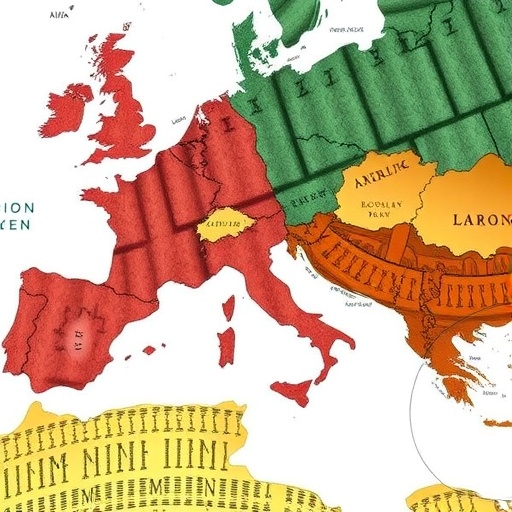
In recent decades, the investigation into the complexities of the Atlantic Bronze Age’s metalworking practices has intensified, driven by a desire to uncover the intricate social networks and trade relationships that underpinned this vibrant historical period. Central to this research is an innovative study conducted by C. Tomczyk, who delves into the enigmatic world of copper mixing through the lens of lead isotope data. By employing a Bayesian interpretation framework, Tomczyk offers a fresh perspective on the distribution and sourcing of copper in the Bronze Age, illuminating how this vital resource interlinked various communities across the Atlantic.
Tomczyk’s research is pioneering in its methodical use of lead isotope analysis to track the origin and movement of copper, challenging the traditional narratives surrounding material culture and production. The study highlights that copper was not merely a raw material; it was a catalyst for interaction, facilitating exchanges among distant societies. Analyzing isotope signatures allows researchers to connect artifacts with their geographical source, effectively creating a map of interactions in the Atlantic basin during a time characterized by dynamic social transformations.
The methodological framework adopted in this study is noteworthy. By applying Bayesian statistics, Tomczyk skillfully integrates prior knowledge with empirical data, facilitating more robust inferences regarding trade routes and copper sources. This approach not only enhances the reliability of the findings but also introduces a layer of sophistication to the analysis of isotopic data. The ability to quantify uncertainty in lead isotope ratios is crucial, revealing the nuanced complexities of ancient trade networks that might otherwise remain hidden in conventional interpretations.
What makes this research particularly compelling is its broader implications for understanding societal dynamics in the Bronze Age. By tracing the movements of copper and its isotopic fingerprint, Tomczyk articulates how the procurement of this metal was not an isolated act but rather part of a wider tapestry of cultural interconnectedness. This reveals that the Atlantic Bronze Age was marked not just by local practices but also by far-reaching interactions transcending regional boundaries, reshaping our understanding of trade and cultural exchange in antiquity.
The study is timely, coinciding with a renewed interest in the Bronze Age among archaeologists and historians, who are increasingly recognizing the importance of interdisciplinary approaches. By bridging the gap between archaeology and scientific analysis, Tomczyk contributes to a growing body of work that emphasizes the value of integrating quantitative data into archaeological interpretations. This intersection of humanities and sciences offers rich possibilities for re-evaluating historical narratives built on qualitative observations alone.
Tomczyk’s work also reignites discussions regarding the sourcing and trade of metals during antiquity. The significance of copper as a material is often contextualized within larger economic frameworks, and this research enriches that dialogue by providing empirical data to support claims about the interconnectedness of Bronze Age societies. As metal artifacts are unearthed in different regions, the isotopic analysis offers a clearer picture of the pathways through which materials traversed vast distances, elucidating the mechanisms of ancient commodity exchanges.
Moreover, the focus on copper brings to light its symbolic and functional roles in Bronze Age societies, as it was used not only for tools and weapons but also for ceremonial objects. By understanding where these materials originated, researchers gain insights into the economic, social, and ritual significance of copper across different cultures. The nuanced connections established through this research invite further examination of how the societal value placed on materials defined social hierarchies and influenced intercultural relations.
The implications of Tomczyk’s findings extend beyond the boundaries of archaeology and anthropology, intersecting with disciplines like materials science and history. The compelling results challenge scholars to reconsider established theories about trade and resource distribution. This creates a rich arena for discussions about technology, resource management, and the synergetic relationships between humans and their environment during the Bronze Age.
Furthermore, the research contributes profoundly to our understanding of technological advancements in metalworking. The isotope data provide insights into the sophistication of the production techniques employed by Bronze Age craftsmen, reflecting a level of expertise and knowledge about materials that was previously underappreciated. Such insights open avenues for exploring how these technological innovations may have influenced other aspects of life, including social structures and identity formation.
As archaeologists leverage advancements in scientific techniques, the narrative of human history continues to evolve. The use of lead isotopes as indicators of human activity is a prime example of how contemporary methods can enrich archaeological discourse. Tomczyk’s research is a landmark contribution, fostering further studies that could refine our comprehension of ancient societies, their trade networks, and their evolving relationships with the natural resources available to them.
Ultimately, the reverberations of Tomczyk’s findings resonate through the fields of archaeology, history, and anthropology, urging scholars to adopt more interdisciplinary approaches. As new methods are developed, and deeper collaborations are forged between disciplines, our understanding of the past becomes increasingly nuanced. This research paves the way for exciting future inquiries into how ancient communities navigated their worlds, establishing trade relations that paralleled the intricacies of their social lives.
In conclusion, C. Tomczyk’s exploration into the mixing of copper in the Atlantic Bronze Age through the utilization of lead isotope data marks a significant contribution to our understanding of ancient trade networks. The innovative Bayesian interpretation not only sheds light on the movements of copper but also invites scholars to reconsider the socio-economic frameworks of ancient societies. As the field progresses, the intersection of archaeological practice and scientific inquiry promises to unlock even more mysteries of the human past.
Cite Scienmag News
Courtney Benton. (November 21, 2025). Decoding Copper Exchanges in Atlantic Bronze Age. Scienmag. https://scienmag.com/decoding-copper-exchanges-in-atlantic-bronze-age/
Courtney Benton. "Decoding Copper Exchanges in Atlantic Bronze Age." Scienmag, 21 November 2025, https://scienmag.com/decoding-copper-exchanges-in-atlantic-bronze-age/. Accessed 4 September 2026.
Courtney Benton. "Decoding Copper Exchanges in Atlantic Bronze Age." Scienmag. November 21, 2025. https://scienmag.com/decoding-copper-exchanges-in-atlantic-bronze-age/


