


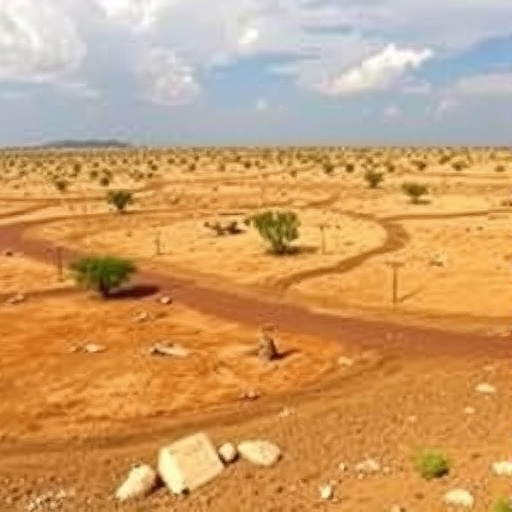
In recent decades, West Africa has been gripped by a profound and prolonged drought that has left an indelible mark on the region’s hydrological systems. Emerging research led by Peugeot, Wendling, Le Roux, and colleagues, published in Nature Communications in 2026, has provided compelling evidence of profound hydrological regime shifts associated with this drought. These findings illuminate the complex interplay between climate variability, land-use changes, and water resource dynamics, offering crucial insights into the future of water security not only in West Africa but across similarly vulnerable global landscapes.
The study employs an impressive array of technical methodologies, integrating long-term hydrological dataset analysis with climatological modeling, to unravel the mechanisms driving these regime shifts. The researchers focused on river discharge records, groundwater levels, precipitation patterns, and evaporation rates spanning several decades. Importantly, this multidisciplinary approach enabled them to detect subtle yet significant alterations in the water cycle that had previously gone unnoticed in broader climate impact assessments.
At the heart of this hydrological transformation is a persistent decline in precipitation beginning in the late 20th century, punctuated by multi-year drought episodes. While drought is a recurring phenomenon in this semi-arid region, the unprecedented duration and intensity of the recent decades-long drought have triggered nonlinear responses in hydrological behavior. The team’s analysis revealed that river systems once characterized by sustained seasonal flows now exhibit erratic discharge patterns and extended dry spells, signaling a departure from historically stable hydrological regimes.
One of the critical technical observations reported involves groundwater depletion, a consequence of both reduced recharge during drought periods and increased anthropogenic extraction for irrigation and urban use. The study utilized advanced isotope hydrology techniques to differentiate between recent recharge and fossil water sources, demonstrating a worrisome decline in the replenishment rates of aquifers. This insight underscores the unsustainable reliance on groundwater in the face of diminishing surface water availability, raising alarms about the long-term viability of water supplies in the region.
The findings further underscore the role of land cover changes—particularly deforestation and agricultural expansion—in modulating local climate feedbacks and water fluxes. Employing remote sensing data alongside in situ measurements, the research team documented how alteration of vegetation patterns has influenced evapotranspiration rates, thereby affecting local rainfall generation and soil moisture retention. This feedback loop exacerbates drought conditions and amplifies the hydrological stress experienced across watersheds.
The team’s hydrological regime shift concept stems from an observed threshold phenomenon whereby the system transitions from one quasi-stable state to another, with significant implications for ecosystems, agriculture, and human settlements. For example, the new regime is marked by reduced baseflow in rivers, impacting aquatic habitats and compromising the sustainability of farming communities dependent on irrigation. These regime shifts could fundamentally alter regional water management paradigms, necessitating innovative adaptive strategies at multiple governance levels.
Modeling efforts incorporated into the study reveal the potential for delayed recovery of hydrological systems even after the cessation of drought conditions. This inertia is partly due to soil desiccation, altered vegetation dynamics, and structural changes in river channels that persist long after precipitation normalizes. The researchers raise concerns that such hysteresis effects may impose long-term constraints on water availability, intensifying vulnerability to future climatic shocks.
A crucial aspect of the research lies in its synthesis of paleohydrological data with contemporary observations, providing a longer temporal context for understanding the severity and uniqueness of the current drought. Sediment core analyses and tree ring records were instrumental in reconstructing historical water availability patterns, revealing that the present regime shift surpasses any similar events recorded in recent centuries. This temporal perspective underscores the increasing frequency and intensity of climate extremes under anthropogenic global warming scenarios.
From a socio-economic viewpoint, this hydrological disruption carries severe consequences. The paper draws attention to how altered water cycles exacerbate food insecurity by diminishing crop yields and complicating livestock management. Moreover, the increased incidence of water scarcity contributes to social conflicts and displacement, intertwining environmental stress with human vulnerability. The researchers advocate for the integration of hydrological regime shift data into regional development planning to mitigate these cascading risks.
Crucially, the study highlights the effectiveness of certain mitigation and adaptation strategies, such as reforestation, improved water harvesting technologies, and sustainable groundwater management. It recommends bolstering transboundary water governance structures to foster collaborative monitoring and resource sharing in this geopolitically complex region. These proactive approaches could potentially buffer communities against the worst impacts of ongoing regime shifts.
Overall, this groundbreaking research redefines our understanding of drought impacts by shifting focus from isolated drought episodes to systemic transformations in hydrological function. Its robust analytical framework and comprehensive data analysis set new standards for drought-related impact studies, making it a critical reference for scholars, policymakers, and practitioners confronting water insecurity in climate-challenged regions worldwide.
By detailing the interconnected drivers and intricate feedbacks underlying hydrological regime shifts, the paper not only advances academic discourse but also galvanizes urgent action. The stark realities uncovered serve as a clarion call for immediate investment in climate resilience tailored to local hydrological contexts, underscoring water’s central role in sustaining human and ecological well-being amid a changing climate.
As global climate models anticipate further intensification of droughts in various hotspots, this West African case study provides essential lessons on anticipating, detecting, and responding to hydrological regime changes. It aims to inspire expanded research networks and technology deployment to enable real-time water resource monitoring, advancing early warning systems and adaptive capacity far beyond current capabilities.
In conclusion, Peugeot and colleagues’ contribution reshapes the narrative around droughts from episodic disturbances to drivers of lasting hydrological transformation. Their findings demand reconceptualizing water management policies and emphasize an integrated, science-driven response to one of the most pressing environmental challenges of our time. This shift in perspective is vital for safeguarding water security and sustaining livelihoods across vulnerable regions confronting the relentless march of climate change.
Cite Scienmag News
Violet Maxwell. (May 8, 2026). Decades-Long West Africa Drought Reveals Hydrological Shifts. Scienmag. https://scienmag.com/decades-long-west-africa-drought-reveals-hydrological-shifts/
Violet Maxwell. "Decades-Long West Africa Drought Reveals Hydrological Shifts." Scienmag, 8 May 2026, https://scienmag.com/decades-long-west-africa-drought-reveals-hydrological-shifts/. Accessed 4 September 2026.
Violet Maxwell. "Decades-Long West Africa Drought Reveals Hydrological Shifts." Scienmag. May 8, 2026. https://scienmag.com/decades-long-west-africa-drought-reveals-hydrological-shifts/


