


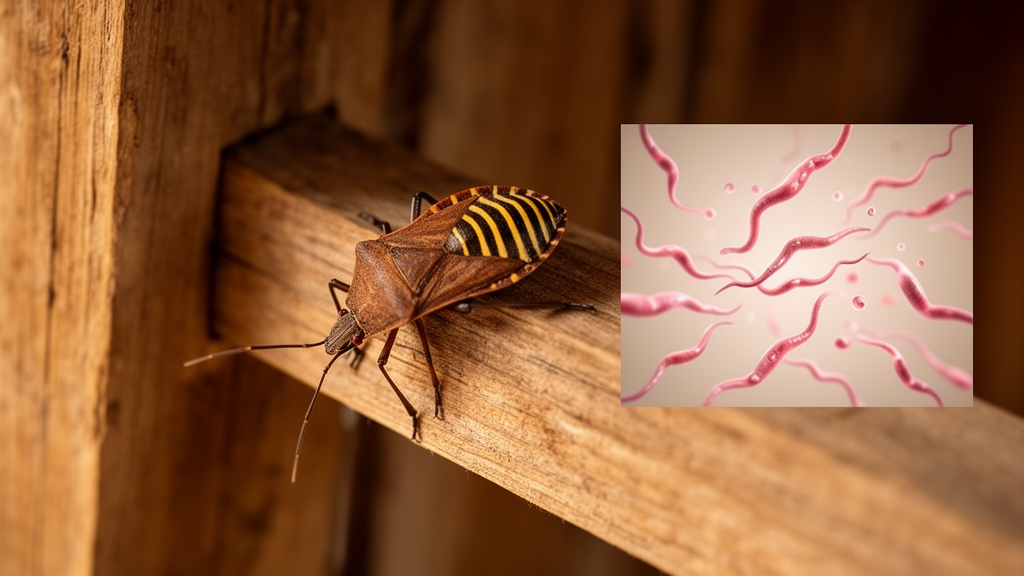
In the sprawling rural municipality of Pampa del Indio, in Argentina’s Chaco Province, a ten-year war was waged against the insect that transmits Chagas disease. The main enemy, Triatoma infestans, was all but eliminated from rural homes by sustained insecticide spraying and community vigilance, and domestic transmission of the parasite Trypanosoma cruzi was effectively halted. But removing the dominant vector left an ecological vacuum, and a secondary species, Triatoma sordida, rushed in to become the most abundant triatomine bug in local houses. A new long-term study now reveals what this opportunistic invader actually means for Chagas risk, and the answer is more reassuring than many feared, with an important technical twist about how infection is measured.
The research, conducted by an Argentine team from the Universidad de Buenos Aires and CONICET as part of what they call the Pampa del Indio Project, tracked T. cruzi infection in T. sordida from 2007 to 2016. The researchers had reason for suspicion. Across the Gran Chaco, where T. sordida thrives once the main vector is gone, reported infection prevalence varies wildly, from under one percent to as high as 46 percent in some Bolivian and Paraguayan settings. And the standard diagnostic tool, direct optical microscopy of the insect’s gut contents, is known to miss a substantial fraction of infections. The team hypothesized that once T. infestans was suppressed, infection in T. sordida would rise above the low levels, zero to six percent, they had previously reported.
What they found instead was remarkable stability. Out of 10,728 T. sordida collected from 528 premises over nearly a decade, 1,946 insects were tested by optical microscopy or a molecular technique called vkDNA-PCR, which targets the parasite’s kinetoplast DNA. The raw, or naive, prevalence of infection was just 1.44 percent. On average, each infested house harbored about 1.12 infected bugs, and across the entire surveillance period fewer than two percent of examined insects carried the parasite, with no more than roughly five percent of houses harboring infected specimens at any time. Infection never spiked, never crept upward, and never filled the gap left by the main vector.
The technical twist lies in the occupancy modeling. Because neither diagnostic method is perfect, the team applied single-season occupancy models, a statistical framework borrowed from ecology that jointly estimates the true probability of infection and the probability of detecting it. The models confirmed what earlier comparisons had hinted: optical microscopy detected at most 73 percent of truly infected insects, meaning it missed nearly one in every four infections. The molecular assay, by contrast, was assumed to catch essentially all of them. This method gap matters, because microscopy alone returned a prevalence of 0.65 percent while vkDNA-PCR returned 3.42 percent among tested insects, a difference that was statistically significant and that explains why older surveillance reports based on microscopy may have understated risk.
The fine structure of infection within the landscape tells its own story. Adjusted prevalence was highest in domiciles, reaching 4.72 percent, intermediate in peridomestic kitchens, storerooms and granaries at 3.30 percent, and lower in chicken-associated sites, corrals and other outbuildings. Adult bugs were far more likely to be infected than nymphs, a pattern seen across triatomine species and attributed to cumulative exposure to infected bloodmeals over a longer life and larger blood meals in later stages. Intriguingly, males showed more than twice the infection rate of females, 3.81 percent versus 1.34 percent, a finding the researchers find hard to explain given that male T. sordida live shorter lives in the laboratory and no known sex-based susceptibility differences exist. They speculate that males may feed more often or roam more widely, but the question remains open.
Spatial analysis added another layer. Global tests found no overall clustering of infection, but a local statistic pinpointed a significant hotspot in the northwestern corner of the municipality, spanning 24 houses within a radius of roughly 200 to 1,300 meters. Notably, the geography of infection shifted over time. At baseline and in the early post-intervention phase, infected bugs concentrated in that northwestern zone; by the late phase, the handful of infections appeared in the central and eastern sections instead. Baseline prevalence, adjusted to 2.65 percent, was about double the prevalence in both post-intervention phases, and the difference between baseline and pooled post-intervention data was statistically significant.
Molecular epidemiology offers a plausible explanation for that spatial and temporal shift. Trypanosoma cruzi is a genetically diverse parasite with several discrete typing units, or DTUs, that occupy different transmission cycles. In the Argentine Chaco, hybrid lineages such as TcV and TcVI dominate the domestic cycle, while TcI prevails in sylvatic settings, often linked to opossums. In Pampa del Indio, TcI predominated among infected T. sordida throughout the study, and hybrid lineages were detected only at baseline and early post-intervention, when domestic transmission by T. infestans still simmered. Once that domestic cycle was suppressed, the remaining infections in T. sordida appear to have flowed entirely from the sylvatic cycle, with molecular fingerprinting previously linking the TcI parasites in these bugs to local white-eared opossums, Didelphis albiventris, captured near the hotspot.
The blood-feeding habits of T. sordida likely dampen its threat. Chickens and other poultry, which are refractory to T. cruzi infection, rank among its favorite hosts in peridomestic environments across the region, and infected bugs in Pampa del Indio were most often collected in poultry-associated sites. Combined with the species’ strong flight dispersal and opportunistic feeding, this avian-leaning diet helps explain why a bug that invades houses freely nevertheless carries so little parasite. The picture contrasts sharply with scenarios in Brazil, Paraguay, Bolivia and Colombia, where native secondary vectors, after the main vectors were removed, exhibited high infection levels and genuinely jeopardized control gains.
The authors are careful not to declare victory. Infection prevalence is only one component of transmission risk, which also depends on bug abundance, feeding behavior and the degree of contact with humans. The T. sordida complex itself contains several cryptic species that morphological identification cannot reliably separate, adding uncertainty, though recent work suggests the relevant species share similar feeding and defecation behavior. Intense deforestation and land-use change during the study period may also have reshaped sylvatic populations and their house-invasion dynamics in ways the data cannot yet resolve. Because T. cruzi transmission is enzootic, permanently circulating in wild mammals and their insects, infected T. sordida continued to appear even a decade into control.
The practical message is twofold. First, molecular diagnostics should be standard in vector surveillance, because microscopy systematically understates infection and can mislead risk assessments across the Gran Chaco. Second, successful elimination of a primary vector does not end the story; it reshapes the ecosystem of risk. The Pampa del Indio experience shows that with sustained, adaptive surveillance, a secondary invader can be monitored effectively and kept from becoming a new engine of transmission. But it also shows that vigilance cannot lapse, because the sylvatic cycle persists indefinitely at the edges of human settlement, ready to send the occasional infected bug across the threshold.
Subject of Research: Long-term variation of Trypanosoma cruzi infection in the secondary Chagas disease vector Triatoma sordida following Triatoma infestans elimination in rural Argentina
Article Title: The Pampa del Indio Project: long-term variations of Trypanosoma cruzi infection in Triatoma sordida, a non-target invasive vector
Article References: The Pampa del Indio Project: long-term variations of Trypanosoma cruzi infection in Triatoma sordida, a non-target invasive vector. (n.d.). https://doi.org/10.3389/fpara.2026.1953889
Image Credits: AI Generated
DOI: 10.3389/fpara.2026.1953889
Keywords: Chagas disease, Trypanosoma cruzi, Triatoma sordida, Triatoma infestans, Gran Chaco, vector control, occupancy models, molecular diagnostics, discrete typing units, Argentina, entomological surveillance, Didelphis albiventris
Cite Scienmag News
Kristina Jarvis. (October 15, 2026). Decade-Long Study Shows Secondary Chagas Bug Carries Surprisingly Little Parasite After Main Vector’s Removal. Scienmag. https://scienmag.com/decade-long-study-shows-secondary-chagas-bug-carries-surprisingly-little-parasite-after-main-vectors-removal/
Kristina Jarvis. "Decade-Long Study Shows Secondary Chagas Bug Carries Surprisingly Little Parasite After Main Vector’s Removal." Scienmag, 15 October 2026, https://scienmag.com/decade-long-study-shows-secondary-chagas-bug-carries-surprisingly-little-parasite-after-main-vectors-removal/. Accessed 15 October 2026.
Kristina Jarvis. "Decade-Long Study Shows Secondary Chagas Bug Carries Surprisingly Little Parasite After Main Vector’s Removal." Scienmag. October 15, 2026. https://scienmag.com/decade-long-study-shows-secondary-chagas-bug-carries-surprisingly-little-parasite-after-main-vectors-removal/


