


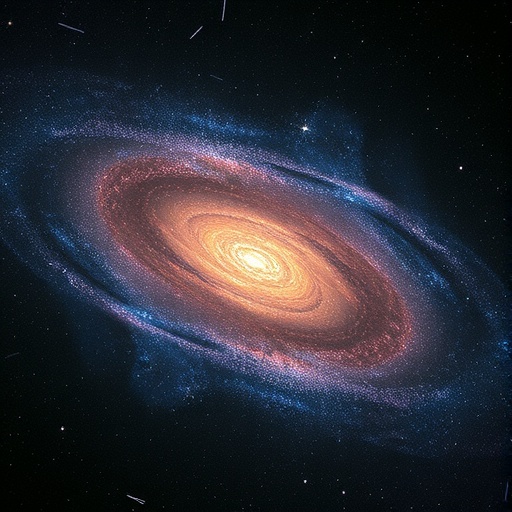
In an ambitious collaboration bridging continents and disciplines, researchers from the University of Vienna and the Lawrence Berkeley National Laboratory have revisited one of astrophysics’ most enigmatic phenomena—the Galactic Center Excess (GCE). For over a decade, the GCE, a subtle yet pervasive gamma-ray glow enveloping the Milky Way’s core, has stimulated intense debate and exploration within the scientific community. This new study, leveraging cutting-edge machine learning methodologies, offers fresh perspectives that reinvigorate the dark matter hypothesis as a viable explanation for the GCE, a prospect previously challenged by conventional analyses.
The Galactic Center Excess presents itself as a roughly spherical halo of gamma-ray emission, extending over thousands of light years around our galaxy’s nucleus. This faint glow eludes straightforward interpretation, primarily due to the complexities of the astronomical environment it inhabits. The region is not only densely packed with astrophysical sources but also exhibits extraordinarily bright and intricately structured gamma-ray emissions, complicating efforts to disentangle the origins of the GCE signal.
Before this study, two primary interpretations vied for dominance in explaining the GCE. One posited that the excess emanates from annihilations of dark matter particles, hypothetical constituents of the universe that interact weakly with ordinary matter and light. Dark matter, while composing approximately 85% of the universe’s matter content, remains elusive, and detecting its indirect signatures through gamma-ray emissions has been a tantalizing goal. The second hypothesis attributes the gamma-ray glow to a population of millisecond pulsars—rapidly rotating neutron stars known for their intense electromagnetic emissions. These pulsars, if sufficiently numerous and faint, could collectively mimic the characteristics of the observed GCE.
However, the astrophysical scenario faced a significant analytical hurdle. Earlier statistical approaches, while sophisticated, did not fully incorporate a vital dimension of the observed data: the energy spectrum of individual gamma-ray photons. Prior analyses predominantly focused on spatial distribution patterns, searching for point sources that could represent pulsars or diffuse emissions consistent with dark matter annihilation. Without the spectral dimension, conclusions remained inconclusive, often biased toward interpretations favoring bright unresolved sources.
The breakthrough in this new research is the implementation of an advanced machine-learning framework that simultaneously evaluates the spatial location and energy distribution of gamma-ray photons captured by telescopes. Training this model required generating over a million simulated gamma-ray skies, replicating a diverse range of scenarios that include both dark matter and pulsar contributions. By synthesizing these rich datasets, the model attains unprecedented sensitivity and discrimination power, uniquely capable of parsing subtle differences in the gamma-ray energy patterns correlated with different source populations.
The enriched analysis dramatically alters the interpretation landscape. The findings demonstrate that the putative point sources—if responsible for the GCE—would need to be extraordinarily faint, to the point where their individual characteristics blur into a diffuse glow nearly indistinguishable from what dark matter annihilation models predict. This faintness requirement for pulsars implies an astronomical population count exceeding 35,000 millisecond pulsars in the central Milky Way region. Such a number challenges existing astrophysical models and contrasts with previous studies that suggested only a few hundred to a few thousand such sources would suffice to explain the gamma-ray excess.
This new quantitative insight reopens the door for dark matter as a plausible explanation. While previous evidence tended to discount dark matter in favor of point sources, the subtlety revealed by including photon energy analysis counters these assertions. It underscores the present limitations in conclusively resolving the GCE’s origin, emphasizing that the dark matter scenario remains firmly on the table alongside pulsar hypotheses.
The difficulty in resolving the GCE nature also reflects broader challenges in high-energy astrophysics—particularly in crowded celestial environments like our galaxy’s core, where overlapping emissions from stars, supernova remnants, and other celestial objects confound the interpretation of indirect dark matter signals. Machine learning, as applied here, represents a transformative tool, capable of synthesizing immense, multidimensional datasets to disentangle complex astrophysical phenomena.
Scientists caution that these findings do not constitute direct evidence for dark matter annihilation; instead, they highlight the incomplete nature of current data interpretations. The inability to definitively favor pulsars over dark matter annihilation underscores the need for next-generation gamma-ray observatories and continued advances in modeling techniques that can incorporate even more nuanced data features, such as temporal variability and polarization signatures.
This research embodies the synergy between theoretical physics, computational innovation, and observational astrophysics, demonstrating how modern data-driven approaches can revitalize longstanding scientific debates. As gamma-ray detection technologies evolve and more data become available, the methodology pioneered here promises further refinement, potentially leading to breakthroughs in identifying signals from the elusive dark sector of the universe.
The Galactic Center Excess remains one of the most compelling mysteries in contemporary astrophysics, symbolizing the frontier where known astrophysical processes intersect with profound questions about the fundamental composition of the universe. Whether future research will tilt the scales decisively in favor of dark matter or pulsars, this study exemplifies the power of interdisciplinary collaboration and sophisticated computational methods to deepen our cosmic understanding.
Moreover, the implications extend beyond academic curiosity. Deciphering the GCE carries the promise of shedding light on the nature of dark matter, a cornerstone of cosmological structure formation and evolution. Success in this endeavor could unveil new physics beyond the Standard Model, revolutionizing our conception of the universe’s fabric and the forces that govern it at the most fundamental level.
As researchers continue to probe the galactic center’s gamma-ray glow, the intellectual journey itself enriches science, reflecting a profound human drive to illuminate the obscure workings of the cosmos. This study marks a significant stride in that journey, blending technology, theory, and observation to navigate a complex astrophysical puzzle whose solution may redefine our place in the universe.
News Publication Date: 12-Jun-2026
Web References:
DOI link
Keywords
Galactic Center Excess, gamma rays, Milky Way, dark matter, millisecond pulsars, machine learning, astrophysics, high-energy astrophysics, neutron stars, indirect dark matter detection, gamma-ray astronomy, astrophysical sources
Cite Scienmag News
Grant Pearson. (June 17, 2026). Dark Matter Still a Possibility at the Heart of the Milky Way. Scienmag. https://scienmag.com/dark-matter-still-a-possibility-at-the-heart-of-the-milky-way/
Grant Pearson. "Dark Matter Still a Possibility at the Heart of the Milky Way." Scienmag, 17 June 2026, https://scienmag.com/dark-matter-still-a-possibility-at-the-heart-of-the-milky-way/. Accessed 3 September 2026.
Grant Pearson. "Dark Matter Still a Possibility at the Heart of the Milky Way." Scienmag. June 17, 2026. https://scienmag.com/dark-matter-still-a-possibility-at-the-heart-of-the-milky-way/


