


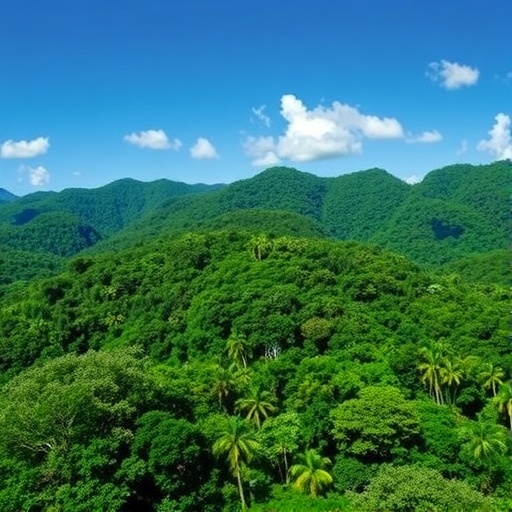
A quiet warning is emerging from Brazil’s forests: the trees that have helped slow the buildup of carbon dioxide in the atmosphere may be losing their ability to absorb carbon at the rate they once did. In a study published in Nature Communications, researchers report a long-term decline in above-ground carbon sinks across Brazil’s tropical and subtropical forests, raising new concerns about one of the planet’s most important natural defenses against climate change.
Forests are often described as the lungs of the world, but their climate role is more precisely understood as a vast biological carbon-storage system. Through photosynthesis, trees remove carbon dioxide from the atmosphere and convert it into organic matter, including trunks, branches, bark and leaves. When forests accumulate more carbon through growth than they release through death, decay, fire or disturbance, they function as carbon sinks. The new research focuses on this above-ground component, which represents a major share of the carbon stored in living forest vegetation and provides a direct measure of how forest ecosystems are changing over time.
The study by V.A. Maia, N. de Aguiar-Campos, F. Coelho de Souza and colleagues is significant because it examines the trajectory of forests over the long term rather than treating carbon uptake as a fixed property. Tropical forests have absorbed a substantial portion of human carbon emissions in recent decades, helping to moderate the pace of atmospheric warming. Yet that service depends on a delicate balance between tree growth and carbon losses. If growth slows, mortality increases or disturbances become more frequent, the sink can weaken even when the forest still appears green from above.
Brazil contains an extraordinary range of forest ecosystems, from the humid Amazon rainforest to subtropical forests in the south and transitional landscapes shaped by seasonal rainfall. These ecosystems differ in climate, soil, species composition and disturbance history, but they are connected by the same basic carbon cycle. Trees take in carbon dioxide, move it into wood and tissue, and eventually return it to the atmosphere through respiration and decomposition. A forest can therefore remain standing while its net carbon uptake declines, an important distinction that satellite images alone may not reveal.
The researchers’ finding points to a shift in that balance. A declining above-ground carbon sink means that the forests are still storing carbon, but their net accumulation is weakening over time. This does not necessarily mean that every forest site is losing carbon or that all Brazilian forests are responding identically. Instead, the result describes a broad directional change across tropical and subtropical forest systems. Such a pattern is especially important because the atmosphere responds to the combined carbon balance of landscapes, not simply to whether individual trees remain alive.
Several forces may be contributing to the decline. Rising temperatures can increase the physiological stress experienced by trees, particularly when heat coincides with drought. Water shortages can close the microscopic pores in leaves, reducing photosynthesis and limiting growth. At the same time, warmer conditions can raise respiration rates, increasing the amount of carbon plants release while maintaining their tissues. Severe drought can also trigger hydraulic failure, in which trees are unable to transport water from roots to leaves, or carbon starvation, in which prolonged stress leaves them without enough energy to sustain vital functions.
Disturbance adds another layer of pressure. Deforestation directly removes biomass, while selective logging, fires, storms and fragmentation can damage forests without eliminating every tree. Forest edges are often hotter, drier and more exposed to wind than intact interiors, creating conditions that can increase mortality and reduce regeneration. Fire is particularly consequential because it rapidly transfers stored carbon into the atmosphere and can alter soils, vegetation structure and the likelihood of future burning. Even areas that eventually recover their canopy may take decades to rebuild the carbon held in mature trunks and large branches.
The study also challenges a comforting assumption in climate policy: that natural carbon sinks will continue absorbing carbon at historical rates while societies reduce emissions. Forest sinks are not machines operating at a constant capacity. Their performance depends on climate, ecological interactions and the history of disturbance. As atmospheric carbon dioxide rises, some trees may initially grow faster, but that fertilization effect can be constrained by nutrients, water availability, temperature and competition. A forest cannot convert unlimited carbon dioxide into biomass if other ingredients required for growth are missing.
This matters far beyond Brazil. The carbon absorbed by forests is included in many climate projections and national emissions strategies, yet the future strength of those sinks remains uncertain. If tropical forests absorb less carbon than expected, the atmosphere could accumulate carbon dioxide more rapidly than models and policy plans anticipate. That would increase the amount of emissions that must be avoided through energy, transport, industry and land-use reforms to achieve the same climate targets. It also means that protecting forests is not only a biodiversity priority; it is a way of preserving a climate service whose value may be declining under pressure.
The findings are especially relevant to Brazil’s efforts to curb deforestation and restore degraded land. Preventing the loss of mature forests protects existing carbon stocks, but conservation alone may not fully restore the forests’ former capacity to absorb additional carbon if warming and drought continue. Restoration can rebuild biomass, improve habitat connectivity and strengthen ecological resilience, but newly planted or regenerating forests do not immediately replace the carbon-storage function of old-growth ecosystems. Effective strategies will therefore need to combine protection, restoration, fire prevention and climate adaptation while addressing the emissions that intensify heat and hydrological stress.
Measuring these changes is technically difficult. Above-ground carbon is not observed directly across every hectare; it is estimated using combinations of field inventories, tree measurements, biomass equations, remote sensing and ecosystem models. Researchers typically convert tree dimensions, such as trunk diameter and height, into estimates of biomass and then into carbon content using established relationships. Repeated measurements reveal whether a forest parcel is gaining or losing carbon, while satellite observations help extend information across much larger areas. Each method carries uncertainty, but agreement across long-term observations can expose trends that short studies might miss.
The importance of a long-term perspective is difficult to overstate. Forest carbon dynamics can fluctuate from year to year because of rainfall, El Niño events, fires, storms and localized outbreaks of pests or disease. A single unusually productive season may suggest that a forest is recovering, while a short period of mortality may exaggerate the appearance of permanent decline. Long records allow researchers to distinguish temporary variation from a sustained change in the underlying carbon balance. They also help identify whether declines are concentrated in particular climates, forest types or regions, information that is essential for designing targeted conservation measures.
The message from Brazil’s forests is therefore both urgent and nuanced. These ecosystems remain indispensable carbon reservoirs, but their ability to keep removing additional carbon from the atmosphere cannot be treated as guaranteed. The reported decline does not erase the value of forests; it makes their protection more consequential. Every avoided clearing, prevented fire and preserved mature tree represents carbon that remains locked away, as well as habitat, rainfall regulation and protection for countless species.
As climate change intensifies, the future of the forest carbon sink will depend on decisions made both inside and outside the forest. Brazil’s landscapes will be shaped by land-use enforcement, Indigenous and local stewardship, restoration, fire management and the pace at which the world cuts fossil-fuel emissions. The new study’s central warning is straightforward: tropical and subtropical forests are still helping humanity, but they may be helping less than before. In a warming world, that fading service could become one of the clearest signals that ecological limits are arriving faster than expected.
Cite Scienmag News
Sloane Callahan. (August 18, 2026). Long-Term Decline of Above-Ground Carbon Sinks in Brazil’s Tropical and Subtropical Forests. Scienmag. https://scienmag.com/long-term-decline-of-above-ground-carbon-sinks-in-brazils-tropical-and-subtropical-forests/
Sloane Callahan. "Long-Term Decline of Above-Ground Carbon Sinks in Brazil’s Tropical and Subtropical Forests." Scienmag, 18 August 2026, https://scienmag.com/long-term-decline-of-above-ground-carbon-sinks-in-brazils-tropical-and-subtropical-forests/. Accessed 3 September 2026.
Sloane Callahan. "Long-Term Decline of Above-Ground Carbon Sinks in Brazil’s Tropical and Subtropical Forests." Scienmag. August 18, 2026. https://scienmag.com/long-term-decline-of-above-ground-carbon-sinks-in-brazils-tropical-and-subtropical-forests/


