

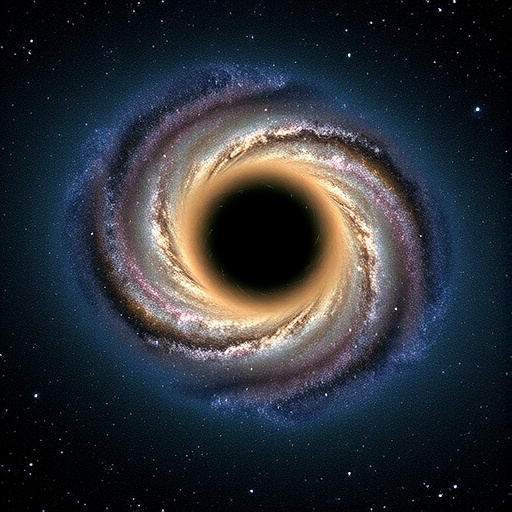
For decades, the astronomical community has widely accepted that the center of our Milky Way galaxy harbors a supermassive black hole known as Sagittarius A (Sgr A). This compact object, with a mass millions of times that of our sun, was believed to govern the orbits of nearby stars moving at extraordinary speeds, as well as shape the gravitational environment of the galactic core. However, recent findings challenge this long-standing paradigm, proposing instead that an enigmatic form of dark matter could be responsible for these gravitational effects, potentially overturning the fundamental understanding of our galactic nucleus.
The new research suggests that rather than a supermassive black hole dominating the heart of the Milky Way, an immense, compact clump of fermionic dark matter may sit at the core. This exotic dark matter, composed of light fermions—particles that follow the Pauli exclusion principle—could form a highly dense but non-singular structure. Such a concentration would exert strong gravitational influence capable of replicating the observed orbits of the S-stars, a cohort of stars which zip around the center at velocities reaching a few thousand kilometers per second.
The implications of replacing the black hole with a fermionic dark matter core extend beyond stellar dynamics nearby. This model posits a dual-component system where a dense inner core transitions smoothly into an extended, diffuse halo. This halo envelops the entire galaxy and plays a crucial role in explaining the rotation curve of the Milky Way, especially in regions far from the center where the velocity of stars and gas typically declines—a phenomenon known as the Keplerian fall-off. The fermionic model’s compact halo predicts a more sharply defined edge compared to the widespread halos produced by traditional cold dark matter theories, offering a refined fit to the latest observational data.
Central to supporting this alternative hypothesis is the detailed rotational mapping from the European Space Agency’s GAIA mission, specifically its third data release (GAIA DR3). GAIA provides unprecedented precision in charting stellar motions across the Milky Way’s vast expanse. The GAIA DR3 dataset reveals a rotational slowdown in the galaxy’s outskirts consistent with the predictions of a fermionic dark matter halo circumscribing the galactic disc and bulge. Such a pattern aligns poorly with the more spread-out Cold Dark Matter profile, thereby bolstering the notion of a tightly bound dark matter conglomerate at the galaxy’s heart.
Astrophysicists from a global consortium—including the Institute of Astrophysics La Plata in Argentina, Italy’s International Centre for Relativistic Astrophysics Network, Colombia’s Relativity and Gravitation Research Group, and the University of Cologne in Germany—have meticulously compared this fermionic dark matter framework with the canonical black hole model. Though current observational data of the inner orbits around Sgr A* cannot definitively rule out either scenario, the fermionic framework offers an elegant unified explanation connecting disparate scales: from the ultra-fast stirring of stars nearby to the expansive dynamics of the galactic halo.
A transformative aspect of this new model lies in its ability to reproduce another hallmark observed in the Milky Way’s center—the enigmatic shadow famously imaged by the Event Horizon Telescope (EHT). Previously attributed to a black hole’s event horizon bending light and casting a dark silhouette, recent studies indicate that dense fermionic dark matter cores, when illuminated by an accretion disk, can produce a similar shadow-like structure. This phenomenon results from the intense gravitational bending of photons near the fermionic core, creating a central darkness surrounded by a luminous bright ring, effectively mimicking the expected black hole shadow signature without necessitating the presence of a singularity.
This revelation is underscored by a prior study published in 2024 by Pelle and colleagues, which successfully modeled accretion illumination patterns on compact fermionic dark matter objects and compared them to the EHT images of Sgr A*. Their results showed a striking resemblance, suggesting that observations once thought to uniquely confirm a supermassive black hole might admit alternative interpretations involving exotic dark matter physics. This paradigm shift opens new avenues for investigating the fundamental nature of galactic centers beyond the limits imposed by classical black hole theories.
Further probing into the differences between these models demands exquisite precision in observational astronomy. Instruments like the GRAVITY interferometer attached to the Very Large Telescope array in Chile are poised to deliver higher resolution measurements of stellar orbits and relativistic phenomena in the vicinity of the Milky Way’s core. Critical to these efforts is the search for photon rings—distinctive features around black holes formed by light trapped in orbit. If photon rings are detected, it would strongly support the black hole hypothesis, as such structures do not naturally emerge in fermionic dark matter scenarios, thus providing an empirical testing ground for competing models.
The fermionic dark matter proposition, therefore, not only challenges the established view of a relativistic black hole anchoring our galaxy but also paves the way for a cohesive understanding of dark matter’s role in shaping cosmic structures across multiple scales. By envisaging the galactic core and dark matter halo as a continuous and unified substance, it prompts the reconsideration of dark matter as a dynamic and structurally complex entity, rather than a diffuse and passive cosmic background.
Ultimately, this groundbreaking study signifies a major step toward reconciling long-standing astrophysical puzzles. It bridges the divide between phenomena observed in the innermost precincts of the Milky Way and those characterizing its vast halo, linking stellar dynamics, gravitational lensing, and galaxy rotation curves under a common theoretical framework. Should future observations validate these models, they will profoundly reshape our understanding of galaxy formation, the behavior of matter under extreme conditions, and the fundamental constituents of the universe itself.
With pending observations and more refined data imminent, the scientific community stands at the threshold of an exciting epoch in galactic astronomy. The potential to unveil the true nature of the Milky Way’s core — be it a classical black hole or a fermionic dark matter titan — holds transformative implications not only for our cosmic neighborhood but also for the physics governing matter and gravity at the most fundamental level.
This new conceptual framework embodies the essence of scientific progress: questioning prevailing assumptions, integrating the latest empirical evidence, and boldly proposing revolutionary ideas that invite scrutiny and further investigation. As instrumentation advances and our cosmic gaze deepens, the enigma at the heart of our galaxy may soon yield its secrets, illuminating paths to new physics and cosmic understanding.
Subject of Research:
Fermionic dark matter as an alternative to the supermassive black hole at the center of the Milky Way and its role in explaining stellar dynamics and the galactic rotation curve.
Article Title:
The dynamics of S-stars and G-sources orbiting a supermassive compact object made of fermionic dark matter
News Publication Date:
5-Feb-2026
Web References:
- https://academic.oup.com/mnras/article/546/1/staf1854/8431112
- https://academic.oup.com/mnras/article/534/2/1217/7759710 (previous study by Pelle et al.)
- Event Horizon Telescope collaboration findings on Sgr A* shadow
References:
- Crespi, V., Argüelles, C. R., et al. (2026). The dynamics of S-stars and G-sources orbiting a supermassive compact object made of fermionic dark matter. Monthly Notices of the Royal Astronomical Society. DOI: 10.1093/mnras/staf1854
- Pelle, F. et al. (2024). Accretion disk illumination of fermionic dark matter cores and shadows. Monthly Notices of the Royal Astronomical Society.
Image Credits:
Valentina Crespi et al.


