


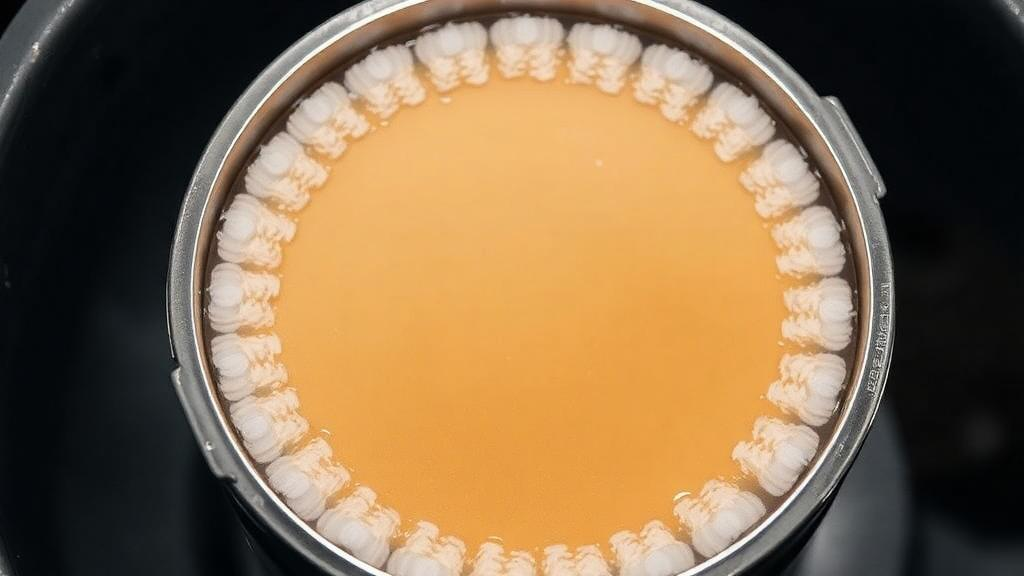
Harvesting the contents of a bioreactor sounds deceptively simple: the culture is finished, the drug substance is sitting in the broth, and all that remains is to separate the cells from the liquid. In practice, this clarification step is one of the most stubborn bottlenecks in modern biomanufacturing. Chinese hamster ovary cells, the workhorses behind a large share of the world’s biologic medicines, are grown to high densities in large stirred-tank reactors, and the resulting harvest is a cloudy soup of cells, cell debris, DNA, host cell proteins, and colloidal particles that must be removed quickly and gently before the valuable antibody product moves downstream. A new study published in Applied Microbiology and Biotechnology argues that a technology called cyclical cake filtration could reshape this step, delivering higher flow rates, smaller filter footprints, and lower process risk than the depth filtration methods that dominate the industry today.
The research, conducted by a team from DrM Dr. Müller AG and the Zurich University of Applied Sciences, set out to compare cyclical cake filtration against two established approaches: conventional depth filtration and alluvial filtration. Depth filtration, the current industry standard, removes particles by forcing the harvest through a porous bed of filter media in which contaminants are trapped in tortuous channels. It works, but it comes with well-known liabilities. The filter bed gradually clogs as it loads with solids, which means engineers must size filters generously to guarantee that a full batch can be processed before the flow stalls. Oversized filter areas translate directly into higher consumable costs and more waste. Depth filters can also reduce yield through non-specific adsorption, in which product molecules bind to the filter media and are lost before they ever reach the chromatography columns downstream.
Alluvial filtration was developed to ease some of these pressures. In this configuration, a protective layer of diatomaceous earth, a porous sediment derived from fossilized algae, is built up on the filter surface before the harvest is introduced. The diatomaceous earth cake acts as a sacrificial shield, capturing the bulk of the particulate load and protecting the underlying filter media from rapid fouling. This extends the filtration capacity considerably compared with bare depth filtration. Yet even alluvial filtration has limits, and the authors of the new study identified an opportunity to go further by exploiting the same diatomaceous earth chemistry in a fundamentally more dynamic way.
Cyclical cake filtration takes the protective cake concept and turns it into a repeating cycle. Rather than building a single cake and running the batch until it is exhausted, the system forms a diatomaceous earth layer on a filter cloth, processes harvest through it, and then regenerates the cloth for the next cycle. This multi-cycle cloth regeneration is the core innovation. Because the filter medium is repeatedly refreshed during operation, the process can sustain high flow rates for extended periods without the progressive clogging that plagues depth filters. In the experiments reported in the study, cyclical cake filtration maintained higher flow rates than depth filtration and showed no clogging under the conditions tested, a striking result given that clogging is precisely the failure mode that forces manufacturers to oversize their equipment.
Clarification alone is not enough, however. A harvest step must also strip out impurities that would otherwise burden downstream purification. The researchers augmented the cyclical cake filtration process with diatomaceous earth and a range of ion-exchange resins, allowing the filter cake to act not just as a physical sieve but as a chemical polishing stage. With this combination, the filtrate turbidity dropped as low as 2.8 nephelometric turbidity units, an exceptionally clear result for a primary clarification step, while product yields remained between 91 and 94 percent. The process reduced DNA concentrations by up to 95 percent and host cell protein levels by up to 62 percent, figures that approach the performance of conventional two-stage clarification trains. For process developers, that means a single, well-designed filtration operation could potentially simplify or shorten the sequence of steps that normally follows the bioreactor.
Scalability is where many promising lab-scale technologies stumble, and the team addressed this concern directly. They ran filtration studies across three scales, spanning an 18-fold increase in filter area, and found that flow rate behavior and filtrate quality were comparable across the range. Product yield stayed consistent from the smallest to the largest configuration, while impurity levels and turbidity showed only minor variation. This kind of scale-up predictability is essential for biopharmaceutical manufacturers, who must transfer processes from development-scale equipment to commercial facilities with confidence that performance will carry over. A filtration technology whose behavior changes unpredictably with area would introduce exactly the kind of process risk that regulators and manufacturers work hard to eliminate.
The commercial implications become vivid when the numbers are projected to manufacturing scale. For a hypothetical batch of 2,000 liters of CHO culture, the study estimated that cyclical cake filtration would require a primary clarification filter area of just 0.88 square meters. Alluvial filtration, by comparison, would need 16.8 square meters for the same task, and conventional depth filtration would demand 28.5 square meters. The difference is not incremental; it is roughly a 19-fold reduction against alluvial filtration and more than 30-fold against depth filtration. Smaller filter areas mean fewer disposable filter cartridges, less storage space, lower shipping and handling burdens, and a smaller volume of solid waste at the end of each batch. In an industry under growing pressure to reduce both cost of goods and environmental footprint, those are consequential advantages.
To capture the trade-off between speed and footprint in a single figure of merit, the authors combined processing time and filter area into a proposed efficiency parameter. When the three technologies were evaluated through this lens, cyclical cake filtration came out on top. The result highlights a point that is easy to overlook in filtration comparisons: a technology that is fast but requires a huge filter area, or compact but slow, may look attractive on one metric while hiding costs on the other. By folding both dimensions into one parameter, the study offers process engineers a more honest basis for comparing clarification options and for modeling how a change in harvest strategy would ripple through facility design, consumable budgets, and batch scheduling.
The authors are careful to frame cyclical cake filtration as an alternative rather than a wholesale replacement. Depth filtration is deeply embedded in validated manufacturing processes, and any new harvest technology must clear regulatory and operational hurdles before adoption. It is also worth noting that two of the study’s authors are employees of DrM, which manufactures the filtration system evaluated, so the work comes from the technology’s own developers, although the findings are presented in a peer-reviewed, open-access venue with detailed methods that other groups can scrutinize and replicate. Independent confirmation at other sites and with different product molecules will be the natural next step for the field.
Even so, the study lands at a moment when the biomanufacturing industry is actively searching for intensification strategies. Continuous processing, perfusion cultures, and higher-titer fed-batch runs all push more solids through the harvest step, making the limitations of legacy clarification technologies more acute each year. If cyclical cake filtration performs as described at industrial scale, it could allow manufacturers to process harvests faster, with dramatically less filter media, lower waste volumes, and impurity removal that rivals multi-step trains. For an industry in which a single batch of a blockbuster biologic can be worth millions of dollars, a clarification step that protects yield, cuts consumable costs, and shrinks the equipment footprint is not a minor optimization. It is the kind of unglamorous engineering advance that quietly determines how affordable the next generation of antibody therapies can become.
Subject of Research: Cyclical cake filtration for clarification of Chinese hamster ovary cell culture harvests in biomanufacturing
Article Title: Increasing CHO cell harvest efficiency with cyclical cake filtration
Article References: Pynos, C. J.-J., Bucher, T., Mannone, A., Gopalakrishnan, A., & Ott, J. (2026). Increasing CHO cell harvest efficiency with cyclical cake filtration. Applied Microbiology and Biotechnology. https://doi.org/10.1007/s00253-026-14021-7
Image Credits: AI Generated
DOI: 10.1007/s00253-026-14021-7
Keywords: CHO cells, biomanufacturing, cell harvest, clarification, cyclical cake filtration, diatomaceous earth, depth filtration, alluvial filtration, host cell protein, impurity removal, scale-up, process efficiency
Cite Scienmag News
Drew Townsend. (October 1, 2026). Cyclical Cake Filtration Slashes Filter Area in CHO Cell Harvesting. Scienmag. https://scienmag.com/cyclical-cake-filtration-slashes-filter-area-in-cho-cell-harvesting/
Drew Townsend. "Cyclical Cake Filtration Slashes Filter Area in CHO Cell Harvesting." Scienmag, 1 October 2026, https://scienmag.com/cyclical-cake-filtration-slashes-filter-area-in-cho-cell-harvesting/. Accessed 4 October 2026.
Drew Townsend. "Cyclical Cake Filtration Slashes Filter Area in CHO Cell Harvesting." Scienmag. October 1, 2026. https://scienmag.com/cyclical-cake-filtration-slashes-filter-area-in-cho-cell-harvesting/


