


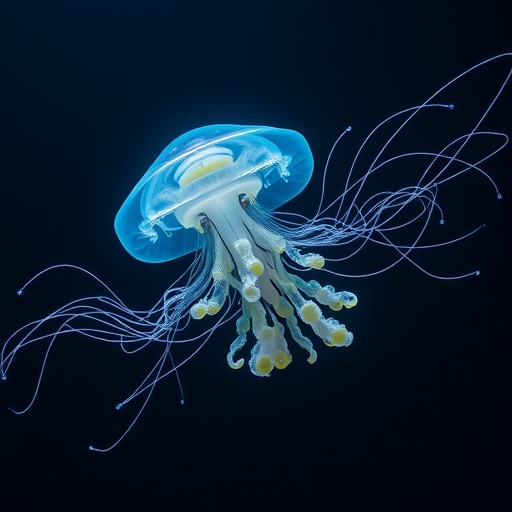
In the dim glow of a laboratory illuminated by neon lights, a mesmerizing scene unfolds within a towering aquarium: moon jellyfish (Aurelia aurita) drift effortlessly, their translucent bells pulsating with rhythmic precision as their delicate tentacles ripple through the water. This graceful ballet of motion, seemingly suspended beyond the bounds of gravity, captivates Nicole Xu, an assistant professor in the Paul M. Rady Department of Mechanical Engineering at the University of Colorado Boulder. Xu’s fascination with these ancient creatures, which have existed for over half a billion years, goes beyond mere admiration; it has driven a pioneering effort to transform biology into innovative technology, fusing the natural efficiencies of jellyfish locomotion with cutting-edge microelectronic control.
Moon jellyfish are among the most energy-efficient swimmers known to science. Their movement relies on a simple yet remarkably effective pulsation of their bell-shaped bodies, propelling them through aquatic environments with minimal energy expenditure. Lacking brains and spinal cords, these invertebrates operate with two overlapping nerve nets that coordinate muscle contractions, allowing their fluid, rhythmic swimming. Xu harnesses this biological marvel by equipping the jellies with microelectronic devices that directly stimulate their swimming muscles. This biohybrid design enables researchers to remotely influence their direction, effectively transforming the moon jelly into a living, steerable underwater drone.
Xu’s innovation opens new frontiers in aquatic research, providing unparalleled access to remote and otherwise inaccessible oceanic zones. As global climate change continues to exert profound effects on marine ecosystems, the urgency for detailed environmental data intensifies. Ocean waters are warming and acidifying due to increased atmospheric carbon dioxide absorption, threatening biodiversity and altering biogeochemical cycles. Traditional underwater exploration tools often entail substantial cost and logistical complexity, limiting their deployment in vast or deep-sea environments. The cyborg jellyfish present a transformative alternative: agile, energy-efficient, and biologically attuned, these organisms can serve as mobile platforms embedded with sensors to monitor temperature, pH levels, and other critical variables in real time.
By implanting stimuli devices that function akin to cardiac pacemakers in humans, Xu’s approach triggers contractions in specific muscle groups, allowing targeted directional control over the jellyfish’s movement. This technique exemplifies an elegant convergence of biomechanics and microengineering, illuminating a path toward sustainable and minimally invasive ocean monitoring systems. Such biohybrid systems stand in stark contrast to mechanized underwater vehicles, which often suffer from limitations in maneuverability, energy consumption, and environmental impact. Leveraging the jellyfish’s inherent efficiency and simplicity could revolutionize how we study the deep sea, elucidating ecological dynamics with unprecedented resolution.
The moon jelly’s physiology is uniquely suited to this purpose. Their gelatinous, bell-shaped bodies range widely in size—from just a centimeter to over a foot in diameter—yet their fundamental anatomy remains consistent. Their fine tentacles, armed with stinging cells or nematocysts, capture zooplankton, crustacean larvae, and small fish. While these cells can immobilize prey, fortunately, they do not penetrate human skin, allowing researchers like Xu to work safely alongside them. Despite their evolutionary antiquity and enigmatic simplicity, moon jellies inhabit a broad range of ocean depths, from coastal zones to the Mariana Trench’s abyssal plains, demonstrating remarkable adaptability to varying pressure and temperature regimes.
Xu’s vision of cybernetic jellyfish is not purely speculative. She co-developed the concept with her former academic advisor approximately five years ago and has already conducted field tests. In 2020, remote-controlled moon jelly biohybrids were steered through shallow waters off Woods Hole, Massachusetts, validating the feasibility of this approach. This proof-of-concept marked a milestone, corroborating that electronic stimulation could effectively modulate biological swimming behavior in natural settings. It also paved the way for integrating environmental sensors, promising a future where these living robots not only navigate but also collect and transmit ecological data from hard-to-reach marine habitats.
In addition to ecological monitoring, Xu’s work extends into the fundamental fluid dynamics of jellyfish propulsion. Collaborating with her research associates and graduate students, she recently published findings on how moon jellies influence water flow fields during locomotion. Using laser illumination techniques paired with biodegradable tracer particles, the researchers captured intricate fluid patterns generated by swimming jellies. This novel use of sustainable, non-toxic particulate tracers, such as corn starch, heralds more environmentally responsible experimental methods in fluid mechanics, replacing conventional synthetic materials like silver-coated glass beads which can be costly and ecologically harmful.
The ethical dimension of working with living organisms is a cornerstone of Xu’s research philosophy. Moon jellies lack nociceptors, indicating that they cannot perceive pain in the traditional sense. Nonetheless, Xu and colleagues emphasize the importance of minimizing stress and harm, noting that increased mucus secretion and reproductive cessation can signify distress. Through meticulous observation, including the presence of healthy polyps in laboratory tanks, Xu confirms that her cyborg jellies are thriving and that the interventions do not induce undue stress. Such commitment to ethical standards underscores a broader call within marine biology and robotics for responsible integration of living systems into scientific inquiry.
Looking ahead, Xu aims to enhance navigational precision, making biohybrid jellyfish more controllable in wild oceanic environments. Her ambition extends beyond jellyfish, envisioning a suite of nature-inspired underwater tools that capitalize on biological design principles to achieve new levels of energy efficiency and adaptability. The lessons gleaned from the moon jelly could inform the next generation of autonomous underwater vehicles, offering scalable technologies that merge the best of nature’s engineering with human ingenuity.
The team’s breakthrough in leveraging biodegradable tracers for underwater flow visualization represents a significant technical advancement. Particle Image Velocimetry (PIV), a technique central to examining fluid flows, traditionally relies on non-biodegradable materials that pose sustainability challenges when used extensively. By substituting these with starch-based particles, Xu’s group not only reduces ecological footprint but also maintains measurement fidelity, ensuring that visualized data accurately reflect natural swimming dynamics. This refinement promises to broaden the accessibility of fluid dynamics studies, particularly in sensitive marine environments where chemical contamination must be curtailed.
In synthesizing principles across mechanical engineering, marine biology, and environmental science, Nicole Xu’s work embodies the frontier spirit of interdisciplinary research. It leverages the inherent efficiencies found in millennia-old evolutionary solutions to tackle the pressing scientific challenges of the Anthropocene. As ocean ecosystems face unprecedented threats from climate change, such visionary approaches may provide critical insights and technologies needed to understand, conserve, and sustainably manage our planet’s watery realms.
Xu’s biohybrid jellyfish concept is emblematic of a deeper narrative—one that recognizes the value of melding biology with technology not only to extend human capability but also to evoke respect and stewardship for natural systems. In this unfolding story, moon jellyfish become more than ecological indicators; they are living collaborators in our quest to explore and protect the mysterious depths of the ocean.
News Publication Date: 28-Jul-2025
Web References:
– Nicole Xu’s lab at University of Colorado Boulder: https://www.colorado.edu/mechanical/nicole-w-xu
– Study on biodegradable tracers: https://journals.aps.org/prfluids/abstract/10.1103/bg66-976x
– Ethical considerations of invertebrate research: https://iopscience.iop.org/article/10.1088/1748-3190/adc0d4/meta#bbadc0d4s2
Cite Scienmag News
Denise Maddox. (August 20, 2025). ‘Cyborg Jellyfish’ to Advance Deep-Sea Exploration and Inspire Next-Gen Underwater Technology. Scienmag. https://scienmag.com/cyborg-jellyfish-to-advance-deep-sea-exploration-and-inspire-next-gen-underwater-technology/
Denise Maddox. "‘Cyborg Jellyfish’ to Advance Deep-Sea Exploration and Inspire Next-Gen Underwater Technology." Scienmag, 20 August 2025, https://scienmag.com/cyborg-jellyfish-to-advance-deep-sea-exploration-and-inspire-next-gen-underwater-technology/. Accessed 4 September 2026.
Denise Maddox. "‘Cyborg Jellyfish’ to Advance Deep-Sea Exploration and Inspire Next-Gen Underwater Technology." Scienmag. August 20, 2025. https://scienmag.com/cyborg-jellyfish-to-advance-deep-sea-exploration-and-inspire-next-gen-underwater-technology/


