


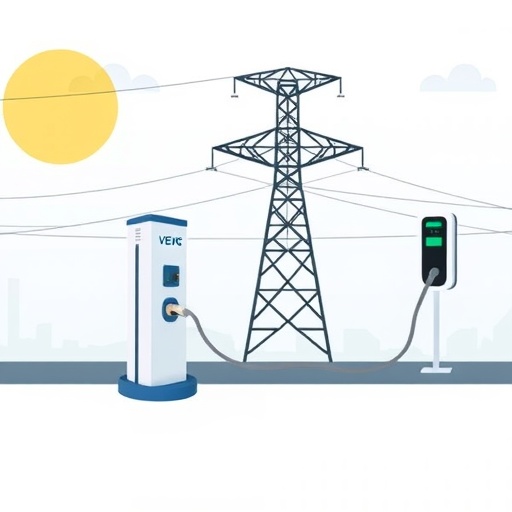
As electric vehicles (EVs) become increasingly common on urban streets, the question arises: how can our aging electrical grid handle the surging demand for power without buckling under the pressure? Researchers from the University of Michigan Engineering, National University of Singapore, and the Chinese University of Hong Kong, Shenzhen, have embarked on a comprehensive analysis to tackle this pivotal issue. Their findings illustrate that while vehicle-to-grid (V2G) technology offers remarkable promise, the path to sustainable and cost-effective electrification demands a shrewd blend of strategic grid upgrades paired with progressive charger deployment.
V2G technology allows EVs not only to draw power from the grid but also to feed electricity back into it when demand peaks. This bidirectional flow essentially transforms EV batteries into a vast, distributed energy storage system and could radically smooth out the unpredictable swings in daily electricity demand. In theory, EV owners could charge their vehicles during periods of low demand or abundant renewable energy generation — such as midday solar peaks — and discharge stored energy back to the grid during evening rush hours, alleviating strain on traditional power plants.
Yet, reality is far more complex, especially in dense urban environments where the ideal conditions for V2G are rarely met. Unlike suburban contexts with home chargers readily available, urban EV drivers often rely on public and workplace charging infrastructure, which means the timing and location of charge and discharge cycles are more erratic. Furthermore, rising solar panel adoption modifies the dynamics by injecting fluctuating clean energy into local grids, with EVs potentially acting as buffers or energy reservoirs to store surplus generation and release it later.
In their groundbreaking work, the international research team modeled the electric grid of California’s Bay Area — a region at the forefront of EV adoption, where over 25% of new vehicles registered in 2024 were electric. By integrating census demographics, solar installation projections, electricity consumption patterns, and charging behavior, they constructed an intricate representation of future demand scenarios. This holistic approach enabled them to explore various infrastructure strategies and their long-term economic impacts.
Central to their study was a comparison between staged, incremental upgrades and proactive, large-scale grid enhancements aimed at supporting full EV adoption by 2050. They evaluated different charger capabilities: basic unidirectional chargers allowing straightforward energy delivery; intermediate chargers providing flexible charging windows; and sophisticated V2G-enabled chargers that can bidirectionally exchange power with the grid depending on real-time needs. By embedding solar generation variability into these scenarios, the researchers sought to identify the most cost-effective sequencing of investments.
Contrary to expectations that V2G might defer costly grid overhauls, the analysis reveals that an upfront commitment to substantial grid enhancements is financially wiser over the long term. Transformers, transmission lines, and substations typically have lifespans extending up to four decades, while chargers need replacement roughly every ten years. Repeatedly upgrading grid components on a piecemeal basis results in disproportionate expenditures compared to a single comprehensive upgrade calibrated for future peak demand.
Moreover, early grid modernization lays the groundwork for maximizing the benefits of V2G as EV fleets and distributed solar proliferate. Once the foundational electrical infrastructure is robust enough, upgrading to more expensive V2G-capable chargers becomes an economically compelling proposition. By then, the aggregated battery storage across millions of EVs can act synergistically with local solar production, buffering intermittent renewable energy, alleviating transmission bottlenecks, and contributing significantly to grid stability.
The researchers emphasize that V2G is not a panacea but a powerful complement within a broader strategic framework. Employing V2G technology without upgrading grid infrastructure risks inefficiency and missed opportunities. As Shunbo Lei, co-corresponding author and assistant professor at the Chinese University of Hong Kong, Shenzhen, notes, “The most cost-effective path forward requires strategically pairing progressive V2G adoption with forward-looking grid investment.”
Ziyou Song, assistant professor at the University of Michigan and another co-corresponding author, underscores the novelty of their work, stating, “V2G has been discussed for two decades but lacked clarity about the contexts where it truly shines. Our study establishes a foundation to identify those optimal scenarios, laying the groundwork for informed policy and investment.”
Their analytical models further account for the nuanced interplay of urban factors—variations in charging accessibility, shifting commuter patterns, and local renewable energy integration—thus providing policymakers and utility planners with granular insights. The findings suggest that relying solely on V2G to delay essential grid upgrades is a suboptimal strategy. Early proactive grid investment emerges as critical, simultaneously enabling a smoother transition to full vehicle electrification and unlocking latent cost savings through optimized asset lifecycles.
This paradigm has broader implications for urban sustainability and decarbonization. By coordinating large-scale electrical infrastructure upgrades with phased deployment of increasingly capable charging technology, cities can foster resilient energy ecosystems where transportation electrification supports rather than stresses urban power networks. Furthermore, integrating V2G systems with solar arrays can maximize renewable utilization, slashing carbon emissions associated with electricity generation.
In conclusion, the collaborative research presents a compelling vision for a future where EVs transcend their role as mere transportation devices to become instrumental grid assets. The blueprint advises immediate prioritization of transformative grid investments, complemented by a measured rollout of conventional chargers, setting the stage for a cost-effective transition. Only thereafter, as electrification saturates, should grid operators ramp up V2G charger deployment to fully capitalize on the distributed energy storage potential embedded within the vast EV fleet.
Such forward-thinking strategies will be indispensable as the United States, California in particular, marches toward near-total EV adoption over the next few decades. Harnessed intelligently, the synergy of advanced electrical infrastructure, dynamic charging capabilities, and pervasive solar power could redefine urban energy landscapes, driving sustainability and efficiency to unprecedented heights.
Keywords
Electric vehicles, Vehicle-to-grid (V2G), Electrical grid upgrades, Urban energy systems, Distributed energy storage, Solar power integration, Electrical infrastructure planning, Demand response, Power systems, Sustainable transportation
Cite Scienmag News
Faith Mcneil. (April 2, 2026). Cut Infrastructure Costs of EV Adoption by Prioritizing Grid Upgrades Before Installing V2G Chargers. Scienmag. https://scienmag.com/cut-infrastructure-costs-of-ev-adoption-by-prioritizing-grid-upgrades-before-installing-v2g-chargers/
Faith Mcneil. "Cut Infrastructure Costs of EV Adoption by Prioritizing Grid Upgrades Before Installing V2G Chargers." Scienmag, 2 April 2026, https://scienmag.com/cut-infrastructure-costs-of-ev-adoption-by-prioritizing-grid-upgrades-before-installing-v2g-chargers/. Accessed 3 September 2026.
Faith Mcneil. "Cut Infrastructure Costs of EV Adoption by Prioritizing Grid Upgrades Before Installing V2G Chargers." Scienmag. April 2, 2026. https://scienmag.com/cut-infrastructure-costs-of-ev-adoption-by-prioritizing-grid-upgrades-before-installing-v2g-chargers/


