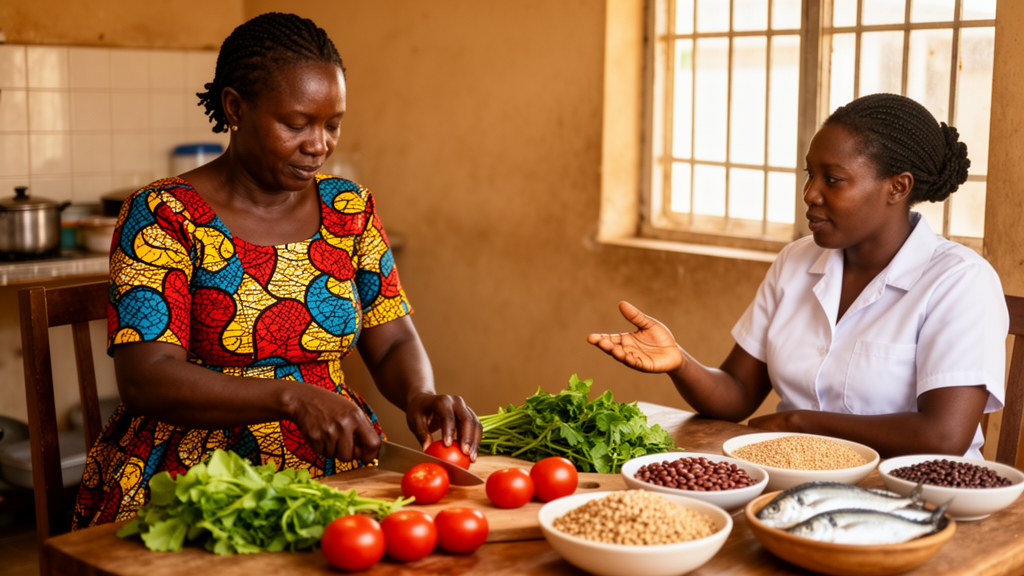
A culturally adapted nutrition program for adults living with type 2 diabetes in Cotonou, Benin, has passed its first real-world test. In a 12-week, single-arm feasibility study published in Frontiers in Nutrition, researchers report that the OSanDiaBé intervention — short for Objectif Santé Diabète Bénin — met every prespecified progression criterion for recruitment, retention, attendance, fidelity, and participant satisfaction, clearing the way for a pilot randomized controlled trial. The findings address a conspicuous gap: while medical nutrition therapy is a cornerstone of type 2 diabetes care worldwide, nearly all the evidence supporting it comes from high-income countries whose food systems, health infrastructure, and literacy contexts differ sharply from those of West Africa.
The scale of the underlying problem is considerable. According to the International Diabetes Federation figures cited by the study team, an estimated 589 million adults worldwide were living with diabetes in 2024, nearly 80 percent of them in low- and middle-income countries. Sub-Saharan Africa is projected to see the fastest growth, with the number of affected adults expected to more than double by 2045. In Benin alone, roughly 467,000 adults were living with diabetes in 2024, with projections approaching 1.1 million by 2050. Yet structured diabetes self-management education, multidisciplinary chronic disease care, and specialized nutrition services remain inconsistently available in the country, a shortfall the authors link to poor glycemic control, complications, and premature mortality.
OSanDiaBé was designed to close that gap by working with, rather than against, local realities. Developed through the Obesity-Related Behavioral Intervention Trials (ORBIT) framework, the intervention drew on extensive formative research into dietary practices, family dynamics, affordability constraints, and barriers to diabetes self-management in Benin. Its cultural tailoring is concrete rather than cosmetic: counseling uses familiar locally available foods and traditional meals, portion estimation relies on household utensils and hand measures, recipes and meal plans are built around affordability and local availability, and educational materials are visual and low-literacy friendly, with local-language clarification available when needed. Participants also received a recipe booklet, Mes repas santé OSanDiaBé, developed with linear goal programming to balance nutritional quality, cost, and cultural acceptability.
Delivery combined two individualized home-based nutrition counseling sessions of 45 to 60 minutes with eight community-based group sessions of 90 to 120 minutes over 12 weeks, all facilitated by six trained dietitians and nutritionists. Group sessions, run in cohorts of roughly 10 to 12 participants, followed a progressive structure organized around three phases — Understand, Act, and Maintain — and covered nutrition education, portion control, meal planning, food purchasing and preparation, physical activity, goal setting, relapse prevention, and family and peer support. A moderated WhatsApp group reinforced key messages between sessions, and family members were invited to selected sessions to strengthen household-level change.
The feasibility results were strong. Of 52 potentially eligible adults identified from an earlier intervention-refinement cohort, 42 were screened and 36 enrolled, a recruitment rate of 85.7 percent that exceeded the prespecified threshold of 80 percent. Thirty of the 36 participants completed the 12-week follow-up, a retention rate of 83.3 percent. Among the 34 who attended group sessions, 24 completed all eight, and mean attendance was 7.2 of 8 sessions — a 90 percent rate against a 75 percent threshold. Implementation fidelity, assessed through facilitator checklists, session observations, and logs, exceeded 85 percent of planned components, well above the 80 percent criterion. No intervention-related adverse events were reported.
Acceptability, the study’s other primary outcome, was equally emphatic. The prespecified criterion required a mean rating of at least 4.0 on a 5-point overall satisfaction item; participants delivered a mean of 4.87 with a standard deviation of 0.35. Median scores of 5 were recorded for satisfaction, enjoyment, willingness to recommend the program, cultural relevance of materials, respect for participants’ beliefs and food practices, and the value of community-based delivery. One participant captured the practical appeal in a quoted remark: “The foods discussed were foods we already eat at home, so it was easier to apply the recommendations.” Another described the group dynamic simply: “We encouraged each other during the sessions and learned from each other’s experiences.”
Beyond the feasibility metrics, the study reported exploratory changes in behavioral, psychosocial, and clinical outcomes — and the authors are careful to frame these as signals, not proof of effectiveness. Overall diabetes knowledge rose from 50.0 percent to 83.3 percent, with the largest gain in treatment knowledge, which jumped from 23.3 percent to 93.3 percent. The proportion reporting regular physical activity climbed from 26.7 percent to 86.7 percent. Diet quality scores increased by a mean of 9.29 points, and diabetes self-efficacy rose by 15.45 points. Mean HbA1c fell from 7.53 percent to 6.95 percent, a within-participant reduction of 0.58 percentage points (95 percent confidence interval −1.12 to −0.04), alongside modest decreases in body weight and body mass index. Changes in waist circumference and blood pressure did not reach statistical significance.
The caveats here are central to how the findings should be read. Because the study had no comparison group, secular trends, regression to the mean, or other unmeasured factors could account for the observed changes, and the authors state explicitly that the HbA1c reduction “cannot be attributed to the intervention.” The sample of 30 completers limits precision, the 12-week follow-up cannot show whether changes persist, and participants — recruited from urban outpatient clinics and previously exposed to the intervention during its refinement phase — may have been more motivated than the broader population of adults with type 2 diabetes in Benin. Self-reported behavioral outcomes are vulnerable to recall and social desirability bias, and no cost-effectiveness data were collected, so the economic affordability of the program remains undetermined.
Even with those limits, the study matters for what it demonstrates about implementation. Trained dietitians and nutritionists delivered structured, culturally adapted medical nutrition therapy within existing community and outpatient structures in a low-income urban African setting, with high fidelity and strong engagement. Qualitative analysis identified five themes: cultural relevance and practical applicability, peer support and group cohesion, increased confidence and self-management capacity, implementation barriers such as transportation constraints and competing work responsibilities, and facilitator observations on fidelity. Facilitators credited the standardized manual, participant workbook, and ongoing supervision for consistent delivery, while recommending simplification of some carbohydrate-counting activities before the next phase.
The research team, led by Halimatou Alaofè of the University of Arizona with colleagues at the Université d’Abomey-Calavi in Benin, argues that the results justify progression to a pilot randomized controlled trial — the step that will determine whether the encouraging signals in glycemic control, diet quality, and self-efficacy survive contact with a control group. If they do, the model offers a template for expanding access to diabetes nutrition care across sub-Saharan Africa: build the intervention from local foods and household budgets, deliver it through community settings and existing clinics, and treat cultural adaptation as a design requirement rather than an afterthought. For now, the verdict is deliberately narrow — feasible, acceptable, and ready for the trial that will tell us whether it works.
Subject of Research: Feasibility and acceptability of a culturally adapted medical nutrition therapy intervention for adults with type 2 diabetes in Cotonou, Benin
Article Title: Feasibility and acceptability of a culturally adapted medical nutrition therapy intervention for adults with type 2 diabetes in Benin: a single-arm mixed-method study
Article References: Alaofè, H., Degbelo, Y., Bedrick, E. J., Acakpo, A., Medenou, L., & Ehiri, J. (2026). Feasibility and acceptability of a culturally adapted medical nutrition therapy intervention for adults with type 2 diabetes in Benin: a single-arm mixed-method study. Frontiers in Nutrition, 13, 1954177. https://doi.org/10.3389/fnut.2026.1954177
Image Credits: AI Generated
DOI: 10.3389/fnut.2026.1954177
Keywords: type 2 diabetes, medical nutrition therapy, Benin, cultural adaptation, feasibility study, ORBIT framework, sub-Saharan Africa, HbA1c, diet quality, peer support, community-based intervention, global health
Cite Scienmag News
Daisy Hatcher. (October 28, 2026). Culturally adapted diabetes nutrition program proves feasible in Benin feasibility trial. Scienmag. https://scienmag.com/culturally-adapted-diabetes-nutrition-program-proves-feasible-in-benin-feasibility-trial/
Daisy Hatcher. "Culturally adapted diabetes nutrition program proves feasible in Benin feasibility trial." Scienmag, 28 October 2026, https://scienmag.com/culturally-adapted-diabetes-nutrition-program-proves-feasible-in-benin-feasibility-trial/. Accessed 28 October 2026.
Daisy Hatcher. "Culturally adapted diabetes nutrition program proves feasible in Benin feasibility trial." Scienmag. October 28, 2026. https://scienmag.com/culturally-adapted-diabetes-nutrition-program-proves-feasible-in-benin-feasibility-trial/