


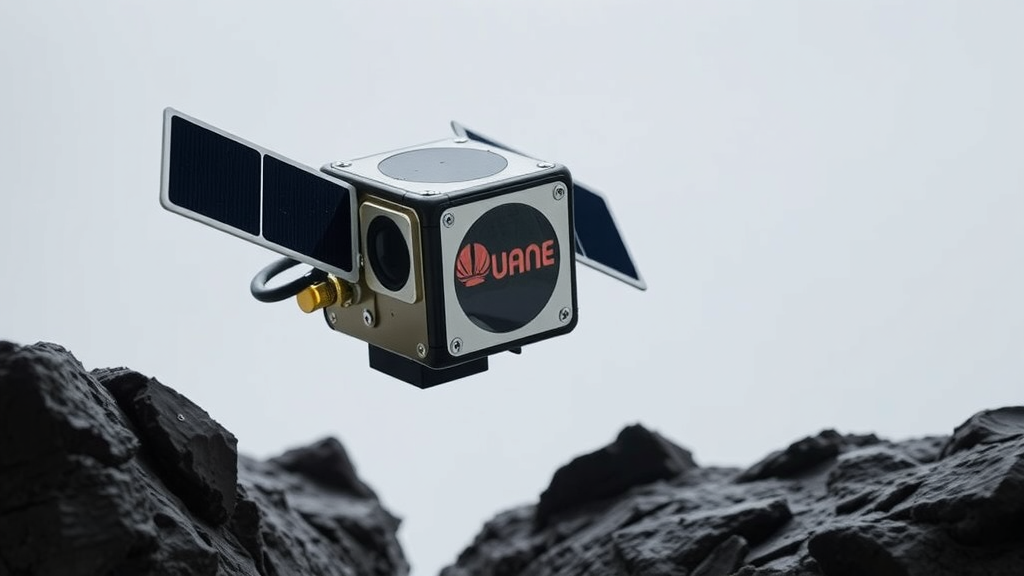
When Europe’s Hera spacecraft arrives at the Didymos asteroid system in late 2026, it will carry more than its own science suite. Tucked aboard the mothership are two shoebox-sized CubeSats, and one of them, Milani, will deploy a compact navigation camera that its team now says could reshape how small spacecraft explore small worlds. A newly published paper in Space Science Reviews details the scientific operations planned for Milani’s Navigation Camera, or NavCam, revealing an instrument that does double duty as both a steering system and a genuine scientific camera. The device, built by Tyvak International on the heritage of a star tracker, will photograph the asteroid pair Didymos and Dimorphos in visible light, guide the CubeSat’s autonomous pointing, and support the mission’s central ambition: measuring, in situ, the aftermath of humanity’s first deliberate asteroid impact.
Hera launched on October 7, 2024, and will become the first mission ever to rendezvous with a binary asteroid system. It is also the first multi-satellite expedition devoted to deep-space asteroid exploration. The stakes are high because NASA’s DART spacecraft slammed into Dimorphos on September 26, 2022, deliberately altering the moonlet’s orbit as a test of planetary defense. Hera, together with Milani and its sibling CubeSat Juventas, will survey the impact site and characterize the system in unprecedented detail. Milani’s trajectory design is aggressive for a six-unit CubeSat, involving a cascade of maneuvers through three main phases: a roughly three-week Far-Range Operations Phase for global mapping, a four-week Close-Range Operations Phase for close-up observations of Dimorphos and the DART impact site, and an Experimental Phase in which the satellite descends along a self-stabilized terminator orbit and eventually attempts a landing on Dimorphos.
The NavCam itself is a study in pragmatic engineering. Its optical head, designed and coated by Optec SpA, uses three lenses that hold focus at infinity with distortion below one percent, delivering an average transmissivity above 90 percent across the visible spectrum and a focal length of 12.96 millimeters. A coating on the first lens blocks wavelengths beyond 700 nanometers, shielding the detector from near-infrared leakage. At its heart sits a 1/3-inch CMOS rolling-shutter sensor from Onsemi, fitted with an RGB Bayer filter and an array of 2048 by 1536 pixels, each 2.2 micrometers square. That fine pixel pitch yields an instantaneous field of view of 35 arcseconds and a field of view spanning 19.72 by 14.86 degrees. In practical terms, the camera resolves 1.7 meters per pixel at 10 kilometers and a remarkable 8.5 centimeters per pixel at 500 meters, comfortably covering observation distances from 30 kilometers down to 200 meters.
Before any of that can happen, the camera had to earn its flightworthiness on the ground. Calibration at the Budapest University of Technology and Economics, the same facility that calibrated Hera’s instruments, covered bias and dark frames, bad-pixel identification, flat fields, linearity, radiometric response and distortion. The results are striking for such a small instrument: dark and bias frames show a uniform noise pattern with a standard deviation of only about 0.6 digital numbers, with no significant drift across exposure times, thanks to on-chip black-level correction. Flat-field correction removes strong vignetting, a 50 percent intensity drop toward the frame edges, and achieves better than 1 percent uniformity, while absolute radiometric uncertainty comes in under 2.5 percent. Distortion near the edges can shift star positions by as much as 50 pixels, but radial correction handles most of it, and in-flight starfield imaging against the Hipparchos and Tycho catalogs is expected to tighten the residual uncertainty from about 1.5 pixels down to 0.1 pixels.
The operations plan turns those optics into science. Data acquisition profiles, generated from the latest operational SPICE kernels, show that Milani will enjoy viewing geometries unavailable to Hera or Juventas, sampling a wide spread of phase angles that is crucial for surface characterization. By the team’s cumulative accounting, the NavCam can operate for 37 days with ground sampling better than 2 meters per pixel on Dimorphos, compared with 20 days for Hera’s Asteroid Framing Camera over the same window and 61 days for Juventas’ camera along its terminator orbit. Roughly 200 megabytes of asteroid imagery, compressed losslessly onboard with JPEG2000, will be downlinked over the mission, amounting to about 540 images or one picture every four hours on average. Each frame serves triple duty: orbit determination, flight dynamics reconstruction, and science.
The scientific payoff begins with global properties. Pre-impact models pictured Didymos as a top-shaped body like Bennu or Ryugu, but DART’s own DRACO camera revealed a surprisingly different silhouette, with a pronounced equatorial bulge and a shorter polar axis. Because DART’s observations are biased toward one hemisphere, Milani’s NavCam will help fill in the far side, contributing to high-resolution shape models built through stereophotoclinometry, a technique that fuses limb observations with landmark-based surface maplets. Those shape models cascade into bigger questions: how binary asteroids form, how the thermally driven binary YORP effect slowly reshapes their spins and orbits, and how much the DART impact deformed Dimorphos itself, which carries direct implications for assessing the efficiency of kinetic deflection. Combined with the Juventas radar’s mass and interior measurements, NavCam-derived shapes will also let the team test whether Didymos and Dimorphos share a uniform density or hide internal heterogeneity.
Surface science is the second pillar. The NavCam’s RGB channels cover roughly 400 to 700 nanometers, complementing the ASPECT hyperspectral imager on the same CubeSat, which works from 650 to 2500 nanometers, and providing color where Hera’s panchromatic Asteroid Framing Cameras offer finer resolution but no spectral information. To test what the camera can detect, the team convolved known mineral spectra from the RELAB database with the measured RGB response curves and ran k-means clustering on simulated measurements of asteroid Bennu, using spectra recorded by OSIRIS-REx’s OVIRS instrument. The clustering recovered distinct surface groups that overlap with earlier spectroscopic mapping, suggesting the camera can discriminate materials on Didymos and Dimorphos. Simulations of shocked anorthosite and irradiated ordinary chondrite add nuance: shock darkening changes reflectance uniformly across wavelengths and will be nearly invisible in color ratios, but space weathering reddens surfaces enough to raise the red-to-blue ratio by roughly 12 percent, a signal well within the camera’s reach. Mapping that ratio across the two asteroids could reveal freshly exposed impact ejecta and trace the system’s exposure age.
The camera will also feed gravity science. The University of Bologna leads Hera’s Radio Science Experiment, which fuses Earth-based tracking, inter-satellite links and optical images to estimate the asteroids’ mass, gravity harmonics and moments of inertia. NavCam images, taken from orbital geometries that differ from Hera’s, add independent constraints on the spacecraft-asteroid relative state, and tracking data collected during the final descent and landing will pin down the local gravity field near Dimorphos. The team even quantified the detectability of orbiting debris: one- and ten-centimeter particles should be visible across a useful range of distances and phase angles, echoing OSIRIS-REx, where tracking Bennu’s natural ejecta sharpened that asteroid’s gravity estimate dramatically.
Finally, the NavCam fronts Milani’s headline technology demonstration, the Autonomous Optical Navigation experiment. Milani’s vision-based guidance, navigation and control system, developed at Politecnico di Milano, computes asteroid centroids onboard to steer the spacecraft without relying on Earth. A dedicated Navigation Experiment Operation Centre in Milan will opportunistically compare the onboard navigation solution against a more precise, landmark-based ground reconstruction, testing the image-processing algorithms, the onboard estimator’s covariance, and even the GNC state machine’s ability to switch modes autonomously. In a closing twist, fictitious maneuvers computed from the onboard knowledge will be propagated in simulation and scored against the mission’s official flight dynamics solution, effectively rehearsing a fully closed-loop autonomous guidance cycle. For a CubeSat priced at a fraction of a flagship mission, the NavCam’s blend of navigation muscle and legitimate science makes a compelling case that the future of asteroid exploration may be very small indeed.
Subject of Research: The scientific operations and calibration of the Milani CubeSat's navigation camera aboard ESA's Hera mission to the Didymos binary asteroid system.
Article Title: The Scientific Operations of Milani NavCam
Article References: Ferrari, F., Fodde, I., Piccolo, F., Giordano, C., Rizza, A., Cremasco, A., Panicucci, P., Civati, L. F., Califano, P., Pugliatti, M., Topputo, F., Cardi, M., Pavoni, M., Calvi, D., Zanotti, A., Corradino, F., Kovacs, G., Palomba, E., Dirri, F., … Michel, P. (2026). The Scientific Operations of Milani NavCam. Space Science Reviews, 222(6), Article 73. https://doi.org/10.1007/s11214-026-01327-1
Image Credits: AI Generated
DOI: 10.1007/s11214-026-01327-1
Keywords: Milani, NavCam, Hera mission, Didymos, Dimorphos, DART impact, CubeSat, planetary defense, autonomous navigation, asteroid science, Space Science Reviews, stereophotoclinometry
Cite Scienmag News
Grant Pearson. (September 20, 2026). CubeSat Camera Turns Watchdog Over DART-Battered Asteroid System. Scienmag. https://scienmag.com/cubesat-camera-turns-watchdog-over-dart-battered-asteroid-system/
Grant Pearson. "CubeSat Camera Turns Watchdog Over DART-Battered Asteroid System." Scienmag, 20 September 2026, https://scienmag.com/cubesat-camera-turns-watchdog-over-dart-battered-asteroid-system/. Accessed 5 October 2026.
Grant Pearson. "CubeSat Camera Turns Watchdog Over DART-Battered Asteroid System." Scienmag. September 20, 2026. https://scienmag.com/cubesat-camera-turns-watchdog-over-dart-battered-asteroid-system/


