


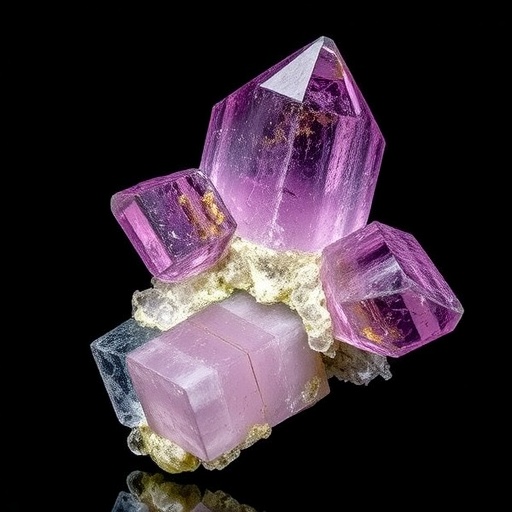
A new study published in Communications Earth & Environment highlights how trace scandium (Sc) can be captured by beryl crystals when they are reshaped by hydrothermal processes. The work focuses on beryl formed in lithium–cesium–tantalum (LCT)–type pegmatites, where rare elements are typically redistributed during late-stage fluids. By combining microstructural analysis with geochemical measurements, the researchers link the fate of Sc to specific defect structures inside the crystal lattice.
The key finding is that hydrothermally modified beryl does not incorporate scandium uniformly. Instead, Sc enrichment closely tracks the development of crystal dislocations—linear lattice imperfections that act as high-energy pathways and binding sites. These dislocations can locally distort the crystal framework, creating chemically favorable microenvironments for foreign ions to enter.
The team examines how fluid-driven reactions during hydrothermal alteration affect beryl’s internal architecture. As the mineral responds to changing temperature and chemistry, the crystal undergoes structural reorganization. That reorganization includes the activation and propagation of dislocations, which in turn influence how ions migrate and become stabilized within the crystal.
Scandium is particularly important because it is scarce in many geological settings yet technologically valuable for advanced alloys and functional materials. Understanding natural Sc sequestration therefore matters both for geoscience and for future resource exploration strategies. The study suggests that hydrothermal alteration of LCT pegmatites may be an underappreciated route for concentrating Sc in mineral hosts.
Importantly, the researchers show that Sc incorporation is tied to the “defect chemistry” of beryl rather than solely to bulk fluid composition. In other words, the mineral’s internal damage state can govern whether scandium will be taken up and retained. This reframes how geologists interpret trace-element enrichment in minerals altered by late-stage fluids.
The results also provide a more mechanistic picture of how crystal defects form during hydrothermal modification. Dislocations are not just passive features; they can actively mediate the transport and incorporation of trace species. That makes them promising targets for deciphering fluid–rock interaction histories in pegmatitic systems.
Beyond its implications for scandium, the work offers a broader template for studying other trace elements in defect-rich minerals. If similar defect-driven pathways operate in related minerals and settings, it could help scientists predict where economically relevant elements accumulate.
With hydrothermal alteration capable of both remobilizing and immobilizing elements, the study underscores the double role of fluids: they can dissolve beryl components and then rebuild the crystal with new defect landscapes. In doing so, they may turn geological processes into a controllable “natural synthesis” for trace-element hosting minerals.
Overall, the research adds a viral, high-impact twist to mineral chemistry: the internal wiring of crystals—specifically dislocations—may be the key to why scandium ends up locked inside hydrothermally modified beryl from LCT pegmatites.
Cite Scienmag News
Violet Maxwell. (July 28, 2026). Crystal Dislocations Govern Sc Incorporation in Hydrothermally Modified Beryl. Scienmag. https://scienmag.com/crystal-dislocations-govern-sc-incorporation-in-hydrothermally-modified-beryl/
Violet Maxwell. "Crystal Dislocations Govern Sc Incorporation in Hydrothermally Modified Beryl." Scienmag, 28 July 2026, https://scienmag.com/crystal-dislocations-govern-sc-incorporation-in-hydrothermally-modified-beryl/. Accessed 3 September 2026.
Violet Maxwell. "Crystal Dislocations Govern Sc Incorporation in Hydrothermally Modified Beryl." Scienmag. July 28, 2026. https://scienmag.com/crystal-dislocations-govern-sc-incorporation-in-hydrothermally-modified-beryl/


