


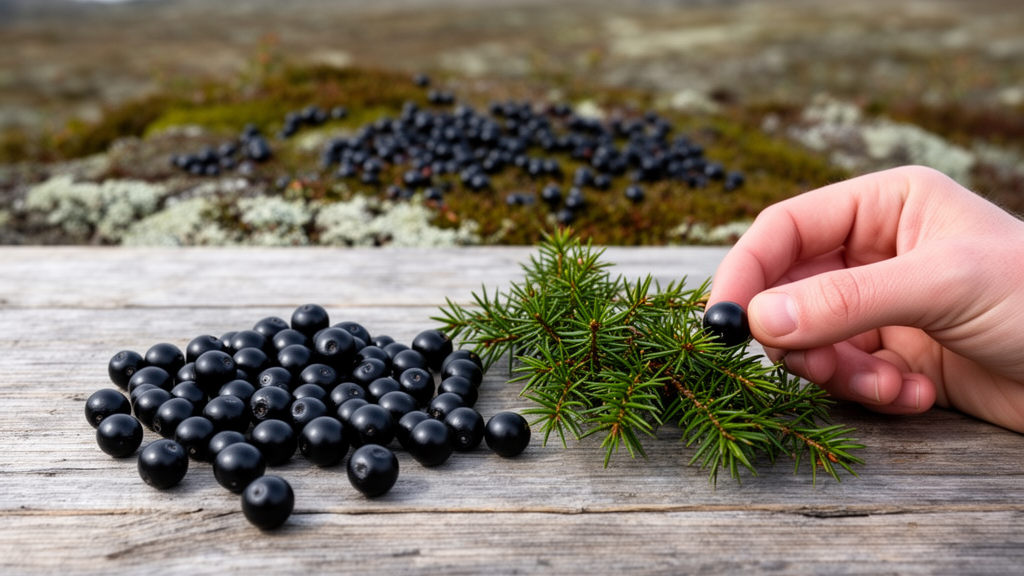
Crowberry, Empetrum nigrum, has encroached across Arctic ecosystems in recent decades, and a new systematic review of 116 scientific articles reveals that this native invader delivers both gifts and harms to people — but only its harms reach humans indirectly, through damage to local ecosystems and biodiversity. Crowberry's competitive success stems from a formidable combination of traits. The species is allelopathic, producing leaf chemicals that are harmful to other organisms.
Its horizontal creeping growth form impedes access to light for subordinate species, its phenolic-rich litter lowers nitrogen availability in the soil, and its nitrogen-poor leaves make it unpalatable to herbivores. Through these mechanisms, crowberry can shift entire vegetation communities, deteriorating the quality and quantity of grazing pastures that underpin the iconic reindeer husbandry of the indigenous Sámi people. Climate change has amplified the shrub's expansion, adding crowberry encroachment to a list of Arctic disruptions that includes rain-on-snow events, birch treeline expansion, moth outbreaks and willow shrubification.
Yet the same plant is also a resource. Its berries, rich in antioxidant substances, are an important food source for indigenous people, wader birds and herbivores. Crowberry endophytes have been tested for anti-inflammatory substances in the treatment of urinary catheter-associated infections, and polyphenolic compounds from its leaves possess orosensory properties that could make the species fit for industrial food production.
The new review identified twelve positive and negative impacts in total, including one benefit overlooked by previous reviews: carbon fixation. Because crowberry stores a higher proportion of carbon per unit biomass than other vegetation, its allelopathic encroachment paradoxically increases the total volume of carbon sequestered in Arctic ecosystems. To make sense of this duality, the research team applied three competing concepts: ecosystem services (ES), ecosystem disservices (EDS) and nature's contributions to people (NCP).
The ES framework, formalised in the Millennium Ecosystem Assessment, classifies nature's benefits into provisioning, regulating, cultural and supporting groups, and underpins major initiatives such as TEEB, SEEA, MAES and CICES. But ES covers only the benefits humans receive from nature, leaving detriments out. The EDS concept, defined in 2008, was created to address species' real or perceived harms to human well-being.
Despite its usefulness, EDS literature remains scarce: a systematic review showed that EDS articles represent just 0.4 percent of the total ES literature, with 87 percent published after 2012. The NCP concept, constructed by the Intergovernmental Science-Policy Platform on Biodiversity and Ecosystem Services (IPBES), was intended to provide a more pluralistic philosophy within nature-human relationships. IPBES reframed services as contributions to underline a gifting relationship rather than a lord-and-servant impression, and surrounded NCP with two other foci of values: nature itself, encompassing impacts on other organisms and biophysical processes, and good quality of life.
The framework redefined provisioning, regulating and cultural ES as material, regulating and non-material NCP, and claimed that NCP includes both nature's benefits and detriments. The review's central finding challenges that claim. Amongst the twelve impacts of crowberry, the three detriments — plant growth inhibition, biodiversity depression and habitat deterioration — are all indirect, operating through allelopathic suppression of neighbouring plants' regeneration, reduced species richness and degraded wildlife habitat.
No direct disservices of crowberry were found in the literature. When the team mapped these impacts onto the frameworks, the results diverged sharply. Under the MA framework, the twelve impacts divided into five groups, including supporting EDS, making indirect negative impacts conceptually visible.
Under MAES/CICES, however, the three indirect detriments could only be considered negative impacts on ecosystem condition, because the framework neither addresses nor categorises disservices. Within the IPBES framework, eight sub-categories were used, but the names of the eighteen NCP sub-categories reflect only positive impacts of nature on humans, so the three indirect negative impacts were again left uncategorised. This divergence matters because decision-makers tend to act faster when both species' detrimental and beneficial impacts are known rather than when only the positive impacts are recognised.
The authors propose integrating EDS into the MAES/CICES and IPBES frameworks, classified in a manner parallel to existing ES categories. For CICES, this could mean introducing a new, parallel Disservices section with its own Divisions, Groups and Classes, mirroring the existing Services section. Such a layered approach would maintain the clarity and consistency that are the hallmarks of CICES while transforming it into a truly comprehensive framework for assessing the full spectrum of nature's contributions, both positive and negative.
The analysis also reveals a semantic conflict at the heart of the services terminology. The purpose of the MA framework was to emphasise the indispensable relationship between nature and humans so that nature would be accorded conservation priority in policy development, embedding positivity within the ES concept. But more recent works, especially the TEEB initiative, separated the services that nature provides from the benefits that humans receive.
If the service itself can have different directions of influence on human beings under different contexts, then ecosystem services can be seen as a neutral noun — and the term ecosystem disservices, coined with negativity, would not have been necessary. This philosophical conflict will remain unless the importance of both the benefits and detriments that humans receive from nature is recognised. The review also demonstrates that the NCP concept, contrary to IPBES claims, does not consistently offer a more inclusive lens for assessing multifaceted impacts, due to the lack of elements equivalent to disservices.
Subcategories like habitat creation and maintenance or regulation of climate still describe nature acting for our good, rather than acknowledging harm such as allelopathic encroachment. The authors suggest improving the neutrality of NCP subcategories and adopting an endogenous perspective in assessing nature's contributions, treating positive and negative effects of invasive species as contributions or disservices directly from the species themselves rather than as exogenous factors influencing other NCPs. They also warn that combining supporting and regulating ES into regulating NCP may lead to double counting in the valuation phase, since values should only be assessed once.
Ultimately, the choice of concept may depend on specific research objectives. The MA framework, though dated, explicitly allows space for supporting EDS, making indirect negative impacts visible. MAES and CICES provide clearer operational categorisation but exclude disservices.
IPBES claims conceptual neutrality yet in practice does not explicitly accommodate either direct or indirect negative contributions. By explicitly identifying the indirect detriments of crowberry, this study reveals a shared gap across these frameworks, where negative indirect impacts have historically not been a primary focus and remain weakly categorised despite their growing relevance.
Subject of Research: Assessment of crowberry's beneficial and detrimental impacts using ecosystem services, ecosystem disservices and nature's contributions to people frameworks
Article Title: How dis-services illuminate divergence between “nature’s contribution to people” and “ecosystem services” – an assessment of Empetrum nigrum
Article References: Nhat, P., Armstrong, C., Tuomi, M., & Bråthen, K. A. (2026). How dis-services illuminate divergence between “nature’s contribution to people” and “ecosystem services” – an assessment of Empetrum nigrum. One Ecosystem, 11, Article e141552. https://doi.org/10.3897/oneeco.11.e141552
Image Credits: AI Generated
DOI: 10.3897/oneeco.11.e141552
Keywords: crowberry, Empetrum nigrum, ecosystem services, ecosystem disservices, nature's contributions to people, Arctic, Fennoscandia, Sámi, reindeer husbandry, invasive species, CICES, IPBES
Cite Scienmag News
Gavin Prescott. (October 20, 2026). Crowberry’s hidden harms expose gaps in how science classifies nature’s benefits. Scienmag. https://scienmag.com/crowberrys-hidden-harms-expose-gaps-in-how-science-classifies-natures-benefits/
Gavin Prescott. "Crowberry’s hidden harms expose gaps in how science classifies nature’s benefits." Scienmag, 20 October 2026, https://scienmag.com/crowberrys-hidden-harms-expose-gaps-in-how-science-classifies-natures-benefits/. Accessed 20 October 2026.
Gavin Prescott. "Crowberry’s hidden harms expose gaps in how science classifies nature’s benefits." Scienmag. October 20, 2026. https://scienmag.com/crowberrys-hidden-harms-expose-gaps-in-how-science-classifies-natures-benefits/


