


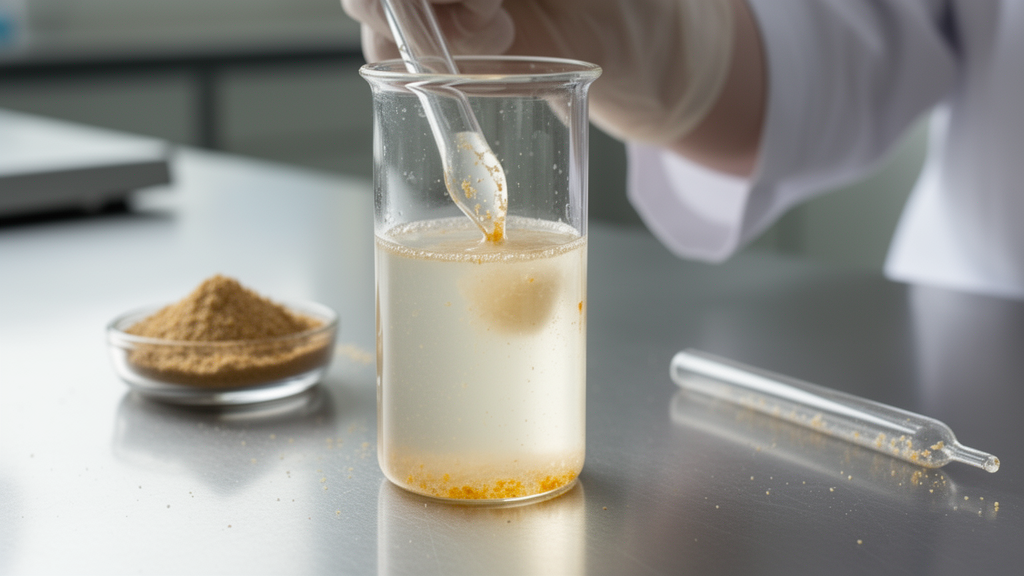
A corn-derived protein complex improved the aqueous dispersibility of Venenum Bufonis, a traditional Chinese medicine with poor water solubility and gastrointestinal irritant effects, according to an in vitro formulation study. Researchers prepared four zein–Venenum Bufonis mesoscopic complexes at zein-to-drug mass ratios of 5:1, 10:1, 20:1 and 30:1, then compared their particle characteristics, surface charge, encapsulation performance, stability and release under simulated gastric and intestinal conditions. The 10:1 formulation achieved the highest encapsulation efficiency, 98.29%, a loading capacity of 9.04% and cumulative release of 49.0% under the simulated gastrointestinal sequence. These findings are formulation results, not evidence of improved clinical efficacy or safety.
Venenum Bufonis is prepared by drying the white serous secretion obtained from the postauricular and skin glands of Bufo bufo gargarizans or Duttaphrynus melanostictus. Its major bioactive constituents include the bufadienolides cinobufagin, bufalin and resibufogenin. The source material reports that these compounds have been investigated for activities including inducing apoptosis in tumor cells, inhibiting angiogenesis and affecting signaling pathways. The highly lipophilic bufadienolides contribute to Venenum Bufonis’s poor aqueous solubility and limited bioavailability, while the material can irritate blood vessels and the gastrointestinal tract. Rapid elimination and extensive tissue distribution may also contribute to a short biological half-life, and cardiotoxicity further narrows the range within which it might be used.
The study used zein, a major storage protein obtained as a by-product of corn-starch processing, as a carrier for the poorly water-soluble material. Zein contains relatively high proportions of proline, leucine, alanine and phenylalanine, giving it strong hydrophobic characteristics and self-assembly properties that can support encapsulation of hydrophobic compounds. The investigators dissolved 0.04 g of zein and different amounts of Venenum Bufonis in 20 mL of 60% aqueous ethanol, producing the four tested mass ratios. The mixtures were treated in an ultrasonic shaker at 35 ± 1 °C for 10 minutes, stirred at 4,000 rpm for two hours and freeze-dried. The resulting powders were stored in sealed bags at 4 °C and analyzed within 48 hours. This antisolvent-precipitation approach was selected for its comparatively mild preparation conditions and its suitability for hydrophobic compounds.
The complexes differed markedly in physical behavior. At a 5:1 ratio, the light-scattering hydrodynamic radius was 2,567 ± 55 nm, with a polydispersity index of 1.01 ± 0.02, indicating large, broadly distributed structures rather than conventional nanoparticles. Electron microscopy showed irregular particles averaging about 560 nm, with wrinkled surfaces and aggregation. The 10:1 formulation had a much smaller hydrodynamic radius of 721 ± 7 nm and a polydispersity index of 1.32 ± 0.01, while microscopy identified structures of approximately 40–107 nm. The 20:1 and 30:1 formulations had hydrodynamic radii of 1,041 ± 23 nm and 607 ± 3 nm, respectively, and contained aggregated or assembled particles in the tens to hundreds of nanometers. These measurements were made by different methods, so their numerical sizes are not directly interchangeable.
Surface charge also changed with composition and did not follow a simple progression. The 5:1 suspension had a pH of 5.60 ± 0.01 and a zeta potential of 1.900 ± 0.390 mV, whereas the 10:1 formulation had a pH of 5.32 ± 0.02 and a zeta potential of −2.747 ± 0.379 mV. The 20:1 complex had a pH of 5.15 ± 0.01 and was nearly neutral at 0.384 ± 0.219 mV, while the 30:1 complex had a pH of 5.01 ± 0.01 and a zeta potential of 9.087 ± 0.405 mV. The authors associated these differences with altered exposure of charged residues during zein assembly and binding, but the measurements do not by themselves establish the detailed molecular arrangement of the protein. Infrared spectroscopy showed shifts near characteristic hydroxyl and carbon–hydrogen stretching bands, while changes near the amide I region suggested modification of zein conformation. The researchers interpreted the combined spectral evidence as consistent with hydrogen bonding and hydrophobic interactions between zein and Venenum Bufonis.
Encapsulation efficiency did not rise with every increase in protein content. The 5:1 formulation encapsulated 96.54 ± 0.06% of the drug and had a loading capacity of 16.63 ± 0.14%, the highest loading measured. The 10:1 formulation reached the study’s highest encapsulation efficiency, 98.29 ± 0.06%, but its loading capacity was lower at 9.04 ± 0.09%. At 20:1, encapsulation fell to 58.29 ± 0.11% and loading to 4.74 ± 0.09%; at 30:1, the corresponding values were 40.27 ± 0.07% and 3.19 ± 0.09%. The proposed explanation is that excess zein self-associates through hydrophobic interactions and intermolecular disulfide bonding, competing with drug binding and reducing the amount of Venenum Bufonis that can be accommodated. The results therefore show a trade-off: adding more zein did not guarantee better encapsulation or larger particle size.
Storage experiments revealed that none of the formulations remained physically unchanged throughout 12 days in aqueous dispersion at room temperature. The 5:1 and 20:1 complexes initially aggregated, with their hydrodynamic radii increasing from 2,567 ± 55 to 4,403 ± 215 nm and from 1,041 ± 23 to 4,173 ± 357 nm, respectively, before falling to 1,173 and 20 nm by day 12. The 10:1 complex decreased continuously from 721 ± 7 nm to 199 ± 9 nm and then 32 ± 1 nm, while the 30:1 formulation fell from 607 ± 3 nm to 445 ± 30 nm and finally 23 ± 1 nm over the same period. The authors interpreted these patterns as structural rearrangement, dissociation, aggregation and, possibly, precipitation rather than simple storage stability. Exposure to pH 2.0 left few detectable complexes in suspension, whereas pH 12.0 produced smaller particles. Heating caused size changes that were interpreted as initial disruption followed by possible reassembly, with the 30:1 formulation remaining within the nanoscale range after one-hour treatments at 60, 80 and 100 °C.
Release profiles also depended on composition. All four formulations released Venenum Bufonis gradually in simulated gastric fluid and simulated intestinal fluid, but the 10:1 formulation showed somewhat faster release than the 5:1 complex. The 20:1 and 30:1 formulations released the drug more rapidly, consistent with weaker retention in those systems. The 10:1 preparation released 49.0% cumulatively under the simulated gastrointestinal conditions and was judged to offer the best balance among encapsulation, loading and controlled release. A first-order kinetic model described the release profile of the 5:1 formulation most closely, and the source reports that the other formulations could also be described by that model except for the 10:1 preparation, although fitting quality differed among formulations. The Higuchi, Hixson–Crowell, Korsmeyer–Peppas and Weibull models were tested. Because the experiments used simulated fluids, they cannot establish how quickly the drug would be released, absorbed or cleared in humans.
The results support further investigation of zein as a plant-protein carrier for Venenum Bufonis, but they do not demonstrate a therapeutic advantage. Encapsulation could reduce direct contact between free drug molecules and gastrointestinal surfaces, and the gradual release observed in vitro could theoretically reduce short-lived peaks in local exposure. The experiments used simulated gastric and intestinal fluids, with no animals or human participants, and therefore did not measure absorption, pharmacological efficacy, cardiotoxicity or gastrointestinal injury. The source also notes that the tested Venenum Bufonis concentration was maintained below approximately 400 μg mL−1, lower than the 6 mg mL−1 concentration reported for intravenous administration, but that concentration comparison does not establish safety or clinical advantage. In vivo pharmacokinetic studies, biological efficacy tests and formal toxicity assessments would still be required. The 10:1 formulation is therefore best described as the most promising laboratory formulation among those tested, rather than as a clinically validated delivery system.
Subject of Research: In vitro zein-based delivery of the poorly water-soluble medicine Venenum Bufonis
Article Title: Characterization and optimization of a zein-based mesoscopic complex system for Venenum Bufonis delivery
Article References: Mao, P., Chen, S., Niu, F., Lu, Z., & Pan, W. (2026). Characterization and optimization of a zein-based mesoscopic complex system for Venenum Bufonis delivery. Frontiers in Nutrition, 13, Article 1916662. https://doi.org/10.3389/fnut.2026.1916662
Image Credits: AI Generated
DOI: 10.3389/fnut.2026.1916662
Keywords: Venenum Bufonis, zein, drug delivery, mesoscopic complexes, encapsulation, gastrointestinal release, plant protein carrier, physicochemical characterization, in vitro digestion, bufadienolides, Characterization, optimization
Cite Scienmag News
Louis Brooks. (October 20, 2026). Zein complex improves Venenum Bufonis dispersibility in laboratory study. Scienmag. https://scienmag.com/zein-complex-improves-venenum-bufonis-dispersibility-in-laboratory-study/
Louis Brooks. "Zein complex improves Venenum Bufonis dispersibility in laboratory study." Scienmag, 20 October 2026, https://scienmag.com/zein-complex-improves-venenum-bufonis-dispersibility-in-laboratory-study/. Accessed 20 October 2026.
Louis Brooks. "Zein complex improves Venenum Bufonis dispersibility in laboratory study." Scienmag. October 20, 2026. https://scienmag.com/zein-complex-improves-venenum-bufonis-dispersibility-in-laboratory-study/


