

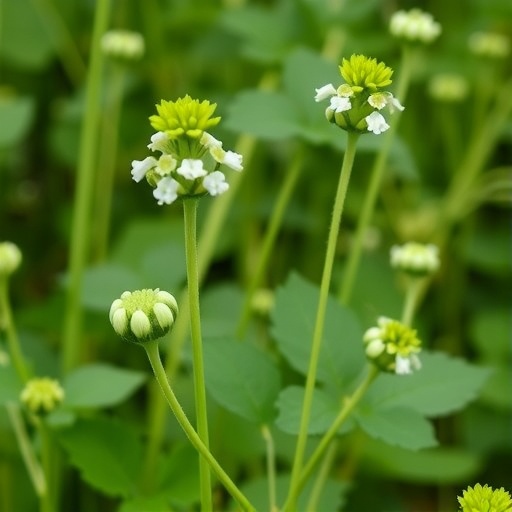
In a groundbreaking advancement with transformative potential for sustainable agriculture, scientists have successfully domesticated a wild brassica species, Thlaspi arvense L., commonly known as field pennycress, using cutting-edge CRISPR–Cas9 genome editing. This development addresses a longstanding agricultural challenge: the vast expanses of off-season farmland that remain fallow due to the difficulty and economic infeasibility of planting profitable intermediate crops. By engineering pennycress to possess traits that enable it to thrive in these intercropping periods without compromising yield, researchers have unlocked a promising avenue for enhancing farm productivity and ecological resilience.
Pennycress is inherently a hardy and fast-growing plant renowned for its freeze tolerance and rapid life cycle, characteristics that make it an ideal candidate for off-season cultivation. Yet, despite these advantages, wild forms of pennycress exhibit traits that traditionally hinder their agricultural viability, such as high seed dormancy and seed coat features contributing to seedling emergence problems and potential weediness. The research team overcame these barriers by deploying highly targeted CRISPR-mediated mutations to tweak and combine key domestication traits while ensuring minimal negative impact on seed production.
One of the most striking outcomes of this genetic refinement is the dramatic reduction of seed glucosinolate levels, compounds that are naturally abundant in many brassicas but can negatively impact the nutritional quality and safety of seeds for food and feed applications. By inactivating genes encoding R2R3-MYB transcription factors, specifically MYB28 (also designated as HAG1), alongside mutations in the basic helix–loop–helix transcription factor MYC3, the engineered pennycress varieties showed a remarkable 75% decrease in seed glucosinolate content. This “double-low” profile mirrors the advantageous traits found in canola, where low erucic acid and reduced glucosinolates have already revolutionized oilseed utility.
In parallel, the researchers tackled the issue of seed coat characteristics and seed dormancy through knocking out the basic helix–loop–helix transcription factor TRANSPARENT TESTA8 (TT8). This mutation significantly attenuated seed dormancy and weakened seed coat defenses, effectively reducing the weediness potential of pennycress by curbing unwanted re-emergence of volunteer plants in subsequent crop cycles. This breakthrough ensures that pennycress not only fits seamlessly as an intermediate crop but also poses minimal risk of becoming an invasive threat in managed agricultural landscapes.
The cumulative effect of stacking these targeted mutations has produced high-yielding, low-carbon-intensity pennycress varieties tailored for the unique temporal niche between two full-season summer crops such as corn and soybean. Integrating pennycress into existing cropping systems enables farmers to harvest three cash crops within a two-year span, effectively transforming the previously idle winter or early spring fallows into productive land with tangible economic benefits. Beyond yield improvements, this approach also confers substantial ecosystem services akin to traditional cover crops, including soil erosion reduction, increased carbon sequestration, and enhanced biodiversity.
This bioengineered pennycress heralds a new era of crop diversification essential for global food security and climate change mitigation. By converting what was once considered marginal or underutilized land into productive farmland with reduced environmental footprint, the innovation aligns perfectly with the urgent demands of sustainable intensification in agriculture. It provides a versatile platform for producing renewable biofuels and plant-based oils essential for food and industrial applications, thereby enhancing resource efficiency.
The utilization of CRISPR–Cas9 technology in this context exemplifies the power of precision breeding enabled by modern molecular genetics. Unlike traditional breeding, which can be laborious and time-consuming, genome editing allows direct modulation of specific genes responsible for domestication traits without introducing extraneous genetic material. This precise approach facilitated rapid iteration and stacking of multiple favorable traits to synergistically improve crop performance.
Moreover, the domesticated pennycress varieties possess seed fiber compositions optimized for human and animal consumption, achieved by selecting mutations that lower seed fiber content while maintaining seed integrity. This balance is critical for ensuring that the seeds can be processed efficiently into oils, meals, and other value-added products within existing agricultural supply chains without requiring mechanical or biochemical modifications.
The success in domestication also underscores the importance of transcription factors as master regulators for complex traits such as seed chemistry and dormancy. Modulating MYB and bHLH family transcription factors demonstrates that subtle shifts in gene expression networks can have profound phenotypic consequences, allowing for the fine-tuning of multiple interrelated traits simultaneously. This insight can inspire similar approaches in other orphan or underutilized crops with potential untapped benefits.
By introducing agronomically valuable traits without compromising the ecological resilience and rapid growth characteristics of pennycress, the study provides a model for sustainable crop development. The integration of this engineered pennycress into crop rotations potentially reduces reliance on synthetic inputs and mitigates greenhouse gas emissions associated with mono-cropping high-intensity crops. This approach also alleviates pressure on land-use expansion, thereby protecting natural ecosystems.
The research not only provides immediate solutions but opens avenues for further improvements, such as refining seed oil compositions tailored to industrial uses or biofuel specifications, enhancing stress tolerance to diverse climates, and optimizing plant architecture for mechanized harvesting. Given pennycress’s short generation time, continuous genetic advancements can be rapidly incorporated to fine-tune performance across different geographies and cropping systems.
This breakthrough also reflects broader trends in plant science where de novo domestication is gaining traction as a viable strategy to accelerate crop diversification. Utilizing genome editing to transform wild species into cultivated crops suited for modern agricultural needs expands the toolbox for breeders grappling with challenges posed by climate change, population growth, and food system sustainability.
In conclusion, the creation of domesticated, genome-edited pennycress strains represents a landmark achievement in agricultural biotechnology with profound implications. By providing a high-yield, low-input, and environmentally compatible intermediate crop, the innovation effectively converts dormant farmland into a productive asset that supports both economic and ecological objectives. This progress exemplifies the promise of synthetic biology to design the next generation of crops tailored for a sustainable future.
Subject of Research: Development and de novo domestication of the oilseed crop pennycress using CRISPR–Cas9 to introduce beneficial agronomic traits.
Article Title: Creating a new oilseed crop, pennycress, by combining key domestication traits using CRISPR genome editing.
Article References:
Gautam, B., Jarvis, B.A., Esfahanian, M. et al. Creating a new oilseed crop, pennycress, by combining key domestication traits using CRISPR genome editing. Nat. Plants (2026). https://doi.org/10.1038/s41477-025-02202-7
Image Credits: AI Generated


