


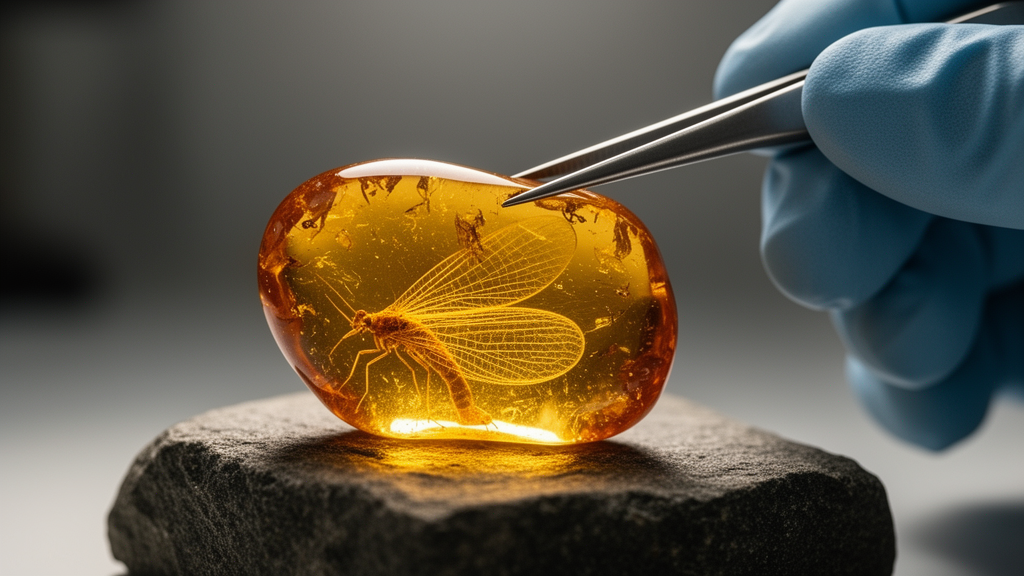
A lacewing preserved in mid-Cretaceous amber from northern Myanmar has turned out to belong to an entirely new genus, and it is only the second member of its enigmatic family ever recorded from the Mesozoic era. The insect, described from a single incomplete female specimen, has been named Sisyroneurorthus aspoeckorum, and it belongs to the family Nevrorthidae, a small group of neuropteran insects whose larvae are exclusively aquatic.
Nevrorthidae today is a tiny family, comprising just 19 extant species in four genera, found in the Mediterranean region, eastern Australia and East Asia. Their larvae are generalist predators that live in the coarsely granular sands of clear, clean rivulets. Together with the spongillaflies (Sisyridae) and the lance lacewings (Osmylidae), they make up the superfamily Osmyloidea, which recent phylogenomic studies place as the sister group to all other living Neuroptera except the dustywings. Despite the family’s evolutionary significance, its fossil record is remarkably thin: only ten species have been described from the Cretaceous to the Miocene, and until now, a single species, Cretarophalis patrickmuelleri from mid-Cretaceous amber of northern Myanmar, was the only known Mesozoic representative of the family.
The new specimen originates from the Hukawng Valley in Kachin State, an amber deposit dated to the mid-Cretaceous, from the late Albian to the early Cenomanian, or slightly older. The holotype, an incomplete female adult, is preserved in a yellowish, somewhat cloudy amber piece measuring approximately 9 by 5 by 4 millimetres. One-third of the left fore- and hind-wings was lost due to over-polishing of the amber before the specimen was studied. The authors note that the amber was collected and purchased prior to June 2017, and therefore is free of ethical concerns regarding the current acquisition of amber from the Kachin region. The specimen is deposited in the Entomological Museum at China Agricultural University in Beijing under the collection number CAU-BA-NH-22001.
Preparing the fossil required careful polishing of the amber piece using waterproof sandpapers of different grain sizes, followed by plastic buffing cloths with an abrasive compound. The researchers then examined the inclusion under a stereomicroscope and photographed it with a digital camera and macro lens, submerging the amber completely in clove oil to increase the visibility of the insect inside. Image stacking software was used to assemble sharp composite photographs of the delicate structures. The body of the insect measures about 2.4 millimetres as preserved, from the vertex of the head to the apex of the abdomen, and the forewing is an elongated oval roughly 3.7 millimetres long and 1.4 millimetres wide.
The wing venation of the new insect carries the diagnostic hallmarks of Nevrorthidae. The authors place the new genus in the family based on the presence of three radial crossveins and the long distal half of the hind-wing cubitus anterior, which bears ten branches and runs nearly parallel to the posterior wing margin. In the forewing, the cubitus anterior carries nine pectinate branches, the cubitus posterior has only a marginal fork, and the crossvein between the two cubital branches is absent. The hind-wing is about 3.3 millimetres long and 1.3 millimetres wide, with the distal half of the cubitus anterior bearing ten pectinate, simple branches. Distinct trichosors, small thickened structures along the wing margin, are visible on part of the forewing margin.
What makes the new genus remarkable is a mosaic of features that blur the boundary between Nevrorthidae and its closest relatives, the spongillaflies. In the forewing of Sisyroneurorthus, the subcostal vein ScP is fused with the radius anterior RA at the distal fourth of the wing, an arrangement shared by many species of Sisyridae. The generic name itself reflects this mixture, combining Sisyra, the type genus of the spongillaflies, with Neurorthus, a common suffix in nevrorthid generic names. The species is dedicated to Dr. Ulrike Aspöck and Dr. Horst Aspöck in recognition of their contributions to the systematics of Nevrorthidae.
The authors are careful to explain why this sisyrid-like venation does not mean the insect belongs among the spongillaflies. In some sisyrid genera, such as Sisyrina, Prosisyrina and Paleosisyra electrobaltica, the fusion of ScP and RA is atypical, because the apical part of ScP is abruptly curved towards RA and the short terminal section connecting to RA could alternatively be interpreted as a crossvein. That is precisely the state seen in the new genus, and the authors argue it should not be used to place it in Sisyridae. Moreover, all known sisyrids have only two radial crossveins and lack one of the radial crossveins in the hind-wing, and they have fewer branches of the hind-wing cubitus anterior, usually five or six, compared with the ten seen in the new fossil.
Among the Cretaceous nevrorthids, the new genus is most similar to its contemporary Cretarophalis, sharing simple forewing costal crossveins and simple hind-wing cubitus anterior branches. The two genera can nevertheless be distinguished by details of the venation: in Sisyroneurorthus the subcosta is terminally curved towards RA, whereas in Cretarophalis it runs straight, and the position of the crossvein between the cubitus and the first anal vein lies distal to the separation of the cubital branches in the new genus but proximal to it in Cretarophalis. The two Kachin amber genera also share several derived character states, including a relatively distal origin of the forewing cubitus posterior, the absence of the forewing crossvein between the cubital branches, simple branches of the hind-wing cubitus anterior, and a female ninth tergum with lateral parts strongly produced backwards.
The discovery carries broader implications for understanding the evolution of these aquatic lacewings. The authors note that the strongly produced female ninth tergum, shared by Cretarophalis and the spongillaflies, may provide evidence supporting a close relationship between the two families, and the distal fusion of ScP and RA in the new genus is another character shared with Sisyridae. Given the probable sister-group relationship between Nevrorthidae and Sisyridae, the authors raise the question of whether these Cretaceous nevrorthids represent a stem group of the combined Nevrorthidae plus Sisyridae lineage, or a transitional form between the two families, a question they say needs critical evaluation. A practical obstacle remains: no male specimens of the Cretaceous nevrorthids have yet been found, and without the informative male genital characters, their phylogenetic relationships with the Eocene Baltic amber and living counterparts cannot currently be inferred.
The three families of the superfamily are thought to have arisen during the Late Permian and Early Triassic, yet the fossil record of Nevrorthidae is so sparse that the two Kachin amber genera still stand as the oldest fossils of the family known to date. The Middle Jurassic neuropteran larvae recently assigned to Nevrorthidae by other researchers are not a definite member of the family, although they may belong to an extinct family of Osmyloidea. With each new specimen, amber from northern Myanmar continues to reveal lineages that persisted through the age of dinosaurs, and Sisyroneurorthus aspoeckorum now stands as a rare window onto the morphological diversity that Nevrorthidae achieved in the Mesozoic, a diversity that today survives only in a handful of stream-dwelling species scattered across three continents.
Subject of Research: A new genus and species of Nevrorthidae described from mid-Cretaceous Kachin amber of northern Myanmar
Article Title: A remarkable new genus of Nevrorthidae ( Neuroptera , Osmyloidea ) from mid-Cretaceous Kachin amber of northern Myanmar
Article References: Nakamine, H., Yamamoto, S., Takahashi, Y., & Liu, X. (2023). A remarkable new genus of Nevrorthidae (Neuroptera, Osmyloidea) from mid-Cretaceous Kachin amber of northern Myanmar. Deutsche Entomologische Zeitschrift, 70(1), 113-120. https://doi.org/10.3897/dez.70.98873
Image Credits: AI Generated
DOI: 10.3897/dez.70.98873
Keywords: Nevrorthidae, Neuroptera, lacewings, Kachin amber, Cretaceous, fossil, Myanmar, Osmyloidea, Sisyridae, paleontology, wing venation, new genus
Cite Scienmag News
Gavin Prescott. (October 27, 2026). Cretaceous amber reveals a new genus of aquatic lacewing from Myanmar. Scienmag. https://scienmag.com/cretaceous-amber-reveals-a-new-genus-of-aquatic-lacewing-from-myanmar/
Gavin Prescott. "Cretaceous amber reveals a new genus of aquatic lacewing from Myanmar." Scienmag, 27 October 2026, https://scienmag.com/cretaceous-amber-reveals-a-new-genus-of-aquatic-lacewing-from-myanmar/. Accessed 27 October 2026.
Gavin Prescott. "Cretaceous amber reveals a new genus of aquatic lacewing from Myanmar." Scienmag. October 27, 2026. https://scienmag.com/cretaceous-amber-reveals-a-new-genus-of-aquatic-lacewing-from-myanmar/


