


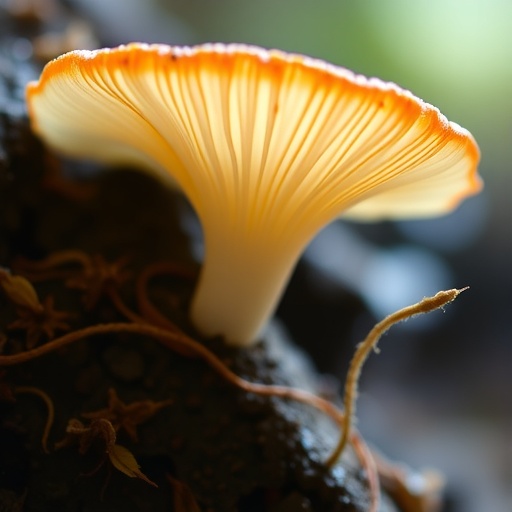
In a groundbreaking development at the intersection of biology and materials science, researchers at the University of Utah have unlocked remarkable properties of a common soil fungus, Marquandomyces marquandii, opening the door to a new class of bioinspired hydrogels with transformative biomedical applications. This discovery represents a significant leap forward in the quest for sustainable, biocompatible materials that could revolutionize tissue engineering, regenerative medicine, and wearable medical devices.
Fungi play an indispensable ecological role by decomposing organic matter and recycling nutrients essential for life. However, beyond their environmental impact, these organisms harbor untapped potential in the realm of advanced materials. The University of Utah’s mechanical engineering team, led by Ph.D. candidate Atul Agrawal and Professor Steven Naleway, has revealed that M. marquandii can be cultivated into multilayered hydrogels—soft, water-saturated networks that closely mimic the mechanical characteristics of living tissues.
Hydrogels are paramount in biomedical engineering because of their ability to retain substantial amounts of water while maintaining structural integrity and flexibility. Traditional artificial hydrogels often fall short due to limitations in durability and biocompatibility. In contrast, the living hydrogels derived from M. marquandii display a unique combination of elasticity, resilience, and hierarchical architecture, making them outstanding candidates for scaffolding materials that foster cell growth and tissue regeneration.
Unlike many fungi that struggle with water retention, M. marquandii hydrogels absorb up to 83% water by volume and demonstrate remarkable ability to recover their shape following mechanical deformation. This elasticity owes much to the fungus’s complex, layered construction, where alternating zones of varying porosity—ranging from 40% to 90%—create a functionally graded structure. Such spatial variations in microarchitecture are critical for distributing mechanical stress, ultimately enhancing the hydrogel’s performance under dynamic physiological conditions.
This discovery was serendipitously made during research initially aimed at studying a hydrocarbon-degrading fungus, colloquially known as “kerosene fungus,” infamous for contaminating aviation fuel. Contrary to expectations, the cultures exhibited unanticipated growth patterns, prompting detailed investigation and correct identification of the organism as Marquandomyces marquandii. This exemplifies the unpredictable yet rewarding nature of mycological research, where misidentifications often lead to novel breakthroughs.
The structural backbone of fungal mycelium chiefly comprises chitin, a biopolymer also found in crustacean shells and insect exoskeletons. The biocompatibility and spongy texture of chitin-rich mycelium present enormous advantages for biomedical use, including ease of integration with human tissues and a reduced risk of inflammatory reactions. Furthermore, the living nature of these hydrogels offers dynamic capabilities, such as self-healing and adaptability under stress—features typically absent in synthetic materials.
In collaboration with mycologist Bryn Dentinger, the team sheds light on why fungal mycelia’s mechanical properties are particularly interesting. The fungi grow by extending hyphae—filamentous threads—that continuously compartmentalize into individual cells separated by cross-walls. This mode of indefinite linear growth without a defined developmental endpoint is distinct from the cellular differentiation found in animals and plants. Every fungal cell remains pluripotent, able to revert and adapt, offering an unparalleled level of malleability and structural complexity advantageous for engineered living materials.
Laboratory assessments employed sophisticated mechanical testing instruments to quantify tensile strength, shear response, and compressive behavior of the mycelium-based hydrogels. The material’s ability to regain 93% of its original shape after stress and maintain cohesive integrity due to a connected mycelial network showcases the intrinsic synergy of biological design and mechanical functionality. Such qualities indicate potential for creating flexible biomedical devices that endure repetitive movements, such as wearable sensors or implantable scaffolds.
An intriguing feature of these living hydrogels is their multilayered design, which deviates from uniform synthetic gels. Optical imaging revealed alternating layers of differing porosities within the fungal colony, a functionally graded architecture that not only distributes mechanical stress more evenly but could also support spatially controlled cellular environments. This property could be harnessed to engineer tissues with region-specific characteristics, closely mimicking natural organ complexity.
The implications of these findings extend beyond biomedicine. The exceptional strength-to-weight ratios inherent to mycelium structures, as outlined in prior research from the Utah team, suggest applications in aerospace and agriculture, where lightweight, sustainable materials are in high demand. The ability to mineralize fungal scaffolds, transforming them into bone-like substrates, hints at a versatile platform technology adaptable to various industrial needs.
Funding from the U.S. National Science Foundation and the American Chemical Society has underpinned the rigorous experimental studies culminating in this breakthrough. The published findings, appearing in the journal JOM, offer comprehensive data on the fabrication, characterization, and mechanical analysis of these fungal hydrogels, marking a pivotal moment in the burgeoning field of bioinspired materials science.
What started as an exploratory path into environmental microbiology has now evolved into a promising frontier for living materials that blend form, function, and sustainability. As researchers continue to decode the complex biology of fungi and harness their intrinsic material capabilities, the future is bright for novel biomaterials that not only push the boundaries of technology but also respect and emulate nature’s designs.
News Publication Date: 27-Aug-2025
Web References:
- https://link.springer.com/article/10.1007/s11837-025-07685-5
- http://dx.doi.org/10.1007/s11837-025-07685-5
References:
Agrawal, A., Elnunu, I., Naleway, S., et al. (2025). Multilayer, Functionally Graded Organic Living Hydrogels Built by Pure Mycelium. JOM. https://doi.org/10.1007/s11837-025-07685-5
Cite Scienmag News
Roger Howard. (October 1, 2025). Could Fungi Inspire the Future of Advanced Hydrogels? Scienmag. https://scienmag.com/could-fungi-inspire-the-future-of-advanced-hydrogels/
Roger Howard. "Could Fungi Inspire the Future of Advanced Hydrogels?" Scienmag, 1 October 2025, https://scienmag.com/could-fungi-inspire-the-future-of-advanced-hydrogels/. Accessed 3 September 2026.
Roger Howard. "Could Fungi Inspire the Future of Advanced Hydrogels?" Scienmag. October 1, 2025. https://scienmag.com/could-fungi-inspire-the-future-of-advanced-hydrogels/


