


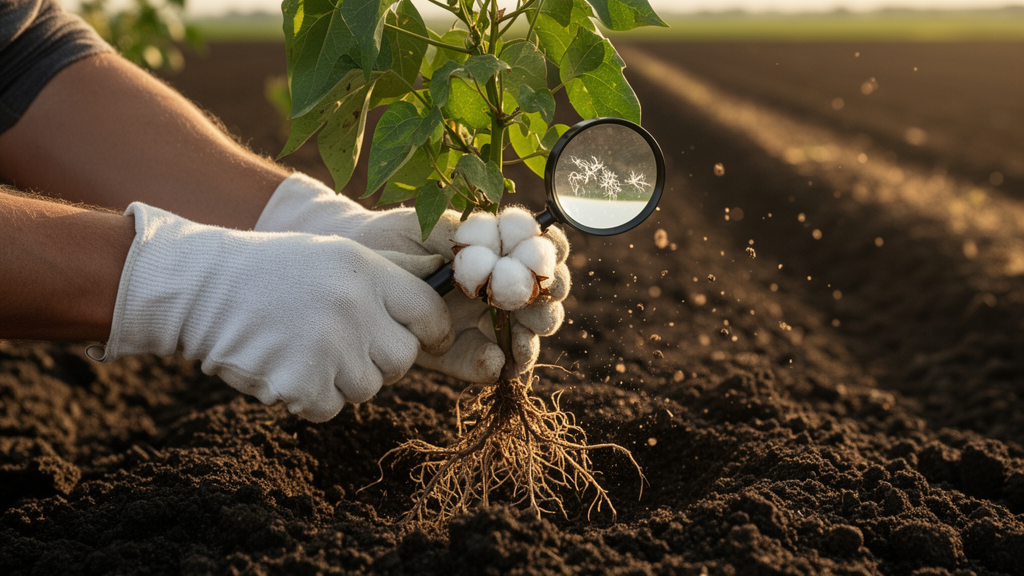
Cotton is the backbone of the global natural fiber economy, cultivated on roughly 32 million hectares and producing more than 24 million metric tons of lint each year. The crop generates an estimated annual economic impact of about 600 billion dollars and supports nearly one billion people worldwide, including some 250 million individuals whose livelihoods depend directly on cotton-related activities. Yet one of the most destructive threats to this vast agricultural system operates largely out of sight, beneath the soil surface, where a fungus called Macrophomina phaseolina quietly colonizes root tissues long before any farmer notices a wilting plant. A new study from researchers at Tel-Hai University and the Migal Galilee Research Institute in Israel now offers a detailed look at the fungal communities living inside cotton roots, and the findings suggest that the future of charcoal rot management may depend less on attacking the pathogen alone and more on understanding the crowded microbial world it inhabits.
Charcoal rot disease, caused by M. phaseolina, is among the most damaging soil-borne diseases of cotton. The pathogen is remarkably versatile, infecting more than 500 plant species across roughly 75 botanical families. Its persistence in fields is largely due to melanized microsclerotia, robust multicellular survival structures that allow the fungus to endure in soil and plant residue for extended periods. Symptoms typically emerge during flowering and boll development, manifesting as wilting, desiccation of stems and leaves, and ultimately plant death, with complete mortality sometimes observed in affected patches. Because no highly resistant cotton cultivars exist, systemic fungicides remain the primary means of suppression, but chemical control often delivers inconsistent results, and the emergence of fungicide-resistant strains has intensified the search for sustainable alternatives.
The research team, led by Ofir Degani, set out to characterize how different disease management regimes shape the community of fungi recoverable from cotton roots. The field trial compared three approaches: conventional chemical management using the fungicide azoxystrobin, biological management based on Trichoderma seed coating, and an integrated strategy combining both. In previously reported agronomic results, the biological and integrated treatments increased cotton yield by up to 17 percent, reduced visible disease symptoms by up to 27 percent, and decreased pathogen DNA levels in roots by up to 37 percent, performing as well as or better than standard chemical management. The integrated biological-chemical approach conferred a statistically significant advantage in plant health over purely chemical interventions.
To probe the root-associated fungal world, the researchers collected roots from 84 field plots at two points in the growing season, once at mid-season when all plants were asymptomatic and again at season’s end when half the sampled plants showed visible charcoal rot symptoms. After surface sterilization to remove epiphytic contaminants, internal root tissues were plated onto potato dextrose agar to recover viable endophytic microorganisms. Approximately 300 isolates emerged, from which 66 representative morphotypes were selected and molecularly identified using ribosomal DNA markers and phylogenetic analyses anchored to type strains. The final collection comprised 56 fungal and 10 bacterial isolates spanning 24 fungal species across 11 genera.
The temporal patterns were striking. Aspergillus dominated the mid-season recovery, representing 30 to 43 percent of fungal isolates from asymptomatic roots, followed by Trichoderma at 14 to 20 percent. By season’s end, however, Alternaria had become the most frequently recovered genus in symptomatic plants, accounting for 35 percent of isolates. The numbers of recovered fungal isolates and taxa increased modestly in asymptomatic plants but rose sharply in symptomatic plants, a pattern consistent with the idea that declining host vigor opens ecological niches for secondary colonists, latent pathogens, and saprotrophs. This progressive diversification supports an emerging view of plant disease in which severity reflects cumulative microbial interactions rather than the action of a single dominant pathogen.
Management regime left its own fingerprint on the recovered community. The highest taxon richness was consistently observed in plants under integrated or chemical management, likely reflecting partial suppression of dominant taxa that preserves ecological space for subdominant colonists. In contrast, Trichoderma seed coating was associated with markedly lower recovery of fungal isolates and taxa, with richness declining from 29 percent to as low as 9 percent in asymptomatic plants by season’s end. Whether this reduction reflects suppression of opportunistic pathogens or broader effects on non-target root fungi remains an open question that sequencing-based community profiling will need to resolve. The finding raises an ecologically important consideration: biological interventions may reshape the entire root microbiome, not just the pathogen they target.
To understand how these co-occurring fungi interact with M. phaseolina, the team selected four representative isolates for controlled testing: Aspergillus niger, Alternaria alternata, Rhizopus arrhizus, and the Fusarium-like pathogen Neocosmospora solani. In dual-culture plate assays, antagonism proved highly species-dependent. A. niger and N. solani emerged as potent competitors, while R. arrhizus consistently showed growth stimulation or neutral interactions, physically overgrowing other colonies without effectively suppressing them. Notably, diffusible extracellular compounds exerted stronger inhibition than direct contact in several combinations, with N. solani suppressing M. phaseolina growth by 74 percent in the culture-conditioned medium assay. Volatile-mediated antagonism, by comparison, was weak and inconsistent, suggesting that in the dense, hydrated environment of cotton roots, soluble metabolites may matter more than airborne signals.
The biocontrol strain Trichoderma asperellum P1, used in the field seed coating, showed its strongest activity in direct confrontation assays, achieving 55 percent inhibition of M. phaseolina growth, with volatile-mediated inhibition at 51 percent and a shallow liquid assay at 38 percent. A solid-medium growth-fluid format produced negligible inhibition of just 3 percent, a result the authors attribute to differences in how antifungal compounds diffuse and remain stable across assay matrices. To connect this activity to a chemically defined natural product, the researchers tested commercial 6-pentyl-alpha-pyrone, a compound previously isolated from P1 culture medium. The results were dramatic: at nominal concentrations of 400 to 800 micrograms per milliliter, 6-PP inhibited M. phaseolina by 94.5 to 100 percent through 72 hours, with effects that were both concentration- and time-dependent.
The greenhouse seedling assay added a critical in planta dimension. Over 33 days, co-inoculation experiments revealed that certain root-associated fungi can influence early pathogen establishment even when no visible symptoms develop. Quantitative PCR revealed mean reductions in M. phaseolina root DNA of 92 percent with A. niger, 94 percent with N. solani, and 99 percent with A. alternata, compared with only 47 percent for R. arrhizus. After statistical adjustment for multiple comparisons, only the reduction associated with A. alternata remained significant, underscoring the need for rigorous validation. Early seedling development itself was largely unaffected, consistent with the latent nature of charcoal rot during its invasion stage, but the molecular diagnostics clearly detected differences in pathogen colonization that visual assessment could not.
The broader implications reach beyond a single crop or pathogen. The study demonstrates that charcoal rot severity is shaped by microbial context rather than pathogen presence alone, and that specific co-occurring fungi can either suppress or enable pathogen colonization during early plant development. The authors caution that their culture-dependent, morphotype-selected approach captures only a subset of the recoverable root community and cannot establish community-wide restructuring or causality. Still, the framework they propose, integrating field isolation with functional interaction assays and molecular diagnostics, offers a practical path toward microbiome-informed disease management. Future priorities include validating these interactions across diverse field conditions, developing multispecies biocontrol consortia, and combining culture-based functional testing with next-generation sequencing. As synthetic fungicides face mounting resistance and regulatory pressure, the message from Israeli cotton fields is clear: the most durable defense against one of agriculture’s most persistent pathogens may lie in cultivating the right fungal neighbors.
Subject of Research: Root-associated fungal community dynamics and biological interactions affecting cotton charcoal rot disease management
Article Title: Dynamics of culture-recovered cotton root-associated fungi under charcoal rot disease and preventive management regimes
Article References: Etedgi, E., Demenchuk, D., Dimant, E., Hadari, P., & Degani, O. (2026). Dynamics of culture-recovered cotton root-associated fungi under charcoal rot disease and preventive management regimes. Frontiers in Fungal Biology, 7, Article 1928692. https://doi.org/10.3389/ffunb.2026.1928692
Image Credits: AI Generated
DOI: 10.3389/ffunb.2026.1928692
Keywords: cotton, charcoal rot, Macrophomina phaseolina, Trichoderma, root microbiome, biological control, 6-pentyl-alpha-pyrone, qPCR, integrated disease management, endophytic fungi, Aspergillus, Alternaria
Cite Scienmag News
Morgan Morrow. (October 15, 2026). Cotton’s Hidden Fungal Allies Could Reshape the Fight Against Charcoal Rot. Scienmag. https://scienmag.com/cottons-hidden-fungal-allies-could-reshape-the-fight-against-charcoal-rot/
Morgan Morrow. "Cotton’s Hidden Fungal Allies Could Reshape the Fight Against Charcoal Rot." Scienmag, 15 October 2026, https://scienmag.com/cottons-hidden-fungal-allies-could-reshape-the-fight-against-charcoal-rot/. Accessed 15 October 2026.
Morgan Morrow. "Cotton’s Hidden Fungal Allies Could Reshape the Fight Against Charcoal Rot." Scienmag. October 15, 2026. https://scienmag.com/cottons-hidden-fungal-allies-could-reshape-the-fight-against-charcoal-rot/


