


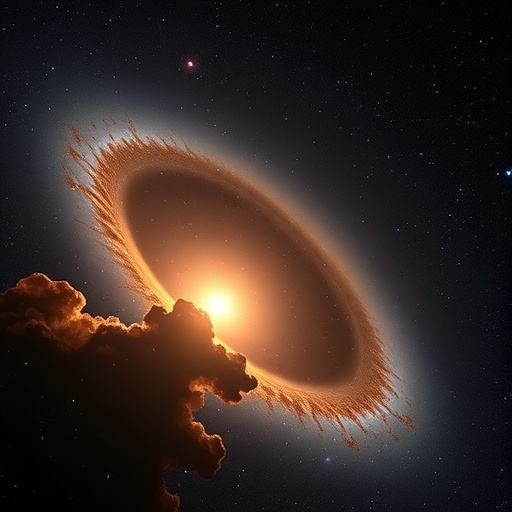
In a groundbreaking discovery in astrophysics, astronomers have recently unveiled a peculiar incident involving a star known as ASASSN-24fw, which experienced an astonishing dimming event. This star, located approximately 3,000 light-years away in our galaxy, appeared stable for over a decade before exhibiting a dramatic brightness drop of about 97% between late 2024 and early 2025. Following this eight-month period of extremely low luminosity, ASASSN-24fw began to brighten once more, igniting debates and discussions among scientists regarding the mechanisms behind such an unusual phenomenon.
The international research team leading this investigation, including scientists from The Ohio State University, meticulously examined the data from this star’s unique behavior. In their recent publication in The Open Journal of Astrophysics, they proposed that the sudden dimming may not stem from changes inherent to the star itself but rather from an obstructive mass associated with it—a considerable cloud of dust and gas that temporarily occluded our view. This assertion was bolstered by the observation that the star’s color remained remarkably consistent throughout its dimming, implying that the stellar evolution process was not at play in this instance.
Raquel Forés-Toribio, the lead author of the study and a postdoctoral researcher in astronomy at Ohio State, explained their rationale, saying, “We explored three different scenarios for what could be going on. Evidence suggests it is likely that there is a cloud of dust in the form of a disk around it.” This claim shifts the focus from ASASSN-24fw’s individual characteristics to its broader cosmic environment, suggesting the importance of the star’s surroundings in understanding its behavior.
Notably, ASASSN-24fw belongs to the category of F-type stars, which are more massive than our Sun—roughly twice its size. This classification highlights the star’s significance regarding stellar evolution and lifecycle exploration. Researchers estimated the size of the surrounding cloudy disk to be approximately 1.3 astronomical units wide, which surpasses the distance between Earth and the Sun. This unique characteristic presents exciting prospects for studying materials, such as carbon and water ice, resembling ingredients found in planet-forming disks.
However, the researchers did not stop at merely attributing the dimming to a surrounding dust cloud. They speculate the existence of an additional, much fainter star in orbit around ASASSN-24fw, indicating that this system might form a hidden binary system. Forés-Toribio stated, “At this moment, with the data that we have, what we propose is that there should be two stars together in a binary system.” The existence of this secondary star, characterized by its lower mass and luminosity, could provide clues about the geometric changes leading to the eclipses observed during the dimming event.
This unique dimming event is not only significant due to its rarity but also because it represents a departure from other similar systems. Chris Kochanek, a co-author of the study and an astronomy professor at Ohio State, highlighted the unusual nature of this case, explaining that they found very few comparable systems during their research. The hope is to unveil more about such events by identifying potential similarities in future discoveries, enriching our understanding of stellar dynamics.
The ASASSN-24fw system was initially identified as part of the All-Sky Automated Survey for Supernovae (ASAS-SN), a collaborative project utilizing a network of small telescopes dedicated to monitoring the night sky. Over the past decade, ASAS-SN has amassed approximately 14 million images of celestial objects, underscoring the importance of long-term sky surveys in revealing unusual cosmic phenomena.
Krzysztof Stanek, another co-author and professor at Ohio State, emphasized the perpetual nature of discovery in the universe, stating, “The universe’s capacity to surprise us is continuous.” This sentiment highlights the enthusiasm within the astronomy community to leverage both ground-based and space-based telescopes to refine observations, ensuring that the future of astrophysical exploration remains vibrant and full of potential.
The researchers anticipate that eclipses occurring within the ASASSN-24fw system may take place approximately once every 43.8 years, making the next predicted event around 2068. While this forecast may mark significant progress in understanding the system, many team members recognize that they may not be around to witness this future phenomenon. Regardless, their commitment to preserving data reflects an aspiration for contributing to the scientific legacy, allowing subsequent generations to build upon their findings.
“Our goal is to ensure that our data remains accessible even a hundred years from now,” said Stanek. This forward-thinking approach is vital for the scientific community, as it demonstrates an understanding of the importance of historical data in the context of ongoing astronomical research and discovery. As the universe continues to evolve and surprise us, the groundwork laid by initiatives like ASAS-SN will undoubtedly facilitate new methods of inquiry and enhanced comprehension of celestial systems.
To further comprehend the complexities of the ASASSN-24fw phenomenon and to dissect its implications thoroughly, astronomers plan to utilize larger telescopes, including the James Webb Space Telescope and the Large Binocular Telescope Observatory. The collective effort aims at more comprehensive observations of this fascinating system as it returns to full brightness, ensuring a meticulous understanding of the celestial mechanics involved.
Ultimately, this endeavor not only sheds light on a peculiar star and its surrounding conditions but also serves as a quintessential case study illustrating the broader implications that arise when investigating strange astrophysical behavior. Such inquiries push the boundaries of current astrophysical theories, inviting scientists to reevaluate their understanding of stellar formation and evolution processes. As new peculiarities emerge from systems across the universe, researchers remain keen to delve deeper into the realms of stellar dynamics, seeking to unravel the mysteries of our cosmos.
Keywords
astrophysics, ASASSN-24fw, dimming event, binary system, star formation, cosmic phenomena, Ohio State University, telescopes, astronomical surveys, stellar dynamics
Cite Scienmag News
Grant Pearson. (August 22, 2025). Cosmic Dust Reveals Secrets Behind the Dimming of Distant Star. Scienmag. https://scienmag.com/cosmic-dust-reveals-secrets-behind-the-dimming-of-distant-star/
Grant Pearson. "Cosmic Dust Reveals Secrets Behind the Dimming of Distant Star." Scienmag, 22 August 2025, https://scienmag.com/cosmic-dust-reveals-secrets-behind-the-dimming-of-distant-star/. Accessed 3 September 2026.
Grant Pearson. "Cosmic Dust Reveals Secrets Behind the Dimming of Distant Star." Scienmag. August 22, 2025. https://scienmag.com/cosmic-dust-reveals-secrets-behind-the-dimming-of-distant-star/


