


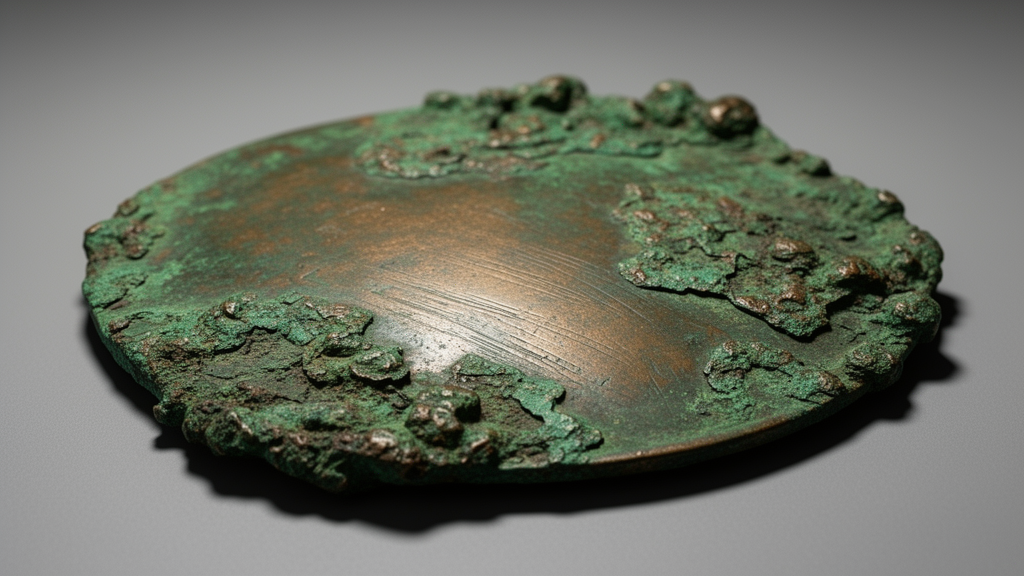
A bronze knife can pass through thirty days of accelerated corrosion and emerge with most of its history written on the surface effectively erased. That is the central finding of a controlled laboratory experiment published in Archaeological and Anthropological Sciences, in which researchers Kamil Nowak and Jakub Michalik of Nicolaus Copernicus University in Toruń tracked how an artificially induced patina progressively altered the visibility of known surface traces on a copper alloy replica. Their results suggest that the visible surface of an archaeological metal artefact is not a direct record of past use, but a transformed and selectively preserved signal, one that systematically favours deep, high-intensity features while quietly deleting the subtle evidence of lighter use.
Use-wear analysis, or traceology, has become an important tool for reconstructing past human activities in archaeology. Originally developed for lithic and osseous materials, the approach has increasingly been applied to metal artefacts in recent years, reflecting both methodological advances and a growing recognition of the role that metal tools and weapons played in past economies and social practices. Yet metals behave very differently from stone or bone. They are chemically reactive, and after deposition they undergo corrosion processes that can preserve, obscure, alter, or destroy the original surface — defined by conservators as the surface that existed at the moment of abandonment. What an analyst sees under the microscope may therefore bear only a partial and distorted relationship to what the artefact actually experienced.
The problem runs deeper than simple concealment. As corrosion progresses, the original surface does not necessarily correspond to the presently visible surface or to the boundary of the surviving metallic core. Its limit may instead be preserved within the stratigraphy of corrosion products and identified through features such as fossilised metallurgical structures, elemental distributions, and cleavage between corrosion layers. In copper alloys, some corrosion structures — the smooth, compact surfaces sometimes described as noble patina — may preserve morphological details of the original surface, whereas more disruptive forms of corrosion may conceal or destroy it. Crucially, the relationship between the visible surface and the original surface cannot be inferred from external appearance alone. A trace that has lost visibility has not necessarily lost all of its information, and conversely, a feature visible on a corroded surface is not necessarily an unaltered original trace. Corrosion itself can also generate new surface features such as cracks, pits, notches, and irregular textures that may be mistaken for use-wear, and it is rarely evenly distributed: preservation can differ between opposing sides of the same object, as illustrated by copper alloy knives from a single deposit at Karmin IV in Poland.
Despite broad acknowledgement that corrosion shapes metal surfaces, its impact on the readability of wear traces had rarely been tested under controlled conditions. Previous experimental work concentrated on generating manufacturing and use-wear traces in the first place, leaving the downstream effects of patination largely unexamined. Nowak and Michalik set out to close that gap with a deliberately structured design: create a set of known traces on a fresh bronze replica, subject it to a staged artificial patination process, and observe the same surface areas at each stage under standard analytical magnifications, combining qualitative observation with a semi-quantitative assessment of trace visibility.
The experimental object was a replica of a bronze knife with a looped handle, a form typical of the Late Bronze Age between roughly 1350 and 750 BC. The researchers cast it themselves from a certified copper-tin alloy containing ten percent tin, using moulding sand — a technique considered plausible for Bronze Age metalworkers. Casting in sand produced a relatively smooth surface, which was then ground in multiple directions, concentrating traces along the blade and handle edges. A crescent-shaped ornament was added to the upper blade with a modern steel punch, its deepest point at the centre of each crescent, exceeding the depth of the grinding traces. The controlled modifications varied in depth and intensity, deliberately approximating features observed on genuine archaeological artefacts, and gave the team a baseline against which every subsequent change could be measured.
Patination was induced by a reproducible chemical procedure based on the reaction between acetic acid and calcium carbonate, which generates carbon dioxide and creates a reactive atmosphere conducive to the growth of copper corrosion compounds, expected on the basis of the reaction chemistry to include basic copper carbonates and copper acetates. Ten grams of powdered calcium carbonate and one hundred millilitres of a five percent acetic acid solution sat in an open vessel at the bottom of a sealed chamber, never touching the metal directly. The knife, degreased and pre-moistened once with thirty percent acetic acid, was positioned above the gas source. The process ran for thirty days at twenty degrees Celsius, with the specimen removed every four days, air-dried, and returned with a freshly prepared reaction mixture. The authors are careful to note that this accelerated treatment was never intended to reproduce the full complexity of natural archaeological corrosion, which unfolds over far longer timescales and under the influence of soil chemistry, moisture, oxygen availability, and reactive ions such as chlorides.
Observations were made with a Leica M205 C stereoscopic microscope at magnifications of ten to twenty times, the range commonly used in metalwork wear analysis, at four key points: before patination, after seven days, after thirty days, and after partial mechanical cleaning. The same surface locations were photographed and compared throughout, and trace visibility was scored on a semi-quantitative ordinal scale, with shallow and deep traces evaluated separately. Before patination, all traces scored at the top of the scale — sharply defined, high-contrast, and easily distinguishable even at low magnification.
The transformation unfolded in a distinctly selective pattern. After seven days, a thin corrosion layer had formed and the metal had acquired a greenish tint. Shallow scratches were already losing clarity and contrast, their edges softening as the developing patina partially covered them; their visibility scores dropped from level three to levels one and two. Deeper traces held their ground at levels two and three. By thirty days, a continuous, relatively thick green patina dominated the surface. Shallow modifications were effectively obscured and could not be identified under optical magnification at all, scoring near zero, while even the deepest features — including the crescent ornament — survived only partially, with reduced contrast and blurred edges. In some areas the patina introduced its own irregularities, further muddying the picture. The corrosion layer, in other words, was not a passive veil but an active filter, changing both the colour and the texture of the surface and thereby determining which traces remained legible.
The final stage added a cautionary twist about conservation. The researchers mechanically removed the artificial patina from selected areas using a rotary brass-bristle tool at speeds between ten thousand and thirty thousand revolutions per minute, continuing until underlying metal was locally exposed. Previously obscured traces did partially re-emerge, and visibility scores recovered somewhat — shallow traces returning to levels one and two, deeper ones to level two — but their morphology remained altered. Crucially, the cleaning also generated new scratches and textural changes that differed in character from the original experimental traces. Where patina was only partially removed, original features and cleaning damage coexisted on the same surface, producing a composite record in which use-related and secondary features become genuinely difficult to distinguish. The authors stress that this result concerns the specific intervention tested and should not be generalised to all conservation treatments, but it reinforces earlier findings that conservation history must be considered when reading traces on archaeological metal.
The methodological implications are significant. If patina preferentially erases low-intensity traces, then analyses of corroded artefacts will systematically underrepresent subtle wear, potentially leading to underestimation or misinterpretation of an artefact’s function. Most pointedly, the absence of visible traces on a corroded surface should not be taken as evidence that the object was never used — it may simply reflect reduced detectability. There is, however, an important asymmetry in the analysts’ favour: certain technological traits associated with production, such as casting seams, unmodified as-cast surfaces, and preserved sprue remains, tend to persist even under advanced corrosion. Because these features are normally removed or modified during use or finishing, their presence in functionally active areas can serve as a high-confidence indicator of limited or no use before deposition — a principle the authors illustrate with heavily corroded finds from the Paszowice and Nowe Kramsko hoards in Poland.
The team is candid about the limits of the study. It involved a single replica, one patination method, and one cleaning technique, and the results are exploratory rather than statistically representative of archaeological corrosion at large. Relative humidity inside the sealed chamber was neither measured nor controlled, and the composition of the resulting corrosion layer was not analytically determined. Future work, the authors suggest, should span a broader range of alloys, patination chemistries, and environmental conditions, incorporating scanning electron microscopy, three-dimensional surface profilometry, and confocal microscopy for finer quantification, along with long-term burial experiments and comparative trials of mechanical, chemical, and laser cleaning. Chloride-based patination, which models the unstable corrosion known as bronze disease, deserves separate investigation. Even so, the core message stands: patina should be understood not merely as a protective or destructive layer, but as a selective filter on the observable past, and any trace-based interpretation of metal artefacts must explicitly account for the surface transformations that stand between the analyst and the original record of use.
Subject of Research: Experimental investigation of how artificial patina affects the visibility and interpretation of use-wear traces on copper alloy artefacts
Article Title: Artificial patination as a selective filter: experimental insights into interpretative bias in metalwork wear analysis
Article References: Nowak, K., & Michalik, J. (2026). Artificial patination as a selective filter: experimental insights into interpretative bias in metalwork wear analysis. Archaeological and Anthropological Sciences, 18(11), Article 220. https://doi.org/10.1007/s12520-026-02585-4
Image Credits: AI Generated
DOI: 10.1007/s12520-026-02585-4
Keywords: use-wear analysis, metalwork, patina, corrosion, bronze, experimental archaeology, traceology, conservation, copper alloys, taphonomy, Late Bronze Age, microscopy
Cite Scienmag News
Courtney Benton. (October 23, 2026). Corrosion Acts as a Selective Filter That Erases Faint Wear Traces on Bronze Artefacts. Scienmag. https://scienmag.com/corrosion-acts-as-a-selective-filter-that-erases-faint-wear-traces-on-bronze-artefacts/
Courtney Benton. "Corrosion Acts as a Selective Filter That Erases Faint Wear Traces on Bronze Artefacts." Scienmag, 23 October 2026, https://scienmag.com/corrosion-acts-as-a-selective-filter-that-erases-faint-wear-traces-on-bronze-artefacts/. Accessed 23 October 2026.
Courtney Benton. "Corrosion Acts as a Selective Filter That Erases Faint Wear Traces on Bronze Artefacts." Scienmag. October 23, 2026. https://scienmag.com/corrosion-acts-as-a-selective-filter-that-erases-faint-wear-traces-on-bronze-artefacts/


