


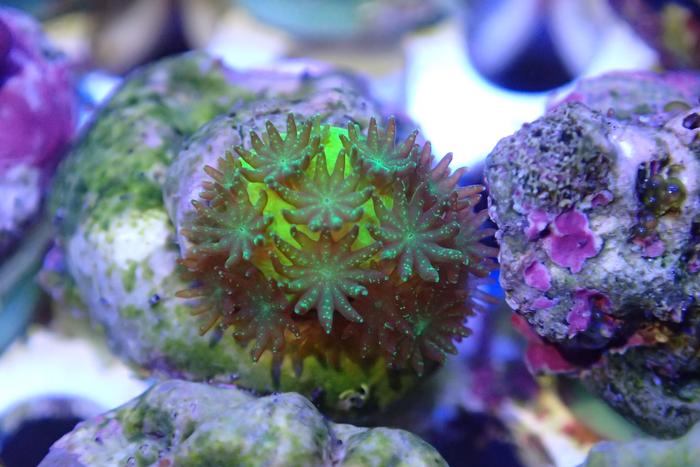
Coral farming based on sexual propagation, leading to a more sustainable coral trade and helping to protect coral reefs – this is the goal of SciReef, a new start-up which is emerging from a research transfer project. SciReef is based on the research conducted by Dr Samuel Nietzer and Dr Mareen Möller in the Environmental Biochemistry research group at the Wilhelmshaven site of the University of Oldenburg’s (Germany) Institute for Chemistry and Biology of the Marine Environment (ICBM). The Federal Ministry for Economic Affairs and Climate Action (BMWK) and the European Social Fund Plus (ESF Plus) support the innovative start-up with around 920,000 euros in EXIST Transfer of Research funding over the next two years. Peter Schupp, Professor of Environmental Biochemistry at the ICBM, will be the start-up’s scientific mentor. The project will receive additional support from the university’s Founding and Innovation Center (GIZ). The researchers are also collaborating with Tropic Marin AG, a seawater aquarium supplies company based in Hünenberg (Switzerland).

Credit: University of Oldenburg / Samuel Nietzer
Coral farming based on sexual propagation, leading to a more sustainable coral trade and helping to protect coral reefs – this is the goal of SciReef, a new start-up which is emerging from a research transfer project. SciReef is based on the research conducted by Dr Samuel Nietzer and Dr Mareen Möller in the Environmental Biochemistry research group at the Wilhelmshaven site of the University of Oldenburg’s (Germany) Institute for Chemistry and Biology of the Marine Environment (ICBM). The Federal Ministry for Economic Affairs and Climate Action (BMWK) and the European Social Fund Plus (ESF Plus) support the innovative start-up with around 920,000 euros in EXIST Transfer of Research funding over the next two years. Peter Schupp, Professor of Environmental Biochemistry at the ICBM, will be the start-up’s scientific mentor. The project will receive additional support from the university’s Founding and Innovation Center (GIZ). The researchers are also collaborating with Tropic Marin AG, a seawater aquarium supplies company based in Hünenberg (Switzerland).
SciReef wants to propagate stony corals via natural reproduction
“We are delighted about the funding and hope to be able to build a sustainable company that will contribute to the protection of wild corals,” said Nietzer, the future managing director of SciReef. In addition to covering the personnel costs for three scientific and one administrative member of staff, the funding includes around 250,000 euros to cover material costs such as chemicals, equipment and consumables. With its EXIST programme, the BMWK supports innovative, sustainable spin-offs that involve high-risk resource development at universities and other research institutions.
SciReef’s goal is to propagate stony corals via their natural sexual reproduction process and then grow out the young corals in aquaria. Commercial production of corals using sexual propagation methods has not been possible to date, meaning that the trade in corals currently relies on the asexual fragmentation technique and wild harvesting, which can pose a problem for reefs at the local level. If the project succeeds, it could lead to the global coral trade becoming considerably more environmentally sustainable and less reliant on wild harvesting. To protect their reefs, many countries have imposed export restrictions which, together with the rising logistics costs, are making the coral trade increasingly expensive. An additional advantage of the sexual reproduction technique is that it allows the breeding of corals with specific characteristics, for example new colour variants that don’t occur in nature. Compared to fragmentation, the most commonly used method to produce corals, in which a large coral is split into a number of smaller ones, sexual reproduction leads to a much higher genetic diversity. Fragmented corals, on the other hand, are clones and thus identical to the original colony.
Oldenburg scientists were first in Germany to successfully breed stony corals via sexual reproduction
The researchers will build on the basic techniques developed in the course of their earlier research. A few years ago, they became the first team of scientists in Germany to successfully breed stony corals in the lab through sexual reproduction. The young corals thus produced are much better adapted to aquarium conditions than those imported from tropical oceans.
One critical aspect of the new production method envisaged by SciReef will be to improve the “settlement” process in which the free-swimming coral larvae attach to a solid substrate. The experts plan to use chemical compounds that prompt the larvae to settle on specially designed artificial substrates. Over the last 15 years the Environmental Biochemistry research group has been able to isolate and identify one such compound.
Another equally decisive factor will be finding ways to improve the conditions for the young corals’ development once they have settled, since they are particularly fragile at this early stage. To this end, SciReef plans to optimise key factors such as nutrition, lighting and the chemical composition of the water in the aquariums and inoculate the young corals with special microalgae in order to improve survival rates.
Method of Research
Experimental study
Subject of Research
Animals
Cite Scienmag News
Violet Maxwell. (April 8, 2024). Coral researchers awarded EXIST start-up funding. Scienmag. https://scienmag.com/coral-researchers-awarded-exist-start-up-funding/
Violet Maxwell. "Coral researchers awarded EXIST start-up funding." Scienmag, 8 April 2024, https://scienmag.com/coral-researchers-awarded-exist-start-up-funding/. Accessed 4 September 2026.
Violet Maxwell. "Coral researchers awarded EXIST start-up funding." Scienmag. April 8, 2024. https://scienmag.com/coral-researchers-awarded-exist-start-up-funding/

