


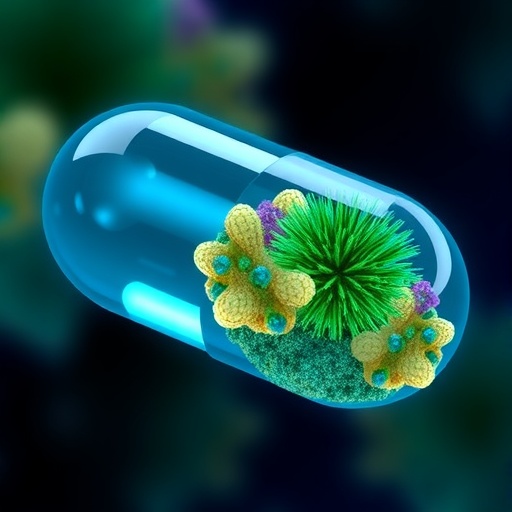
In the quest to unravel the mysteries of the human microbiome, researchers have turned their attention to an innovative approach inspired by nature, specifically marine corals. These organisms boast complex, porous structures that serve as habitats for expansive microbial communities in the ocean’s depths. Now, scientists have adapted this biological design to create a groundbreaking ingestible pill capable of sampling bacteria from the human small intestine, a region notoriously difficult to study due to its inaccessibility.
The newly developed device, known as the CORAL (Cellularly Organized Repeating Lattice) capsule, has been engineered by Khalil Ramadi, an assistant professor of bioengineering at New York University Tandon School of Engineering and NYU Abu Dhabi, in collaboration with his colleagues. This capsule represents the first passive, non-invasive method for collecting microbial samples from the upper digestive tract. Upon ingestion, the capsule navigates the digestive system, trapping bacteria along its journey before ultimately being expelled from the body.
In a recent study published in the journal Device, the research team demonstrated how the CORAL capsule yields a more accurate representation of the small intestine’s microbial landscape compared to traditional stool sampling, which currently serves as the gold standard in microbiome research. The traditional method, while convenient, fails to capture the distinct microbial communities residing in various gut regions, particularly in the small intestine.
Khalil Ramadi emphasized the shortcomings of fecal samples, stating that although they are easy to collect, they do not accurately reflect the diverse microbial populations in specific gut regions. This discrepancy is significant because the small intestine plays a crucial role in numerous bodily functions and processes. As the body’s largest mucosal surface, the small intestine is densely populated with immune cells, receptors, and neurons, making it essential for interactions between the host and microbiome.
Emerging studies indicate that a variety of diseases, including immune system disorders, metabolic conditions, and endocrine issues, may stem from the gut, highlighting the need for a deeper understanding of the unique microbial populations that inhabit the small intestine. These microbes are believed to have distinct metabolic functions and immune roles that differ substantially from their counterparts in the large intestine, making their study vital for developing effective therapeutic interventions.
The CORAL capsule addresses a significant knowledge gap in microbiome science by providing access to previously unreachable bacterial communities. Aashish Jha, an Assistant Professor of Biology at NYUAD and co-senior author of the study, pointed out that understanding these upstream microbial populations may be key in diagnosing diseases early and devising targeted treatments. The implications of this technology are vast, with the potential for enhancing health outcomes through tailored microbiome interventions.
Engineered to mimic marine corals, the CORAL capsule employs a unique design based on Triply Periodic Minimal Surfaces (TPMS), which creates a complex network of labyrinthine channels. These channels are scientifically optimized to trap bacteria while allowing the capsule to safely maneuver through the digestive tract. This innovative design ensures that bacteria from the small intestine can be collected effectively.
What sets the CORAL capsule apart from existing microbiome sampling devices is its entirely passive operation. Unlike previous devices that depend on magnets, mechanical parts, or electronic components to function, CORAL relies solely on the structural design and the natural movement of the gut to facilitate bacterial sampling. Furthermore, the capsule is created in a single step using advanced 3D printing technology, ensuring scalability for potential widespread implementation. A specialized coating enables the capsule to commence sampling only upon reaching the small intestine, thereby preventing contamination by stomach acids.
Hanan Mohammed, the study’s lead author and a Research Associate at NYUAD, noted the simplicity of the capsule’s design, stating that it requires no batteries or electronic components. This makes it an appealing alternative to more complex devices, as it allows researchers to access bacterial communities that have, until now, remained hidden from scientific scrutiny.
Preliminary animal studies have showcased the efficacy of the CORAL capsule in capturing unique bacterial populations from the small intestine, revealing a striking divergence from what is typically found in fecal samples. In these studies, researchers discovered elevated levels of beneficial bacteria such as Lactobacillus, which thrives in the small intestine’s lower pH environment, while deliberately avoiding the types of bacteria predominantly found in the large intestine.
The development of the CORAL capsule is part of Ramadi’s broader objective to revolutionize the way diseases are diagnosed and treated by leveraging insights from the gut microbiome. His research also includes the exploration of “electroceuticals,” which are ingestible devices capable of diagnosing and addressing various conditions ranging from immune disorders to metabolic diseases by tapping into the body’s inherent neural pathways.
With aspirations of translating the CORAL capsule for human use, the research team is focused on scaling the device from its current small size to a standard pill, making it practical for clinical application. Before embarking on human trials, however, developers will need to establish reliable retrieval methods, potentially utilizing magnetic detection or other identification technologies, along with thorough safety testing to ensure the device’s compliance with medical standards.
Ongoing research within the laboratory continues to foster the translation of this innovative technology, with the team actively seeking commercialization opportunities through the HealthX program at StartAD and the Abu Dhabi Department of Health. As the potential for the CORAL capsule unfolds, it stands on the brink of becoming a transformative tool for understanding the microbiome and its implications for health, paving the way for innovative diagnostic strategies and therapeutic approaches reliant on our bodies’ intricate microbial ecosystems.
This breakthrough in microbiome research not only symbolizes a significant advancement in our understanding of the small intestine but also reflects the power of interdisciplinary collaboration in tackling profound scientific challenges. The merging of biological inspiration with cutting-edge engineering paves the way for new frontiers in medicine, offering fresh perspectives on how we can harness the potential of our own microbiomes to foster better health outcomes and improved quality of life.
Keywords
Bioengineering, Microbiome Research, Ingestible Devices, Coral-Inspired Technology, Intestinal Health, Bacterial Sampling, Non-Invasive Diagnostics
Cite Scienmag News
Morgan Morrow. (September 5, 2025). Coral-Inspired Pill Reveals Insights into the Gut’s Hidden Ecosystem. Scienmag. https://scienmag.com/coral-inspired-pill-reveals-insights-into-the-guts-hidden-ecosystem/
Morgan Morrow. "Coral-Inspired Pill Reveals Insights into the Gut’s Hidden Ecosystem." Scienmag, 5 September 2025, https://scienmag.com/coral-inspired-pill-reveals-insights-into-the-guts-hidden-ecosystem/. Accessed 4 September 2026.
Morgan Morrow. "Coral-Inspired Pill Reveals Insights into the Gut’s Hidden Ecosystem." Scienmag. September 5, 2025. https://scienmag.com/coral-inspired-pill-reveals-insights-into-the-guts-hidden-ecosystem/


