


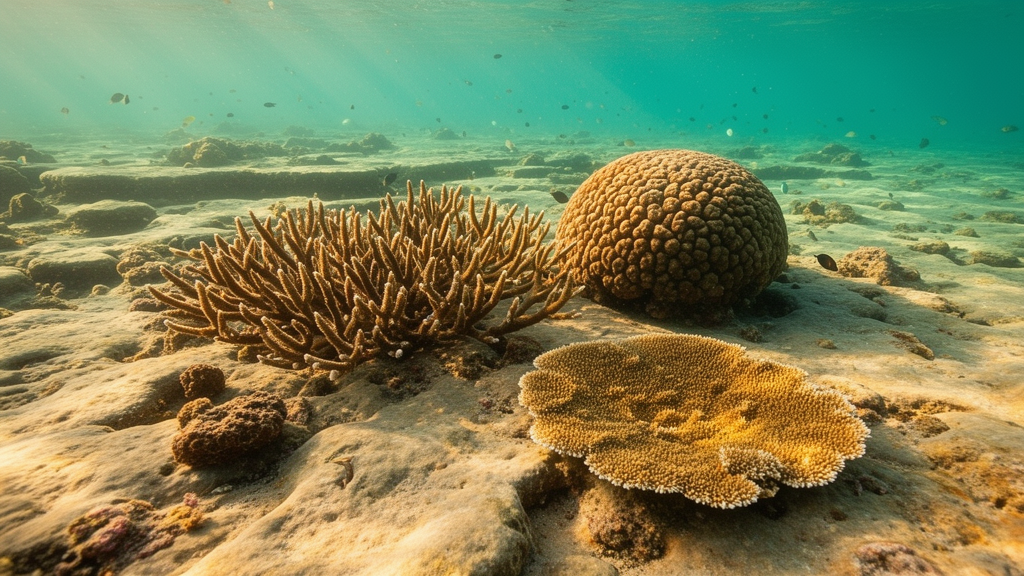
Massive reef-building corals and smaller, opportunistic corals create measurably different three-dimensional structures on the high-relief pinnacle reefs of the Dry Tortugas, according to a structure-from-motion photogrammetry study. Researchers used 1-centimeter digital surface models to compare terrain attributes across seven abundant coral genera, finding that massive builders generally produced steeper, more elevated and convex forms, while the so-called weedy group was more variable. The results show that a coral’s topographic signature may help document both the structure and composition of a reef, although the study team cautioned that these patterns remain site-specific and are not yet reliable enough for genus-level identification on their own.
The study surveyed five Dry Tortugas reefs—The Maze, Davis Rock, Texas Rock, Mayer’s Peak and Temptation Rock—between 2019 and 2020. At each site, four permanent monitoring transects were photographed, with each transect approximately 3 meters wide and 22 meters long. Divers collected between 1,000 and 1,500 overlapping images per transect while swimming about 2 meters above the seabed. Coded targets and metal stakes provided scale and orientation, allowing the images to be converted into color-corrected orthomosaics and digital surface models projected into real-world coordinates. Nineteen of the 20 transects produced usable models; one Texas Rock transect was excluded because it had too few photographs and inadequate overlap.
The reconstruction had a mean root-mean-square reprojection error of 0.911 pixels, and its mean digital surface model resolution was 1.33 millimeters per pixel. Researchers therefore exported terrain products at a 1-centimeter resolution, within the models’ reported range of accuracy. They manually annotated coral colonies in the orthomosaics, recording them to genus where species-level identification was uncertain. Sand and rubble were mapped as an abiotic control. Because terrain metrics depend on the size of the neighborhood used to calculate them, the researchers also tested windows ranging from 1 by 1 to 200 by 200 cells and selected a 9-by-9-centimeter window that captured characteristic coral form while reducing noise.
Six terrain measures were analyzed: the surface-area-to-planar-area ratio, known as SAPA; topographic position index, or TPI; slope; and profile, maximum and minimum curvature. SAPA describes how much three-dimensional surface is packed into a given footprint, while TPI indicates whether a point sits above, below or at the same level as its surroundings. Slope quantifies steepness, and the curvature metrics distinguish convex ridges and crests from concave channels and depressions. Correlated measures were removed before the statistical analysis. Group and genus differences were tested with Kruskal–Wallis rank-based tests because the data did not satisfy the assumptions of parametric analysis of variance, followed by Bonferroni-adjusted Dunn pairwise comparisons with an alpha of 0.01.
The massive reef-builders—Orbicella, Montastraea, Colpophyllia and Pseudodiploria—had the highest average TPI, mean slope and positive profile curvature. Their mean slope was 49.4 degrees, compared with 36.5 degrees for the weedy group and 20.4 degrees for sand and rubble. Their average TPI was 0.010, compared with 0.005 for weedy corals, while their mean profile curvature was 2.10. Massive and weedy corals did not differ significantly in average SAPA, profile curvature or maximum curvature, although both differed from abiotic material in those measures. Porites was the conspicuous exception within the weedy group: it had a mean TPI of 0.012, close to that of massive corals, and the highest profile-curvature value among all genera examined, at 4.79.
Fine-scale comparisons within the massive group exposed differences associated with growth form. Orbicella and Montastraea, both star corals, did not differ significantly from one another across the six metrics, nor did the brain corals Colpophyllia and Pseudodiploria. Star corals were nevertheless consistently distinct from Colpophyllia in SAPA, TPI, slope and maximum curvature. Orbicella had the highest mean slope of any genus, at 55.06 degrees, and the highest mean TPI. Within the weedy group, Siderastrea, Stephanocoenia and Porites had similar slopes of roughly 35 to 37 degrees, but Porites differed from the other two in SAPA and TPI. Stephanocoenia was the only coral genus with a negative mean TPI, suggesting that its mapped colonies more often occupied depressions than built elevated forms.
Coral abundance and size also shaped the structural picture. Orbicella, Montastraea and Colpophyllia had the greatest cover among the genera analyzed, at 2.28, 0.91 and 0.71 percent, respectively, while Pseudodiploria accounted for 0.11 percent. Massive corals had larger mean maximum diameters than the weedy genera, and individual Orbicella and Colpophyllia colonies exceeding 100 centimeters were present. Yet the authors said the topographic differences could not be attributed to size alone: SAPA did not differ significantly between the two functional groups, and Porites produced values comparable to massive builders. The study therefore suggests that colony dimensions and growth morphology jointly determine a coral’s contribution to reef structure, with the relationship varying among taxa.
The findings gain ecological significance because reef framework complexity influences habitat availability and the ecological processes supported by a reef. Historically, Florida’s reef tract contained abundant branching Acropora and massive Orbicella, but many of the largest reef-building populations have declined, leaving smaller, faster-growing opportunistic corals with a greater share of the remaining framework. In the Dry Tortugas, massive corals were also much larger than the weedy genera measured here, while Acropora was represented by only nine colonies in the analyzed transects. The study did not directly measure a change in reef complexity through time, but its results indicate that a shift in coral composition can alter structural contributions. Since the imagery was collected before stony coral tissue loss disease reached the area and before a 2023 mass bleaching event, the present structure of these reefs may differ substantially.
The authors propose that topographic signatures could eventually complement image-based systems used to map coral reefs. Structure-from-motion surveys, aerial imagery, lidar and other remote-sensing products can generate surface models from which standardized terrain attributes can be extracted. Adding measurements such as TPI, slope and curvature to training data could make automated benthic classification less dependent on illumination and water clarity, which can cause errors in image-based systems. The strongest distinctions in this study occurred at the functional-group level, while genus-level patterns overlapped and sometimes crossed group boundaries. For that reason, the authors described the signatures as a foundation for future classification and modeling rather than a ready-made identification system. Standardized metrics might also help estimate how structural trajectories change under disturbance or differ among restoration strategies, but the authors said additional features and broader surveys would be needed.
Several limitations constrain how widely the patterns can be applied. Only the seven most abundant genera were included because samples of branching, plating, columnar and other coral forms were too small for the main statistical comparisons. The study also covered only five pinnacle reefs, and its long, narrow transects were acknowledged as less suitable for photogrammetry than a more balanced footprint, such as 10 by 10 meters. Visibility was approximately 10 meters during image collection and was not expected to have materially reduced model quality, but low visibility can undermine feature detection and make fine-scale measurements less reproducible elsewhere. Expanding the survey to additional taxa, reef types and environmental conditions will be necessary to determine whether the observed signatures remain distinct and transferable. For now, the study provides a quantitative way to show that corals with similar abundance or broad labels such as “massive” and “weedy” can make markedly different contributions to the three-dimensional architecture of a reef.
Subject of Research: Fine-scale coral reef topography and structural complexity measured by underwater photogrammetry
Article Title: Photogrammetric analysis reveals distinct topographic signatures for stony corals
Article References: Mallica, C. M., & Lecours, V. (2026). Photogrammetric analysis reveals distinct topographic signatures for stony corals. Frontiers in Marine Science, 13, Article 1968325. https://doi.org/10.3389/fmars.2026.1968325
Image Credits: AI Generated
DOI: 10.3389/fmars.2026.1968325
Keywords: coral reefs, photogrammetry, reef complexity, stony corals, Dry Tortugas, digital surface models, terrain metrics, Florida Keys, reef monitoring, Photogrammetric, analysis, reveals
Cite Scienmag News
Violet Maxwell. (October 20, 2026). Coral Growth Forms Leave Distinct Topographic Fingerprints on Reefs. Scienmag. https://scienmag.com/coral-growth-forms-leave-distinct-topographic-fingerprints-on-reefs/
Violet Maxwell. "Coral Growth Forms Leave Distinct Topographic Fingerprints on Reefs." Scienmag, 20 October 2026, https://scienmag.com/coral-growth-forms-leave-distinct-topographic-fingerprints-on-reefs/. Accessed 20 October 2026.
Violet Maxwell. "Coral Growth Forms Leave Distinct Topographic Fingerprints on Reefs." Scienmag. October 20, 2026. https://scienmag.com/coral-growth-forms-leave-distinct-topographic-fingerprints-on-reefs/


