

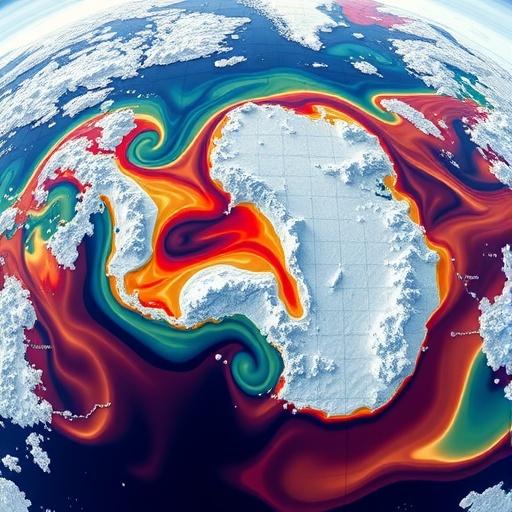
In recent years, the scientific community has grown increasingly concerned about the environmental fate of mercury, a potent neurotoxin that poses significant risks to ecosystems and human health. A groundbreaking study published in Nature Communications illuminates a previously underappreciated mechanism driving the patterns of summertime atmospheric mercury depletion around Antarctica. The research, led by Xie, Yue, Angot, and their colleagues, meticulously examines how continental air masses influence mercury chemistry and distribution in the fragile polar environment, reshaping our understanding of global mercury cycling in high southern latitudes.
Mercury in the atmosphere exists primarily as gaseous elemental mercury (GEM), a relatively stable form that can travel long distances before transforming into more reactive and toxic species. In polar regions, atmospheric mercury depletion events (AMDEs) have been documented primarily during springtime, where rapid oxidation processes convert GEM into reactive gaseous mercury (RGM) and particulate mercury (HgP). These forms rapidly deposit onto snow and ice surfaces, temporarily removing mercury from the atmosphere. However, the occurrence and drivers of similar phenomena during the austral summer have remained enigmatic until recently.
The study by Xie et al. offers compelling evidence that continental outflow, originating from South America and other landmasses at mid-latitudes, plays a pivotal role in amplifying and shaping the summertime patterns of mercury depletion in the circum-Antarctic atmosphere. Utilizing advanced atmospheric modeling combined with comprehensive field measurements, the researchers delineate how air masses enriched with reactive chemical species interact with polar boundary layer processes, catalyzing mercury oxidation far beyond previously recognized boundaries. This continental influence challenges traditional assumptions that Antarctic AMDEs are solely governed by local photochemical reactions within sea ice environments or bromine explosions.
A critical aspect of the investigation involved deploying multiple ground-based and airborne sensors to capture real-time concentrations of various chemical tracers, including bromine, ozone, and mercury species. These datasets were integrated into high-resolution regional atmospheric chemistry models capable of simulating intercontinental pollutant transport and heterogeneous chemistry on aerosol surfaces. The intricate coupling between continental airflows and Antarctic atmospheric composition emerged as a dominant control on mercury transformation pathways, revealing that summertime mercury depletion is not an isolated polar phenomenon but rather a manifestation of broader hemispheric atmospheric dynamics.
Furthermore, the research highlights the seasonal variability and spatial heterogeneity of mercury depletion zones. While springtime events remain linked largely to sea ice photochemical processes, the summertime episodes stretch circum-Antarctic and correlate strongly with episodic continental plume incursions. This temporal and spatial shift underscores the sensitivity of polar mercury cycling to variable meteorological conditions and anthropogenic emissions thousands of kilometers away. As continents modulate the supply of reactive halogen species and oxidants, new chemical reaction networks are triggered, driving unexpected mercury uptake by the southern polar atmosphere.
The implications of these findings extend beyond atmospheric sciences. Mercury deposition onto Antarctic and Southern Ocean surfaces potentially influences biogeochemical cycling within marine ecosystems, with consequences for bioaccumulation in food webs. By modulating mercury availability during the biologically active summer months, continental outflows indirectly affect methylmercury production in aquatic habitats—one of the most toxic mercury forms that biomagnifies in fish and ultimately threatens human consumers globally. Consequently, understanding these atmospheric linkages enhances predictive capabilities for ecological mercury exposure under changing climate and emission scenarios.
In dissecting the chemical mechanisms, the study elucidates how halogen radicals, particularly bromine monoxide (BrO), act as catalysts in mercury oxidation, facilitated by continental emissions enriched with halogen precursors. These reactive halogen species engage in complex photochemical cycles amplified under summer sunlight conditions in polar latitudes, heightening mercury reactivity. Additionally, the presence of continental aerosols serves as reaction surfaces, promoting heterogeneous reactions that accelerate mercury transformation rates. The synergy between plume composition and Antarctic boundary layer dynamics constitutes a novel chemical paradigm in polar environmental chemistry.
Meteorological phenomena, including katabatic winds and cyclonic systems prevalent around Antarctica, further modulate the transport and dispersion of continental plumes. These dynamic atmospheric circulations can enhance vertical mixing, bringing mercury and oxidizing agents closer to the surface where deposition occurs. The interplay between meteorology and chemistry thus creates a dynamic mosaic of mercury hotspots and depletion zones, which vary in intensity and location depending on transient weather patterns. Such complexity calls for sustained monitoring efforts combining atmospheric chemistry, meteorology, and modeling to unravel the full scope of mercury cycling in the Antarctic atmosphere.
This study also reevaluates the role of anthropogenic emissions in shaping remote polar chemistry. Continental outflows carry pollution markers from industrial and urban source regions, intermingled with natural biogenic compounds. Their journey to the southern polar atmosphere not only transports mercury itself but also the chemical agents that dictate mercury’s environmental transformations. The realization that human activities influence mercury depletion zones even in ostensibly pristine environments emphasizes the global reach of pollution impacts and the need for international cooperation under frameworks such as the Minamata Convention on Mercury.
Moreover, the research advances the methodological frontiers for studying polar atmospheric chemistry. Cutting-edge remote sensing techniques combined with in situ observations enable unprecedented spatial and temporal resolution of trace gases and aerosols. These data-rich approaches facilitate validation and refinement of chemical transport models, critical for predictive assessments of mercury’s environmental behavior in response to evolving emission trajectories and climatic shifts. As polar regions undergo rapid warming and sea ice retreat, understanding the evolving chemistry of mercury becomes imperative for anticipating future environmental and health risks.
Beyond the immediate scientific community, the revelations from this work resonate with broader audiences attuned to environmental change and public health. The concept that pollution from distant continents can shape the chemistry and toxicity of one of the Earth’s most remote and sensitive environments is a powerful narrative about planetary interconnectedness. It illustrates the unforeseen pathways through which human-induced changes propagate, challenging traditional geographic notions of pollution responsibility and illustrating the need for holistic environmental stewardship.
Intriguingly, the study also identifies potential feedback mechanisms where altered mercury cycling could influence atmospheric composition and climate processes. Mercury’s interactions with halogen chemistry may affect ozone layer dynamics and the oxidative capacity of the polar atmosphere, thereby indirectly impacting radiative balance and atmospheric lifetimes of greenhouse gases. This multifaceted role for mercury, spanning toxicity and climate relevance, invites interdisciplinary inquiry into its place within Earth system science.
Significantly, the findings call attention to the underexplored Antarctic summer period, a critical window of biological productivity and chemical transformations. Historically overshadowed by springtime research focus, summer atmospheric chemistry now emerges as a crucial determinant of mercury fate. This paradigm shift opens new avenues for polar research investment, including expanded observational campaigns during austral summer months and targeted studies on the ecological consequences of altered mercury deposition patterns.
Finally, the comprehensive analysis presented by Xie and colleagues exemplifies the power of integrative, multinational research collaborations in tackling complex environmental challenges. By weaving together atmospheric chemistry, meteorological science, modeling expertise, and polar fieldwork, the study constructs a coherent narrative that advances both fundamental knowledge and applied policy relevance. As global efforts intensify to mitigate mercury pollution, insights from Antarctica serve as a barometer for the effectiveness and scope of these actions.
In summary, the discovery that continental outflows significantly shape the circum-Antarctic pattern of summertime atmospheric mercury depletion zones redefines existing conceptions of mercury biogeochemistry in polar regions. This work highlights the intrinsic connectivity between mid-latitude emissions and remote southern environments, emphasizing the need for continued surveillance and integrative research to protect vulnerable polar ecosystems and safeguard global public health.
Subject of Research: Atmospheric mercury depletion zones and the influence of continental outflow on mercury biogeochemistry in the Antarctic region during summertime.
Article Title: Continental outflow shapes the circum-Antarctic pattern of summertime atmospheric mercury depletion zones.
Article References:
Xie, Z., Yue, F., Angot, H. et al. Continental outflow shapes the circum-Antarctic pattern of summertime atmospheric mercury depletion zones. Nat Commun (2025). https://doi.org/10.1038/s41467-025-67864-5
Image Credits: AI Generated


