


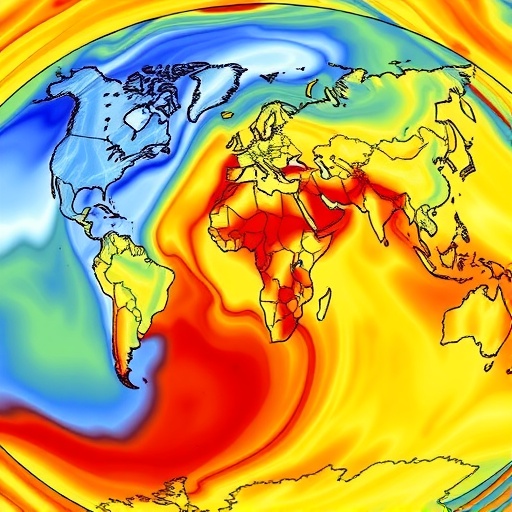
In a groundbreaking study published in Nature Communications, scientists have unveiled compelling evidence that current climate models substantially overestimate the influence of greenhouse gases on recent interhemispheric temperature variations and tropical climate behavior. This revelation challenges prevailing assumptions within climate science and raises critical questions about the precision of predictive climate modeling, with profound implications for future climate policy and adaptation strategies.
The research team, led by climatologists Chuan He, Andrew C. Clement, and Mark A. Cane, meticulously analyzed multiple state-of-the-art climate simulation models alongside comprehensive observational datasets spanning the past several decades. Their analysis revealed a pattern of systematic exaggeration in how these models represent temperature differences between the Northern and Southern Hemispheres as well as tropical climate responses attributed to anthropogenic greenhouse gas emissions. This nuanced discrepancy points to complex interactions and feedback mechanisms in climate dynamics that existing models may inadequately capture.
Central to modern climate science is the ability to simulate the Earth’s response to increasing concentrations of greenhouse gases, especially carbon dioxide and methane, which trap infrared radiation and contribute to global warming. Models typically predict distinct patterns of warming across latitude bands, with the Northern Hemisphere often expected to warm more intensely due to its larger landmass and human activity concentration. However, the new findings suggest that the models amplify this hemispheric contrast beyond what is observed in reality, indicating potential over-sensitivity or missing physical processes in the models.
This overestimation could stem from inadequate representation of oceanic and atmospheric circulations that mediate heat distribution between hemispheres. Ocean currents such as the Atlantic Meridional Overturning Circulation and atmospheric phenomena like the Intertropical Convergence Zone are critical regulators of temperature gradients, and any mischaracterization could skew model outputs. The study’s multidisciplinary approach integrated oceanographic data, satellite measurements, and paleoclimate reconstructions to identify where model predictions diverged from natural variability and observed trends.
One intriguing aspect of the research is its focus on the tropical climate system, which historically has been challenging to simulate due to its complex interplay of convection, cloud formation, and radiation dynamics. The authors found that while climate models correctly capture the general warming trend in tropical regions, they tend to exaggerate regional temperature variations and precipitation anomalies, potentially overshooting the intensity of climate impacts such as droughts and storms. This has critical ramifications for vulnerable tropical populations and ecosystems, for whom climate adaptation planning depends on reliable forecasts.
The implications of these findings extend beyond academic curiosity. Policy decisions surrounding emission reductions, climate adaptation investments, and international agreements are often informed by projections generated from these models. If the magnitude of greenhouse gas impacts is systematically overstated, there is a risk of misallocating resources or misunderstanding the urgency and nature of certain climate threats. Conversely, recognizing the limitations of current models opens avenues to refine models and incorporate additional processes such as aerosol-cloud interactions, natural variability modes like the Pacific Decadal Oscillation, and biogeochemical feedbacks.
In their methodological framework, the researchers utilized ensemble simulations, which combine multiple model runs to assess uncertainty and variability. These ensembles allowed them to compare how different models respond to the same greenhouse gas forcing and to isolate consistent biases. By aligning simulated data with observed temperature records, they could identify a persistent pattern of inflated interhemispheric temperature gradients that is not reflected in empirical measurements. Their statistical rigor ensures confidence in the robustness of these conclusions.
Moreover, the study discusses the importance of temporal and spatial resolution in climate modeling. Many global models operate at coarse scales, potentially smoothing out fine-scale processes that are critical to accurate regional climate representations. This limitation may partly explain why models struggle to replicate observed tropical climate patterns with complete fidelity. Advances in high-resolution modeling and increased computational power offer promising routes to overcome such obstacles, enabling better integration of mesoscale dynamics and localized feedback effects.
The potential causes of the exaggerated greenhouse gas impact could also be linked to how models treat radiative forcing components. For example, some models may insufficiently account for compensating effects of natural aerosols or underestimate land-atmosphere interactions that buffer temperature changes. Additionally, uncertainties in cloud microphysics and the representation of convective processes introduce further complexity, often leading to greater variability across models in simulating tropical climates.
Beyond theoretical advancements, this research underscores the vital role of comprehensive observational networks. Satellite missions, ocean buoys, and ground-based stations provide essential ground-truth data that enable continual model validation and adjustment. The disparity between models and observations revealed in this study calls for enhancing observational coverage, particularly in under-monitored Southern Hemisphere and tropical regions, to better constrain model development and calibration.
The broader climate science community has received these findings with keen interest, recognizing both the challenges they present and the opportunities they afford. Recalibrating model sensitivity to greenhouse gases is not a rejection of climate change science but a refinement that enhances scientific accuracy and predictive confidence. It also exemplifies the iterative nature of scientific progress—models evolve alongside growing data inputs and deepening understanding of Earth’s climate complexities.
Finally, this study encourages a balanced narrative when communicating climate risks to the public and policymakers. While it confirms that greenhouse gases remain a dominant driver of recent climate change, it suggests that the severity and patterns of some impacts might differ from earlier projections. Clear, transparent communication about model uncertainties and strengths is paramount to maintaining trust and fostering informed decision-making.
Moving forward, the authors advocate for intensified collaboration between observational scientists, modelers, and theoreticians to address identified gaps. By integrating more comprehensive physical processes and improving model parameterizations, the climate science community can develop more precise tools for forecasting future climate scenarios. This progress is essential for formulating effective mitigation and adaptation strategies that are resilient and responsive to the true dynamics of the Earth’s climate system.
In conclusion, the study by He, Clement, Cane, and colleagues represents a pivotal contribution to climate science, highlighting critical nuances in how climate models simulate greenhouse gas impacts across hemispheres and the tropics. It offers a sophisticated perspective on climate model performance, combining rigorous statistical analysis with physically grounded interpretations. As climate science continues to advance, such research not only deepens our understanding but also reinforces the call for ongoing refinement of predictive models in service of humanity’s enduring challenge to navigate a changing climate.
Cite Scienmag News
Violet Maxwell. (February 27, 2026). Climate Models Overstate Greenhouse Gas Effects. Scienmag. https://scienmag.com/climate-models-overstate-greenhouse-gas-effects/
Violet Maxwell. "Climate Models Overstate Greenhouse Gas Effects." Scienmag, 27 February 2026, https://scienmag.com/climate-models-overstate-greenhouse-gas-effects/. Accessed 3 September 2026.
Violet Maxwell. "Climate Models Overstate Greenhouse Gas Effects." Scienmag. February 27, 2026. https://scienmag.com/climate-models-overstate-greenhouse-gas-effects/


