


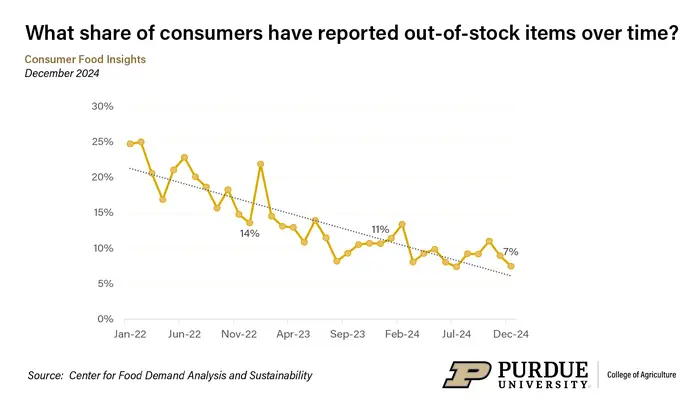
In a recent report released by Purdue University’s Center for Food Demand Analysis and Sustainability (CFDAS), the out-of-stock rate for food items among consumers has shown a notable decline. The data, derived from a comprehensive survey of 1,200 consumers across the United States, reveals that the out-of-stock rate for 2024 stands at 9.5%. This figure marks a significant reduction from the 12.3% recorded in 2023 and 19.3% in 2022. This downward trend is particularly noteworthy given the various factors that have previously contributed to supply chain disruptions.
The Consumer Food Insights Report (CFI), which thoroughly assesses consumer behavior and food-related trends, attributes these changes to a complex interplay of events and market dynamics. Historical disruptions such as the avian flu outbreak, geopolitical tensions, and the ongoing impacts of the COVID-19 pandemic have all played a role in shaping the food supply landscape. Lead author Joseph Balagtas, a professor of agricultural economics at Purdue, highlighted these issues in his analysis, emphasizing the resilience of the food system amidst such challenges.
The report offers a granular view into consumer behavior beyond mere stock availability. In an intriguing shift, nearly half of American adults have expressed a commitment to food or nutrition-related resolutions as they approach the new year. Many focus on modifying their diets by limiting sugar intake or increasing vegetable consumption. This insight reflects a broader trend towards healthier eating habits, with different motivations attributed to varying health statuses among consumers. Individuals in excellent or very good health are more likely to pursue resolutions for reasons beyond personal health, such as supporting family or environmental concerns.
Supporting the notion of proactive dietary changes, further data revealed that consumers are increasingly inclined towards purchases that align with healthier eating goals. A majority of respondents indicated a desire to enhance their intake of fruits, vegetables, and water. However, interest in altering consumption habits for staple items such as dairy, eggs, and beverages like coffee remains low. This trend suggests that while consumers are mindful of their health and nutrition, the habitual consumption of certain staple items has not changed significantly.
Moreover, the report provides a new angle by exploring the implications of GLP-1 medications—drugs traditionally used for diabetes management that have gained traction as weight loss solutions. Around 14% of respondents indicated they have used or are currently using GLP-1 drugs. Notably, these medications are associated with decreased appetite, which has led to a reduction in overall food purchases. Previous studies corroborate that households with at least one member using GLP-1 drugs tend to exhibit lower food expenditure, and there’s an uptick in the purchasing of healthier food options.
The sustainable food purchasing index, a key metric introduced in the report, returned to its historical average of 69 out of 100 in December. According to survey research analyst Elijah Bryant, this stability demonstrates a consistent consumer approach towards sustainable purchasing habits. Interestingly, the data suggests a correlation between an individual’s health status and their sustainable purchasing patterns—individuals reporting excellent health exhibit a higher index score than those stating poor health. This relationship reinforces the notion that nutritional choices are intrinsically linked to personal health outcomes.
In evaluating financial aspects, the report reveals that average weekly food expenditure has risen to $193 in 2024, compared to $187 in the previous year and $178 in 2022. The increasing costs of groceries indicate that consumers are spending more to maintain their standard food shopping experiences due to inflationary pressures. Indeed, consumer inflation expectations have also risen, signaling that individuals are becoming more cognizant of fluctuating food prices.
Food insecurity is another critical issue extracted from the survey results, with figures indicating a slight increase to 14% in December. Worryingly, food insecurity levels are disproportionately higher among individuals in poor or fair health, reflecting a troubling intersection between health challenges and financial accessibility. These insights resonate with research that shows a significant correlation between income levels and the ability to procure adequate nutrition, which raises concerns about the feedback loop of health and financial stability.
At the same time, the analysis evaluates consumer trust in information sources related to health and sustainability. Interestingly, trust levels have remained relatively stable over time, with governmental bodies such as the U.S. Department of Agriculture and primary healthcare providers ranking highest among trusted sources. Fast food entities, conversely, consistently score low on the trust index. The upcoming transition of presidential administrations may bring future changes in perception, as consumers observe how trust is maintained or altered across these critical information channels.
As part of its mission, the Center for Food Demand Analysis and Sustainability continues to focus on improving food systems through innovative use of data and user-friendly platforms. Their ongoing research endeavors aim to tackle pressing challenges in agricultural policy and consumer behavior, enhancing overall understanding of dietary trends within the context of sustainability.
The findings in this report not only highlight evolving consumer perspectives on food supply, health, and nutrition but also provide a crucial lens on the systemic factors influencing these domains in contemporary society. Continued attention to these dynamics will be essential as both consumers and policymakers look toward fostering resilience within food systems amid ever-changing realities.
Cite Scienmag News
Courtney Benton. (January 13, 2025). Consumer Food Insights Report: Decline in Out-of-Stock Food Items Continues for Second Consecutive Year. Scienmag. https://scienmag.com/consumer-food-insights-report-decline-in-out-of-stock-food-items-continues-for-second-consecutive-year/
Courtney Benton. "Consumer Food Insights Report: Decline in Out-of-Stock Food Items Continues for Second Consecutive Year." Scienmag, 13 January 2025, https://scienmag.com/consumer-food-insights-report-decline-in-out-of-stock-food-items-continues-for-second-consecutive-year/. Accessed 3 September 2026.
Courtney Benton. "Consumer Food Insights Report: Decline in Out-of-Stock Food Items Continues for Second Consecutive Year." Scienmag. January 13, 2025. https://scienmag.com/consumer-food-insights-report-decline-in-out-of-stock-food-items-continues-for-second-consecutive-year/


