

Friday, July 10, 2026
Science
No Result
View All Result
  • Login
  • HOME
  • SCIENCE NEWS
  • CONTACT US
  • HOME
  • SCIENCE NEWS
  • CONTACT US
No Result
View All Result
Scienmag
No Result
View All Result
Home Science News Chemistry

Computer Chip Uses Vibrations for Memory Storage

July 10, 2026
in Chemistry
Reading Time: 2 mins read
0
Computer Chip Uses Vibrations for Memory Storage

Computer Chip Uses Vibrations for Memory Storage

65
SHARES
587
VIEWS
Share on FacebookShare on Twitter
ADVERTISEMENT

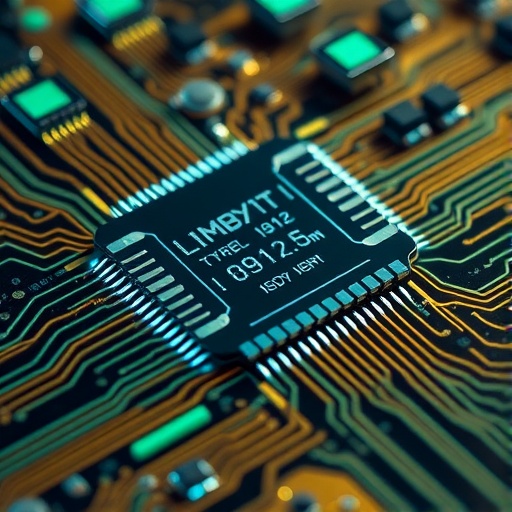
Quantum physicist Yiwen Chu and her team at ETH Zurich have unveiled a groundbreaking quantum computing architecture that echoes the design principles of classical digital computers. The key innovation lies in combining superconducting qubits, which act as the quantum processor, with tiny mechanical resonators serving as quantum memory. These resonators vibrate at quantum levels, storing information in a more compact and stable manner than traditional electromagnetic memory.

Unlike conventional quantum memory that relies on electromagnetic states, Chu’s architecture uses mechanical vibrations—akin to the strings of a guitar—to encode quantum information. These mechanical resonators are microscopic, measuring mere millimeters in length and width, yet they support multiple vibrational modes simultaneously. This capability offers expanded storage capacity and prolonged coherence times, essential for reliable quantum computation.

This new approach addresses a significant challenge in quantum computing: the physical size and scalability of quantum memory. Although electromagnetic quantum memories allow precise control and manipulation of quantum states, their relatively large footprint has limited the transition from laboratory experiments to practical quantum devices. The compactness of mechanical resonators brings a promising path toward scalable and market-ready quantum machines.

In their recent publication in Science, Chu and her team experimentally demonstrated the integration of superconducting qubits with mechanical resonators. This hybrid system can store, retrieve, and manipulate quantum information effectively, functioning as a quantum working memory with enhanced flexibility. Their work distinctly separates the processor from the memory unit, mirroring the division found in classical computers—a stark contrast to many existing quantum architectures where processing and storage are tightly coupled.

To test the computational strength of their design, the researchers implemented two fundamental quantum algorithms: the quantum Fourier transform and period-finding. Both require precise control and coherent linking of multiple quantum states. Successful execution of these algorithms confirmed the system’s capability to perform crucial computational tasks for quantum information processing.

The implications of this research extend beyond proof of concept. By marrying mechanical resonators with superconducting qubits, the system sets the stage for a highly adaptable and expandable quantum computing platform. This approach holds promise for developing more powerful general-purpose quantum computers that could tackle complex problems beyond the reach of classical computing.

While still in its early stages, the architecture developed by Chu’s team represents a significant leap toward practical quantum devices. With mechanical quantum memory offering superior storage capacity and stability, the path to robust, scalable, and efficient quantum computers becomes clearer—as the vibrations of these tiny resonators may well orchestrate the future of quantum computation.


Subject of Research: Quantum Computing, Quantum Memory, Mechanical Resonators
Article Title: Mechanical resonator–based quantum computing
News Publication Date: 28-May-2026
Web References: http://dx.doi.org/10.1126/science.aef4139
Image Credits: Hybrid Quantum Systems Group / ETH Zurich

Keywords

quantum computing, superconducting qubits, mechanical resonators, quantum memory, quantum Fourier transform, scalable quantum architecture, quantum information, quantum algorithms

Tags: advancements in quantum memory technologycoherence times in mechanical quantum systemshybrid quantum computing deviceslimitations of electromagnetic quantum memorymechanical resonator vibrational modesmechanical resonators in quantum computingpractical quantum computing hardware developmentquantum information stability and compactnessquantum memory storagescalable quantum memory architecturessuperconducting qubits for quantum processorsvibrations-based quantum information encoding
Share26Tweet16
Previous Post

UCSF Begins Patient Screening for New Alzheimer’s Treatment Trial

Next Post

Dr. Tim Allerton Receives $3.6M NIH Grant for Heart Failure Research

Related Posts

Artificial Intelligence Transforms Material Synthesis Methods
Chemistry

Artificial Intelligence Transforms Material Synthesis Methods

July 10, 2026
Rapid Screening Advances Discovery of Nanocrystals
Chemistry

Rapid Screening Advances Discovery of Nanocrystals

July 10, 2026
New Eco-Friendly Method Developed for Alcohol Oxidation
Chemistry

New Eco-Friendly Method Developed for Alcohol Oxidation

July 10, 2026
Pre-cooked seafood meals may absorb chemicals during packaging and processing
Chemistry

Pre-cooked seafood meals may absorb chemicals during packaging and processing

July 10, 2026
Temporary Power Reduction Boosts Carbon Dioxide Conversion Efficiency
Chemistry

Temporary Power Reduction Boosts Carbon Dioxide Conversion Efficiency

July 10, 2026
Solar Oscillations, Flares, and Tornadoes Unveiled by Scientists
Chemistry

Solar Oscillations, Flares, and Tornadoes Unveiled by Scientists

July 10, 2026
Next Post
Dr. Tim Allerton Receives $3.6M NIH Grant for Heart Failure Research

Dr. Tim Allerton Receives $3.6M NIH Grant for Heart Failure Research

  • Mothers who receive childcare support from maternal grandparents show more

    Mothers who receive childcare support from maternal grandparents show more parental warmth, finds NTU Singapore study

    27656 shares
    Share 11059 Tweet 6912
  • University of Seville Breaks 120-Year-Old Mystery, Revises a Key Einstein Concept

    1061 shares
    Share 424 Tweet 265
  • Bee body mass, pathogens and local climate influence heat tolerance

    682 shares
    Share 273 Tweet 171
  • Researchers record first-ever images and data of a shark experiencing a boat strike

    546 shares
    Share 218 Tweet 137
  • Groundbreaking Clinical Trial Reveals Lubiprostone Enhances Kidney Function

    531 shares
    Share 212 Tweet 133
Science

Embark on a thrilling journey of discovery with Scienmag.com—your ultimate source for cutting-edge breakthroughs. Immerse yourself in a world where curiosity knows no limits and tomorrow’s possibilities become today’s reality!

RECENT NEWS

  • Dr. Joe Northup Becomes 40th President of Metabolic Surgery Society
  • Protecting Primates Crucial to Preventing Global Mass Extinction Crisis
  • Study Explores Traditional Chinese Medicine for Treating Post-COVID Syndrome
  • Natural Product Exposure Linked to Global Rise in Pulmonary Hypertension

Categories

  • Agriculture
  • Anthropology
  • Archaeology
  • Athmospheric
  • Biology
  • Biotechnology
  • Blog
  • Bussines
  • Cancer
  • Chemistry
  • Climate
  • Earth Science
  • Editorial Policy
  • Marine
  • Mathematics
  • Medicine
  • Pediatry
  • Policy
  • Psychology & Psychiatry
  • Science Education
  • Social Science
  • Space
  • Technology and Engineering

Subscribe to Blog via Email

Enter your email address to subscribe to this blog and receive notifications of new posts by email.

Join 5,146 other subscribers

© 2025 Scienmag - Science Magazine

Welcome Back!

Login to your account below

Forgotten Password?

Retrieve your password

Please enter your username or email address to reset your password.

Log In
No Result
View All Result
  • HOME
  • SCIENCE NEWS
  • CONTACT US

© 2025 Scienmag - Science Magazine

Discover more from Science

Subscribe now to keep reading and get access to the full archive.

Continue reading
