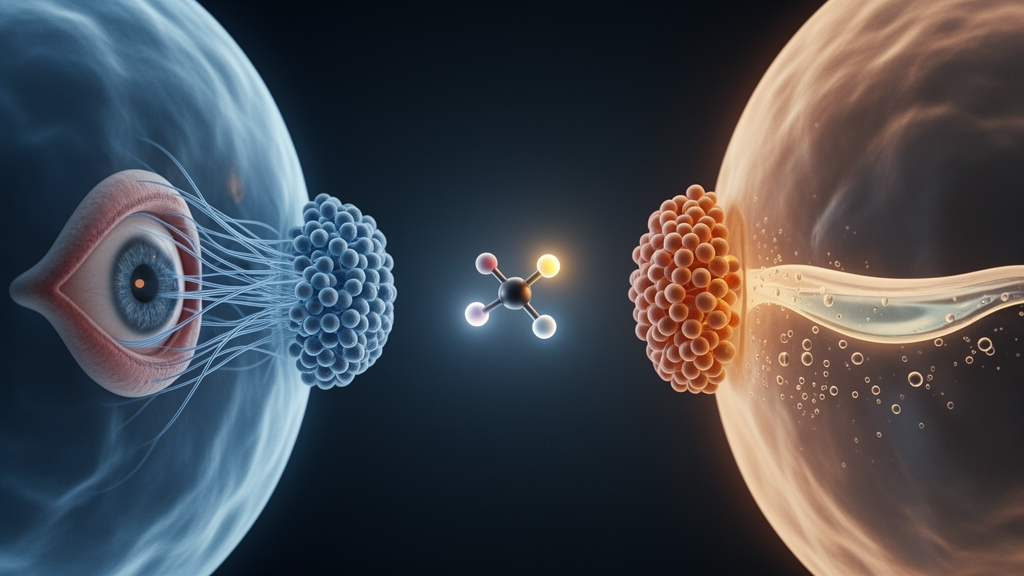
Atropine has long been the go-to drug for slowing childhood myopia, yet some children using it develop dry, irritated eyes. A new computational study now offers the most detailed map yet of why the same eye drop might act on two very different parts of the eye at once. By combining network pharmacology, molecular docking and molecular dynamics simulations, researchers identified two distinct layers of molecular targets: one shared between myopia and dry eye disease, and another that appears specific to myopia control.
The study, published in Eye and Vision, compiled candidate targets for atropine from four public databases and disease-associated genes for myopia and dry eye disease from four additional resources. After cross-referencing these lists, the team identified 57 targets shared by atropine, myopia and dry eye disease, which they designated Class I common targets. They also found 19 targets that overlap between atropine and myopia but not with dry eye disease, labelled Class II myopia-prioritised targets.
Class I targets converged on inflammatory and extracellular-matrix-remodelling pathways. Gene Ontology and KEGG enrichment analyses showed these genes are significantly enriched for biological processes related to inflammatory and immune responses, apoptotic signalling, vascular and extracellular matrix remodelling, and regulation of cell proliferation and differentiation. KEGG pathway analysis highlighted over-representation of PI3K-Akt, MAPK, TNF, IL-17, TGF-β and apoptosis-related pathways, as well as FoxO, HIF-1 and osteoclast-differentiation signalling. This pattern suggests a connected network linking inflammatory cytokine cues with survival, angiogenic and tissue-remodelling cascades.
To prioritise these targets biologically, the researchers integrated retinal and pan-ocular expression data. Using Human Protein Atlas and Genotype-Tissue Expression consensus RNA-sequencing values, they scored retinal expression for each gene, and used the Eye in a Disk resource to assess expression across conjunctiva, cornea, retina and retinal pigment epithelium. Combining these expression scores with protein-protein interaction support from the STRING database yielded composite evidence scores. Tier 1 Class I targets included FOS, CTNNB1, JUN, MAPK3, AKT1, EGFR, HSP90AA1, MAPK1, TP53 and CASP3, with MMP2, IL6, TGFB1 and MMP9 in Tier 2.
Class II targets told a different story. Enrichment analysis of a GeneMANIA-expanded network built from the 19 myopia-prioritised genes revealed over-represented terms related to synaptic signalling and ion-channel function, calcium and cAMP signalling, PI3K-Akt signalling, regulation of the actin cytoskeleton and axon guidance, as well as dopaminergic and glutamatergic synapse and neurotrophin signalling pathways. This neuronal signalling layer is preferentially associated with myopia-specific targets rather than with dry eye biology, pointing to retinal neurotransmission and downstream retinal-to-scleral signalling as central to ocular growth regulation.
Retinal single-cell RNA-sequencing data from a public adult human retinal atlas placed these targets in a cellular context. Class I Tier 1 targets such as FOS, CTNNB1, JUN, MAPK3, AKT1, EGFR and HSP90AA1 were broadly detected across neuronal populations, with particularly high scaled expression and cell-level prevalence in bipolar, amacrine and Müller glial cells. Class II Tier 1 targets including AKR1B1, BAZ2A, CDC42, DUT, OAT and PIK3R1 were enriched in multiple interneuron classes and Müller glia, whereas lower-tier ion-channel and neurotransmission-related targets such as KCNQ2, DRD2 and GRIN2B showed more selective expression in photoreceptors, bipolar cells and microglia.
Molecular docking then tested whether atropine could physically bind to the highest-priority targets. Among Class I Tier 1 proteins, MAPK3, HSP90AA1, AKT1, EGFR, MAPK1 and CASP3 all showed favourable predicted binding, with AutoDock Vina scores ranging from −7.1 to −8.1 kcal/mol. For Class II Tier 1 targets, atropine exhibited similarly favourable docking scores towards PIK3R1, AKR1B1, BAZ2A and OAT, ranging from −8.4 to −6.6 kcal/mol, while DUT showed a weaker predicted interaction at −5.6 kcal/mol. In the best-scoring complexes, atropine formed hydrogen bonds with key active-site residues, including ASP184 in MAPK3, THR152 in AKT1, ASP167 and LYS54 in MAPK1, GLU849 in PIK3R1, ASN51 in AKR1B1 and HIS237 in OAT.
Molecular dynamics simulations of 200 nanoseconds were then run for eight atropine-bound complexes: MAPK3, HSP90AA1, AKT1, EGFR, MAPK1, CASP3, PIK3R1 and AKR1B1. Each atropine-bound system was compared with the corresponding co-crystallised ligand-bound reference state. The atropine-bound trajectories reached stable plateaus during the early phase of the simulations and subsequently remained within relatively restricted fluctuation ranges, indicating that all eight binding pockets accommodated atropine without overt structural destabilisation. MM/PBSA binding free energy estimates identified AKT1 (ΔGbind = −29.68 ± 4.34 kcal/mol), AKR1B1 (−26.42 ± 4.70 kcal/mol) and MAPK1 (−23.46 ± 4.96 kcal/mol) as the most energetically favourable complexes, followed by PIK3R1 and EGFR.
The authors caution that these findings are hypothesis-generating rather than proof of causation. Clinical evidence does not support the simple conclusion that low-dose atropine uniformly induces dry eye disease; prospective data with 0.01% atropine did not show sustained deterioration in tear quantity or stability over several months of use. More recent work suggests that short-term topical atropine can transiently reduce tear meniscus height and increase dry-eye-related symptoms, with more noticeable but reversible effects at higher concentrations such as 0.05%. The shared Class I network may represent a biological interface at which pathways relevant to scleral remodelling, inflammatory signalling, epithelial repair and ocular surface stress partially intersect, rather than a direct causal pathway from atropine to dry eye.
The study also had limitations. The researchers lacked matched transcriptomic information for some highly relevant tissues such as the sclera, meibomian gland and lacrimal gland. The literature-supported plausibility of pathways such as MAPK, PI3K-Akt, TGF-β, MMP and EGFR in ocular biology does not prove atropine-dependent regulation of those pathways in vivo. The docking and molecular dynamics workflow does not replace the need for biochemical binding assays, perturbation experiments or pharmacokinetic confirmation of target accessibility. Nevertheless, the two-layered framework offers a biologically contextualised prioritisation of candidate atropine-associated targets and pathways, generating testable hypotheses about the dual ocular effects of atropine and informing future mechanistic and translational studies.
Subject of Research: Computational mapping of atropine's shared and myopia-specific molecular targets in myopia and dry eye disease
Article Title: Network pharmacology and molecular dynamics simulations reveal shared mechanisms and myopia-specific targets of atropine in myopia and dry eye disease
Article References: Lin, M., Shu, W., Hua, G., Duan, Z., Qu, J., & Hu, L. (2026). Network pharmacology and molecular dynamics simulations reveal shared mechanisms and myopia-specific targets of atropine in myopia and dry eye disease. Eye and Vision, 13(1), Article 27. https://doi.org/10.1186/s40662-026-00493-1
Image Credits: AI Generated
DOI: 10.1186/s40662-026-00493-1
Keywords: atropine, myopia, dry eye disease, network pharmacology, molecular docking, molecular dynamics, Class I targets, Class II targets, retinal expression, PI3K-Akt signalling, MAPK pathway, in silico
Cite Scienmag News
Ophelia Keating. (October 30, 2026). Computational Map Splits Atropine’s Myopia Targets From Dry Eye Pathways. Scienmag. https://scienmag.com/computational-map-splits-atropines-myopia-targets-from-dry-eye-pathways/
Ophelia Keating. "Computational Map Splits Atropine’s Myopia Targets From Dry Eye Pathways." Scienmag, 30 October 2026, https://scienmag.com/computational-map-splits-atropines-myopia-targets-from-dry-eye-pathways/. Accessed 31 October 2026.
Ophelia Keating. "Computational Map Splits Atropine’s Myopia Targets From Dry Eye Pathways." Scienmag. October 30, 2026. https://scienmag.com/computational-map-splits-atropines-myopia-targets-from-dry-eye-pathways/