


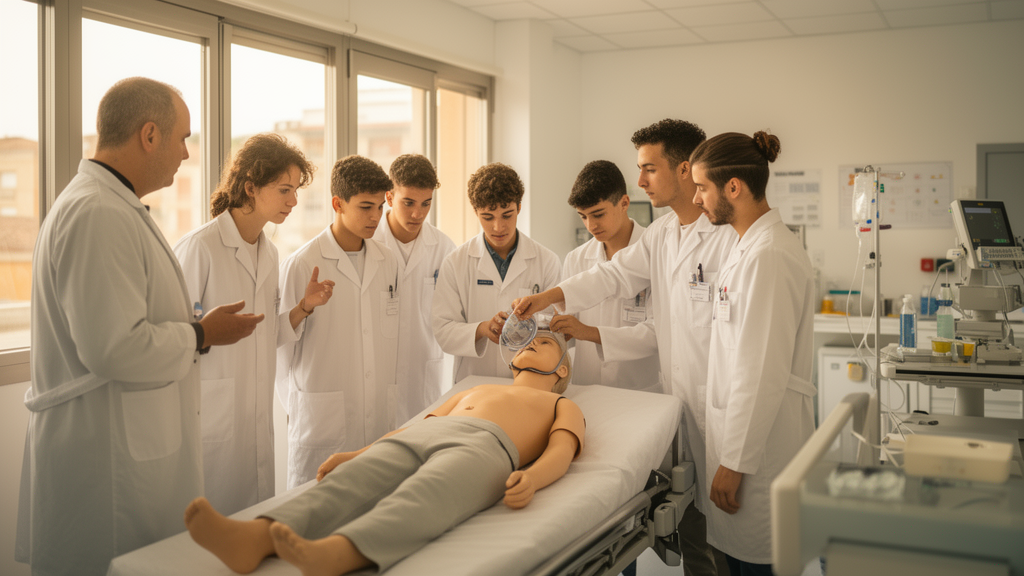
A competitive, league-style clinical simulation tournament in Catalonia has been linked with high perceived educational value among the nurses, medical residents, and attending physicians who took part, according to a post-intervention observational evaluation published in Frontiers in Medicine. The initiative, known as the Lliga Catalana de Simulació, pitted real multidisciplinary teams from different centers against one another in progressive clinical challenges, and participants reported strong satisfaction and a high perception of learning afterward. The study was designed as a cross-sectional evaluation carried out within a structured educational intervention.
Rather than testing whether the competition improved objective clinical performance, the researchers set out to characterize how participants perceived the educational experience and to examine whether those perceptions, along with negative stress, differed by professional category or level of clinical experience. This distinction matters: the findings describe self-reported perceptions collected after the intervention, not measured gains in patient outcomes or technical competence. Each scenario in the league followed a deliberate instructional sequence.
Teams received a briefing, faced a simulated clinical case, and then took part in a structured, reflective debriefing guided by expert pairs. The competitive framing was therefore embedded within a design that also emphasized psychological safety, a factor the authors identify as central to making rivalry educationally productive rather than threatening. To measure perceptions, the team used the High-Fidelity Simulation Satisfaction Scale, known as the ESSAF.
The scale captures several dimensions, including the practical utility of the experience, clinical evaluation, communication, teamwork, and stress-related negative aspects. Participants rated their agreement with items across these domains after their participation, allowing the researchers to map where the perceived value was concentrated. The results showed a consistent pattern.
The highest scores clustered around the practical utility of the experience and the development of communication and teamwork skills, precisely the non-technical competencies that interprofessional training strategies aim to strengthen. Participants also reported excellent overall satisfaction with the activity and a high perception of learning, indicating that the gamified format did not come at the expense of perceived substance. Equally notable was the homogeneity of the results.
The analysis found no statistically significant differences in perceived educational outcomes between professional profiles, meaning nurses, residents, and attending physicians rated the experience similarly. There was also no correlation with years of clinical experience, suggesting that the perceived value of the competitive format was not confined to trainees or to novices but extended across the seniority spectrum within these multidisciplinary teams. Items related to stress and negative aspects received the lowest ratings on the scale.
In this evaluation, participants did not report elevated negative stress, which the authors interpret as consistent with the protective role of the structured debriefing and the psychological safety built into the design. The authors conclude that the Lliga Catalana de Simulació was associated with high perceived educational value and satisfaction across professional groups. They frame the findings as descriptive of post-intervention perceptions, while suggesting that a competitive format, when embedded within a structured instructional design and supported by psychological safety and debriefing, can be perceived as a motivating and educationally valuable experience.
Because the study is cross-sectional and perception-based, it cannot establish causal effects on learning or performance, and the authors note that evidence on competitive and gamified environments for natural multidisciplinary teams still requires further development. Even with those limits, the work addresses a real gap. Traditional clinical simulation is widely established, but the educational value of competitive formats for intact, real-world teams, rather than ad hoc groups assembled for a training day, has been less well documented.
By recruiting nursing staff, medical residents, and attending physicians from various centers and keeping them in their natural multidisciplinary configurations, the league offers a model that mirrors how such teams actually function in clinical practice. For educators weighing whether competition belongs in the simulation suite, the Catalan experience offers a cautious, perception-level endorsement: rivalry appears to have been experienced as motivating rather than stressful, and the skills participants valued most were the communicative and team-based ones that interprofessional education seeks to cultivate. Whether those perceptions translate into durable learning gains or improved patient care remains a question for future studies with objective outcome measures.
Subject of Research: Perceived educational value of competitive multidisciplinary clinical simulation in the Lliga Catalana de Simulació
Article Title: Lliga Catalana de Simulació: a post-intervention evaluation of perceived educational value following competitive clinical simulation in multidisciplinary teams
Article References: Mohamed Mimun, M., Jovell-Fernández, E., Gironès García, X., Camps-Gómez, A., & Cañadell Yetano, E. (2026). Lliga Catalana de Simulació: a post-intervention evaluation of perceived educational value following competitive clinical simulation in multidisciplinary teams. Frontiers in Medicine, 13, Article 1945401. https://doi.org/10.3389/fmed.2026.1945401
Image Credits: AI Generated
DOI: 10.3389/fmed.2026.1945401
Keywords: clinical simulation, competitive simulation, medical education, multidisciplinary teams, nursing education, debriefing, psychological safety, ESSAF, cross-sectional study, interprofessional training, gamification, Catalonia
Cite Scienmag News
Ophelia Keating. (October 27, 2026). Competitive Clinical Simulation Scores High on Perceived Educational Value in Catalan League Study. Scienmag. https://scienmag.com/competitive-clinical-simulation-scores-high-on-perceived-educational-value-in-catalan-league-study/
Ophelia Keating. "Competitive Clinical Simulation Scores High on Perceived Educational Value in Catalan League Study." Scienmag, 27 October 2026, https://scienmag.com/competitive-clinical-simulation-scores-high-on-perceived-educational-value-in-catalan-league-study/. Accessed 27 October 2026.
Ophelia Keating. "Competitive Clinical Simulation Scores High on Perceived Educational Value in Catalan League Study." Scienmag. October 27, 2026. https://scienmag.com/competitive-clinical-simulation-scores-high-on-perceived-educational-value-in-catalan-league-study/


