


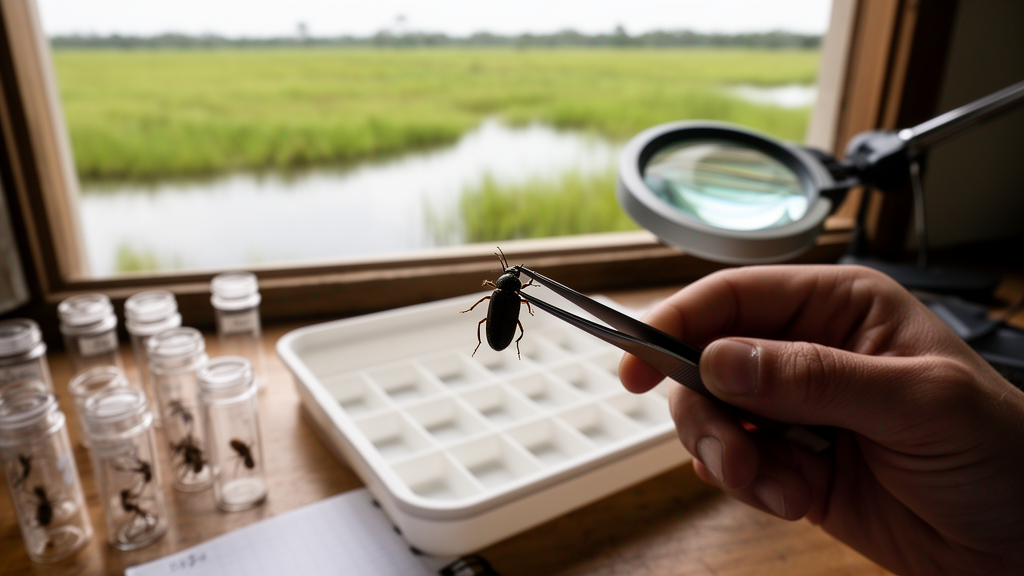
A comprehensive taxonomic revision of the giant water beetle genus Hydrobiomorpha in Argentina has revealed a species new to science, hidden among museum collections and fresh field catches from the country’s celebrated Iberá wetlands. The study, published in the journal ZooKeys, raises the number of Hydrobiomorpha species recorded in Argentina from six to seven and delivers the first updated identification key for the country’s members of the genus in nearly four decades.
The newly described beetle, named Hydrobiomorpha bachmanni, was collected in Corrientes Province within Parque Nacional Iberá, at the Portal Laguna Iberá site, at an elevation of 67 meters. The holotype, a male, was taken on 8 November 2019, and ten male and ten female paratypes followed from the same locality on 14 November 2019. Additional specimens from Paraguay’s Presidente Hayes Department, caught in light traps in December 2002, extend the species’ known range beyond Argentina. The species is dedicated to the late Dr. Axel O. Bachmann (1927–2017), whose descriptions and revisions of Argentine Hydrophilidae laid the taxonomic foundations that this new work builds upon.
Hydrobiomorpha beetles are medium to large aquatic insects, ranging from 13.7 to 28.0 millimeters in body length, with most species falling between 17.0 and 22.0 millimeters. They belong to the family Hydrophilidae and the subtribe Hydrophilina, whose monophyly is supported by a distinctive laterally compressed median lobe of the aedeagus and strongly prolonged lateral margins of the basal piece. The genus is predominantly tropical, spanning the Neotropical, Afrotropical, and Indo-Australian regions and reaching into the southernmost Nearctic. Worldwide, it currently comprises 61 valid species, 56 of them extant and five fossil, along with 15 subspecies. Thirty-one species are recorded for South America.
Adults and larvae of these beetles inhabit vegetated permanent ponds, where adults act mostly as scavengers or periphyton eaters while the larvae are predaceous. Adults swim well, occasionally fly at night, and are frequently drawn to artificial lights, which is how many of the specimens in this study were captured. Aquatic Hydrophilidae are increasingly recognized as valuable bioindicators of aquatic diversity and environmental quality, yet the alpha taxonomy of many groups remains obscure, a gap that limits ecological and conservation work.
To document the Argentine fauna, the researchers examined material deposited in the Museo Argentino de Ciencias Naturales Bernardino Rivadavia (MACN) and the Laboratory of Entomology at the University of Buenos Aires (LEBA). They combined high-resolution digital photography with scanning electron microscopy to capture diagnostic anatomical features in unprecedented detail. Habitus images were shot with a Nikon D800e and macro lens systems, using focal stacks merged with Helicon Focus software. For SEM, selected structures—the head, pronotum, elytron, and the setigerous furrow on the inner face of the male mesotibia—were cleaned, sonicated, dehydrated in a graded ethanol series, mounted on stubs, sputter-coated with gold-palladium, and imaged with a Zeiss GeminiSEM 360 at the MACN.
A notable methodological choice reflects modern curatorial ethics: rather than dissecting the holotype of the new species, the team examined male genitalia from paratype specimens, first verifying that the relevant characters were constant between the holotype and the paratypes. This preserved the integrity of the primary type specimen while still allowing full anatomical documentation. Dorsal, lateral, and ventral habitus photographs of all treated species have been made openly available on Zenodo, and locality coordinates estimated with Google Earth are flagged in square brackets to distinguish estimates from precise collection sites.
The diagnosis of H. bachmanni rests on a unique combination of characters. Males measure 15.5 to 19.0 millimeters long and females 16.5 to 20.5 millimeters. The male bears a setigerous furrow on the mesotibia extending along roughly one-third of the tibial length, armed with a dense brush of reddish setae, and both sexes show a glabrous area on the fifth abdominal ventrite occupying about two-fifths of its length, though the patch is narrower in females. The male genitalia are particularly distinctive: the median lobe’s apex is deeply bifurcate into two long, narrow, subparallel projections, and the parameres carry acute, strongly sclerotized apices curved toward the midline. The closest resemblance is to H. utiariti, a species originally described from Brazil and Paraguay and included in the revision precisely because of this similarity; however, H. utiariti is larger, darker, has a longer mesotibial furrow of about half the tibial length, a larger glabrous area, and a median lobe with two shorter, slightly divergent projections plus denticulate parameres.
The revision also sharpens the distinctions among the six previously known Argentine species. Hydrobiomorpha spinosa, the most widely distributed American species of the genus, ranges across northern and central Argentina and into Brazil, Paraguay, and Uruguay; males possess a very long mesotibial furrow covering one-half to two-thirds of the tibia, while the glabrous ventrite patch is minute or absent. Hydrobiomorpha rudesculpta stands out as the most anatomically distinctive Argentine species, with a subglobose body, a strongly oblique prosternal keel bearing a very long posterior spine, and an enormous spatulate proximal tooth on the male’s anterior protarsal claw. Hydrobiomorpha iguazu, known only from Misiones Province, is the largest Argentine species at 21.0 to 22.6 millimeters, with a very large glabrous area covering about three-quarters of the male’s fifth ventrite. Hydrobiomorpha longa is the smallest and narrowest species at 14.0 to 16.6 millimeters, and H. corumbaensis, originally described as a subspecies of H. longa, differs in its blunt metaventral keel and rounded rather than angular preapical expansion on the male’s posterior metatarsal claw.
Distribution patterns among the Argentine species vary markedly. Species richness is highest in northeastern Argentina, with all seven species collectively recorded from Entre Ríos, Corrientes, and Misiones provinces. The authors attribute this pattern in part to the absence of major biogeographic barriers and the presence of fluvial corridors along the Paraná, Uruguay, and Paraguay rivers, which likely facilitate dispersal in this southern transition of the Paranaense Province. They caution, however, that northeastern Argentina is also the best-sampled region for aquatic Coleoptera in the country, so the observed richness may partly reflect sampling bias rather than a purely biogeographic signal. The apparent restriction of H. iguazu to Misiones may likewise reflect limited sampling in the Paranaense Forest of Paraguay and southern Brazil, compounded by extensive habitat fragmentation and loss in that region.
The authors identify the male mesotibial setigerous furrow, the glabrous area of the fifth abdominal ventrite, claw anatomy, and male genitalia as the most informative characters for species recognition. The furrow shows consistent interspecific variation in length and position and appears stable within species, though some variability was observed in H. spinosa. Notably, despite its diagnostic value, this character was recognized by Bachmann in 1988 but never illustrated and has not been incorporated into subsequent regional revisions of the genus in Australia, Central America, the Afrotropical region, or India. No single character proved sufficient on its own, underscoring the importance of combining external anatomy with genitalia in species identification.
Ecological knowledge of the genus remains fragmentary worldwide. Available records indicate that most species inhabit vegetated permanent ponds with muddy substrates, though H. longa has also been collected from a stream with floating vegetation—the only lotic habitat record for the genus in Argentina. H. irina irina shows considerable habitat breadth, having been taken from small, sun-exposed temporary ponds less than 20 centimeters deep to larger permanent water bodies up to two meters deep, with water ranging from semi-transparent to highly turbid. The biology of H. bachmanni, H. rudesculpta, and H. utiariti remains unknown, a gap the authors flag as a priority for targeted field studies on habitat preferences, seasonal activity, and larval ecology.
Several limitations temper the revision’s conclusions. Phylogenetic relationships among the Argentine species and their placement within the broader Neotropical fauna remain unresolved, and molecular phylogenetic analyses would be needed to test species-group monophyly and reconstruct the genus’s evolutionary history in South America. The immature stages of most Argentine species are unknown; only H. spinosa has had its egg-case, all larval instars, and pupa described in detail, and future rearing or molecular association techniques will be required to link larvae to adults of other species. The taxonomic status of some South American species described from single localities or limited material also merits re-examination with modern approaches.
Even so, the study demonstrates that undocumented diversity persists in Neotropical groups considered relatively well known, and that high-resolution digital imaging and SEM can document subtle anatomical variation—such as that of the prosternal and metaventral keels, the mesotibial furrow, and male genitalia—in ways traditional line drawings could not. The authors suggest that systematic sampling across Argentina’s under-collected ecoregions, particularly the Dry Chaco, Yungas, and Patagonian steppe, would likely yield new records and potentially reveal additional undescribed species of these inconspicuous but ecologically significant freshwater beetles.
Subject of Research: Taxonomic revision of the water beetle genus Hydrobiomorpha in Argentina with description of a new species
Article Title: Revision of the genus Hydrobiomorpha Blackburn, 1888 ( Coleoptera , Hydrophilidae ) from Argentina, with the description of a new species and an updated identification key
Article References: Urcola, M. R., Rodriguez, G., Michat, M. C., & Torres, P. L. M. (2026). Revision of the genus Hydrobiomorpha Blackburn, 1888 (Coleoptera, Hydrophilidae) from Argentina, with the description of a new species and an updated identification key. ZooKeys, 1289, 109-139. https://doi.org/10.3897/zookeys.1289.202453
Image Credits: AI Generated
DOI: 10.3897/zookeys.1289.202453
Keywords: Hydrobiomorpha, Hydrophilidae, water beetles, taxonomy, new species, Argentina, Iberá, Entomology, Neotropical, scanning electron microscopy, freshwater biodiversity, Axel Bachmann
Cite Scienmag News
Gavin Prescott. (October 27, 2026). New water beetle species uncovered in Argentina’s Iberá wetlands in first genus revision in decades. Scienmag. https://scienmag.com/new-water-beetle-species-uncovered-in-argentinas-ibera-wetlands-in-first-genus-revision-in-decades/
Gavin Prescott. "New water beetle species uncovered in Argentina’s Iberá wetlands in first genus revision in decades." Scienmag, 27 October 2026, https://scienmag.com/new-water-beetle-species-uncovered-in-argentinas-ibera-wetlands-in-first-genus-revision-in-decades/. Accessed 27 October 2026.
Gavin Prescott. "New water beetle species uncovered in Argentina’s Iberá wetlands in first genus revision in decades." Scienmag. October 27, 2026. https://scienmag.com/new-water-beetle-species-uncovered-in-argentinas-ibera-wetlands-in-first-genus-revision-in-decades/


