


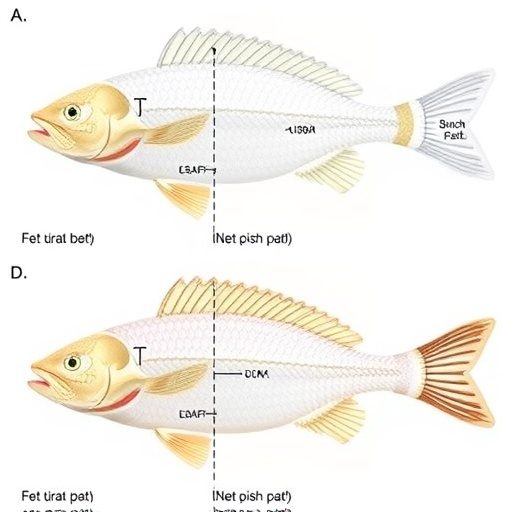
In the dynamic field of aquaculture genetics, a groundbreaking study has emerged, spearheaded by researchers Kaikun Luo and Zhongyuan Shen at Hunan Normal University’s Engineering Research Center of Polyploid Fish Reproduction and Breeding. Their work centers on a significant challenge within fish farming and processing industries: the presence of intermuscular bones (IBs) in teleost fishes. These bony structures, embedded within the muscle septa, have long been a deterrent for consumers who prefer fish with softer, less bony textures. Moreover, excessive IBs complicate industrial processing, limiting the efficiency and quality of products ranging from fish fillets to traditional fish balls.
This pioneering research innovatively employs distant hybridization as a method to create new fish lineages that inherently possess fewer IBs. The study’s experimental subjects included two parent species—Megalobrama amblycephala (BSB) and Culter alburnus (TC)—and resulting hybrids, notably their F1 offspring (BTF1) and a subsequent backcrossed hybrid (BTB). By dissecting the morphological and genetic impacts of these hybridizations, the team revealed compelling reductions in IB incidence, particularly emphasizing the BTB hybrid’s inheriting of reduced intermuscular bones from its female progenitor BSB.
A detailed anatomical and molecular analysis underpinned these findings, with IBs classified into seven distinct morphological types: ‘I’, ‘卜’, ‘Y’, one-end-multi-fork, two-end-bi-fork, two-end-multi-fork, and tree-branch configurations. This granular classification allowed for a nuanced understanding of the complexity embedded within the fish skeletal landscape. It was further observed that epineural bones—those located closer to the fish’s neural spine—exhibited far greater morphological complexity than epipleural bones near the ribs, especially concentrated toward the anterior region of the specimens studied.
The distribution and complexity gradient of IBs across different body segments carry profound implications beyond just consumer preference; they are pivotal for evolutionary biology. The anterior sections, where complexity peaked, may represent evolutionary niches or zones signaling adaptive divergence in skeletal architecture. From a breeding perspective, these regional variations in IB morphology provide measurable phenotypic markers that can be targeted to enhance aquacultural breeding programs.
Through genetic analyses, the team substantiated that the backcross hybrid BTB retains the beneficial trait of reduced IB count, a trait traditionally associated with the female parent line. Intriguingly, BTB fish also displayed a novel reduction in the number of IBs per sarcomere unit—sarcomeres being the fundamental contractile units of muscle fibers. This suggests an intermuscular skeletal evolution that is potentially interconnected with muscle physiology, an insight that opens new avenues for interdisciplinary research spanning genetics, biomechanics, and aquaculture.
This hybridization approach, as demonstrated by Luo and Shen, signals a paradigm shift in fish breeding. Employing distant hybridization not only amalgamates desirable traits from genetically distinct species but also broadens the genetic diversity pool. Such genetic enlargements are critical for fostering new germplasm resources, which are essential for sustainable aquaculture and for meeting rising global fish consumption demands.
Specifically, the research highlights the potential to engineer fish strains that meet both consumer and processing industry needs—offering species that are easier to fillet, possess fewer small bones, and still maintain desirable muscle qualities. This dual benefit is especially relevant for the production of value-added products such as fish balls, which require minimal bone residue to satisfy texture and safety standards.
Technical methodologies in the study incorporated histological imaging coupled with morphometric analyses, providing unparalleled insights into the minutiae of skeletal arrangements within fish musculature. This approach enabled the researchers to draw robust, statistically significant correlations between hybridization patterns and phenotypic variations in IB architecture.
Furthermore, the study contributes significantly to the molecular biological understanding of hybrid fish lineages. By elucidating the genetic underpinnings that explain these phenotypic shifts, Luo and Shen’s work helps decode the complex gene-environment interactions responsible for skeletal development. This molecular framework will be invaluable for future marker-assisted selection or gene editing strategies aiming at skeletal trait refinement.
An evolutionary biology perspective is also enriched by these findings. The observed morphological variations and reductions in IB number across hybrids highlight how hybridization can lead to phenotypic novelty, which may translate into adaptive advantages or niche diversification in natural populations. This work therefore bridges applied aquaculture breeding with fundamental evolutionary developmental biology.
In summary, this transformative research demonstrates that strategic distant hybridization can serve as a powerful tool to shape fish skeletal traits in ways that enhance both marketability and production efficiency. Driven by meticulous morphological categorizations and supported by molecular genetic evidence, the creation of new, low-IB fish hybrids is poised to meet consumer desires while pushing the boundaries of aquacultural genetic innovation.
This scientific advance not only addresses long-standing challenges in fish processing but also unlocks a deeper biological dialogue on skeletal development, hybrid vigor, and trait inheritance. As global demand for fish products continues to surge, sustainable and consumer-friendly breeding solutions like those developed by Luo and Shen will become increasingly pivotal. The research sets a new benchmark for integrating genetic, morphological, and industrial considerations into a cohesive breeding strategy.
Web References: DOI Link
Cite Scienmag News
Juliet Wilcox. (April 8, 2026). Comparative Study of Intermuscular Bones in Hybrid Fish (BTB) and Their Parent Species. Scienmag. https://scienmag.com/comparative-study-of-intermuscular-bones-in-hybrid-fish-btb-and-their-parent-species/
Juliet Wilcox. "Comparative Study of Intermuscular Bones in Hybrid Fish (BTB) and Their Parent Species." Scienmag, 8 April 2026, https://scienmag.com/comparative-study-of-intermuscular-bones-in-hybrid-fish-btb-and-their-parent-species/. Accessed 4 September 2026.
Juliet Wilcox. "Comparative Study of Intermuscular Bones in Hybrid Fish (BTB) and Their Parent Species." Scienmag. April 8, 2026. https://scienmag.com/comparative-study-of-intermuscular-bones-in-hybrid-fish-btb-and-their-parent-species/


