


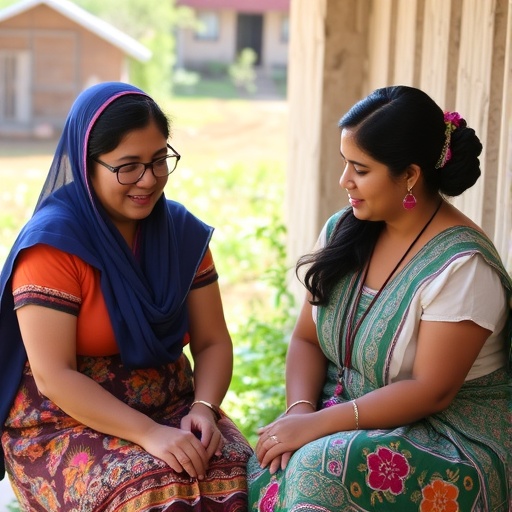
In a groundbreaking pilot study conducted in 2022, researchers at the University of California, Riverside have unveiled promising evidence supporting the effectiveness of a culturally adapted health and lifestyle intervention tailored for low-income Latina and Indigenous Mexican women residing in rural Inland Southern California. This study, published in the esteemed journal Public Health Nutrition, illuminates the critical role of culturally relevant programming in advancing health behaviors in underserved agricultural communities that are often overlooked in mainstream research and healthcare initiatives.
The intervention, titled ¡Coma, Muévase y Viva! (“Eat, Move, and Live!”), is a 10-week program meticulously designed and delivered by trusted bilingual community health workers, known as promotoras. These promotoras serve as vital connectors between health knowledge and marginalized communities, facilitating education on nutrition, healthy cooking, physical activity, and personalized goal setting. The pilot randomized controlled trial included 35 predominantly Latina, foreign-born mothers living in rural farm-working regions, specifically targeting linguistic, cultural, and structural barriers that have historically impeded health promotion efforts in these populations.
The study’s design emphasized cultural grounding and accessibility. The curriculum was adapted to accommodate lower health literacy, diverse language preferences including Indigenous Mexican dialects, and incorporated cultural norms and values inherent to the communities. This thoughtful adaptation ensured not only the relevance of the health messaging but also enhanced the feasibility of engaging a population that frequently experiences food insecurity and limited access to preventive healthcare resources.
Analyses from the randomized controlled trial indicate that participants enrolled in the intervention group exhibited a significant increase in engagement with healthier dietary practices and physical activity routines compared to the control group placed on a waitlist. Specifically, women in the intervention were more than twice as likely to adopt behaviors such as cooking nutritious meals and incorporating regular exercise into their lifestyles. Importantly, these changes were tied to measurable progress toward individualized health objectives, underscoring the tangible benefits of culturally tailored interventions for chronic disease prevention.
Dr. Ann Cheney, a professor of social medicine, population, and public health at UCR and principal investigator, highlights that such results demonstrate the untapped potential of promotora-led programs in advancing health equity within rural farm-working communities. Despite their essential contributions to the nation’s agricultural workforce, these populations frequently experience disproportionately high rates of chronic illnesses, diabetes-related mortality, and systemic barriers to care—a reality this study thoughtfully confronts by addressing the unique socio-cultural landscape of Inland Southern California.
Premedical student Jacqueline Moreira, who coauthored the paper alongside Cheney, credits the study’s success to its community-based participatory research approach. This framework prioritized shared leadership and continuous collaboration with community members, ensuring that the intervention was not imposed top-down but rather emerged from genuine engagement and trust. Such a model is pivotal for sustainable public health outcomes, as it fosters empowerment and respect, elements often absent in traditional health promotion paradigms.
The promotoras delivering the program provided bilingual instruction spanning nutrition education, innovative food preparation techniques, structured physical activity sessions, and behavioral change methodologies aimed at fostering sustainable lifestyle adjustments. This multifaceted approach acknowledges that knowledge alone does not suffice; practical application and motivational support are essential for meaningful transformation, particularly within populations encumbered by socio-economic adversity.
It is critical to note the geographical and demographic specificity of this intervention. The Eastern Coachella Valley—a region characterized by its agricultural economy and a significant population of Indigenous Mexican and Latino farmworkers—has seen limited access to lifestyle programs that consider the linguistic diversity and cultural richness of its residents. Here, conventional urban-centric health education strategies often fail, making the tailored ¡Coma, Muévase y Viva! program a model for addressing disparities through culturally congruent modalities.
The research underscores systemic health inequities that rural Latino and Indigenous Mexican communities confront, including elevated incidences of diabetes-related complications and food insecurity, exacerbated by sparse healthcare infrastructure. By leveraging the community trust in promotoras and delivering linguistically appropriate, culturally sensitive education, the intervention surmounts conventional barriers that have historically thwarted inclusive health promotion efforts.
This study’s findings hold broader implications for public health practice, advocating a paradigm shift toward inclusivity of traditionally marginalized rural populations through community-engaged, culturally grounded interventions. The success in Inland Southern California suggests that similar frameworks could be replicated or adapted in other under-resourced agricultural regions nationwide, potentially mitigating chronic disease burdens on a larger scale.
Additionally, the funding from the National Institutes of Health National Cancer Institute reflects the growing recognition of lifestyle interventions as crucial components of chronic disease prevention strategies with broader cancer control implications. By addressing diet, physical activity, and behavior change comprehensively and contextually, programs like ¡Coma, Muévase y Viva! contribute to the prevention of multiple interrelated health conditions.
In conclusion, the pilot trial delivers compelling evidence that health promotion efforts grounded in culture, community trust, and accessible education can bring about substantive lifestyle changes among low-income Latina and Indigenous Mexican women in rural desert environments. As public health challenges grow increasingly complex, such innovative, community-centered approaches will be indispensable for achieving health equity and improving outcomes in the most vulnerable populations.
News Publication Date: 1-Jun-2026
Web References:
DOI link to the article
References:
Cheney, A., Moreira, J., Ge, S., Ge, Y., Gonzalez, A., Moran, A., & Guzman Hernandez, M. (2026). The Feasibility of a Dietary and Lifestyle Behaviour Change Intervention among Low-income Latinas and Indigenous Mexicans in Rural Desert Communities: A Pilot Randomized Controlled Trial. Public Health Nutrition. https://doi.org/10.1017/S1368980026102729
Cite Scienmag News
Phoebe Ingram. (June 9, 2026). Community Health Workers Drive Positive Outcomes in Rural Latina Women’s Health Program. Scienmag. https://scienmag.com/community-health-workers-drive-positive-outcomes-in-rural-latina-womens-health-program/
Phoebe Ingram. "Community Health Workers Drive Positive Outcomes in Rural Latina Women’s Health Program." Scienmag, 9 June 2026, https://scienmag.com/community-health-workers-drive-positive-outcomes-in-rural-latina-womens-health-program/. Accessed 4 September 2026.
Phoebe Ingram. "Community Health Workers Drive Positive Outcomes in Rural Latina Women’s Health Program." Scienmag. June 9, 2026. https://scienmag.com/community-health-workers-drive-positive-outcomes-in-rural-latina-womens-health-program/


