


Osaka, Japan – The compound of iron and aluminum with the chemical formula Fe3Al has some very useful mechanical properties. A team from Osaka University has combined simulations with experimental techniques to better understand the kinetics of the formation of microstructures to enhance and utilize these properties and how to harness them for specific applications.
In a study recently published in Acta Materialia, the researchers took an in-depth look at the way the microstructure of Fe3Al develops because the ordered domains that form contribute to one of its key properties: superelasticity.
When high loads are applied to superelastic materials they can deform to large strains which would result in a permanent strain in conventional materials without break. Interestingly, they can return to their original shape when unload. This can be used in a diverse range of applications from healthcare materials seismic devices for construction materials.
Superelasticity results from the way the atoms are arranged in a material. This can differ between materials. In the most well-known superelastic material, i.e. TiNi alloys,which consist of precious and rare metals of titanium and nickel, the change of crystal structures in response to the load (i.e. Martensitic transformation) is responsible for the large plastic deformation and the recovery of the shape. In contrast, In Fe3Al consisting of common metals of iron and aluminum, the superelastic properties are caused not by the change of crystal structure but by dislocation slip, which is the relative displacement of atoms keeping crystal structure. Dislocation slip normally gives rise to permanent strain. However, when there is a force which can gives rise to the back motion of dislocation. In Fe3Al, the back motion of dislocation can be caused by antiphase boundaries (APB) which separates areas within a material known as domains, and the shape and size of the boundaries between these domains contribute to the superelastic properties.
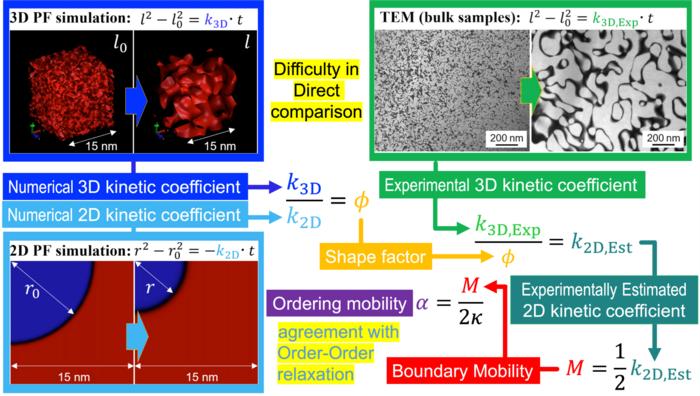
“To harness particular material properties and ensure they are appropriate for their application, you have to understand what is happening,” explains study lead author Yuheng Liu. “Until now, ordering mobility studies of the atoms in Fe3Al have led to different interpretations depending on the experimental technique. We have therefore combined phase-field computer simulations and transmission electron microscopy (TEM) experiments to finally get a good picture.”
The computer simulations predicted the 3D shapes of the areas in the Fe3Al with ordered structure. These findings were then compared with TEM observations for Fe3Al samples heated to different temperatures. The combined data revealed the mobility for forming the ordered D03-type structure.
The D03 structure of Fe3Al is similar to L21 structure of other materials. The findings could therefore provide a starting point for exploring heat treatments for other functional materials, including half metals for spintronics, which may become crucial for quantum computing in the near future.
“It is challenging to design experiments that can capture the movement of boundaries and the details of how the microstructure evolves, particularly in the early stages of ordering,” says senior author Yuichiro Koizumi. “The phase-field simulations provide a window into the process that has been missing from previous studies.”
The study findings are expected to support applications in the construction industry. For example, Fe3Al could be used to 3D print structural parts that can act as shock absorbers for seismic activity.
###
The study, “Resolving the long-standing discrepancy in Fe3Al ordering mobilities: A synergistic experimental and phase-field study,” was published in Acta Materialia at DOI: https://doi.org/10.1016/j.actamat.2024.119958.
About Osaka University
Osaka University was founded in 1931 as one of the seven imperial universities of Japan and is now one of Japan’s leading comprehensive universities with a broad disciplinary spectrum. This strength is coupled with a singular drive for innovation that extends throughout the scientific process, from fundamental research to the creation of applied technology with positive economic impacts. Its commitment to innovation has been recognized in Japan and around the world. Now, Osaka University is leveraging its role as a Designated National University Corporation selected by the Ministry of Education, Culture, Sports, Science and Technology to contribute to innovation for human welfare, sustainable development of society, and social transformation.
Website:

Credit: 2024 Koizumi et al., Resolving the long-standing discrepancy in Fe3Al ordering mobilities: A synergistic experimental and phase-field study. Acta Materialia
Osaka, Japan – The compound of iron and aluminum with the chemical formula Fe3Al has some very useful mechanical properties. A team from Osaka University has combined simulations with experimental techniques to better understand the kinetics of the formation of microstructures to enhance and utilize these properties and how to harness them for specific applications.
In a study recently published in Acta Materialia, the researchers took an in-depth look at the way the microstructure of Fe3Al develops because the ordered domains that form contribute to one of its key properties: superelasticity.
When high loads are applied to superelastic materials they can deform to large strains which would result in a permanent strain in conventional materials without break. Interestingly, they can return to their original shape when unload. This can be used in a diverse range of applications from healthcare materials seismic devices for construction materials.
Superelasticity results from the way the atoms are arranged in a material. This can differ between materials. In the most well-known superelastic material, i.e. TiNi alloys,which consist of precious and rare metals of titanium and nickel, the change of crystal structures in response to the load (i.e. Martensitic transformation) is responsible for the large plastic deformation and the recovery of the shape. In contrast, In Fe3Al consisting of common metals of iron and aluminum, the superelastic properties are caused not by the change of crystal structure but by dislocation slip, which is the relative displacement of atoms keeping crystal structure. Dislocation slip normally gives rise to permanent strain. However, when there is a force which can gives rise to the back motion of dislocation. In Fe3Al, the back motion of dislocation can be caused by antiphase boundaries (APB) which separates areas within a material known as domains, and the shape and size of the boundaries between these domains contribute to the superelastic properties.
“To harness particular material properties and ensure they are appropriate for their application, you have to understand what is happening,” explains study lead author Yuheng Liu. “Until now, ordering mobility studies of the atoms in Fe3Al have led to different interpretations depending on the experimental technique. We have therefore combined phase-field computer simulations and transmission electron microscopy (TEM) experiments to finally get a good picture.”
The computer simulations predicted the 3D shapes of the areas in the Fe3Al with ordered structure. These findings were then compared with TEM observations for Fe3Al samples heated to different temperatures. The combined data revealed the mobility for forming the ordered D03-type structure.
The D03 structure of Fe3Al is similar to L21 structure of other materials. The findings could therefore provide a starting point for exploring heat treatments for other functional materials, including half metals for spintronics, which may become crucial for quantum computing in the near future.
“It is challenging to design experiments that can capture the movement of boundaries and the details of how the microstructure evolves, particularly in the early stages of ordering,” says senior author Yuichiro Koizumi. “The phase-field simulations provide a window into the process that has been missing from previous studies.”
The study findings are expected to support applications in the construction industry. For example, Fe3Al could be used to 3D print structural parts that can act as shock absorbers for seismic activity.
###
The study, “Resolving the long-standing discrepancy in Fe3Al ordering mobilities: A synergistic experimental and phase-field study,” was published in Acta Materialia at DOI: https://doi.org/10.1016/j.actamat.2024.119958.
About Osaka University
Osaka University was founded in 1931 as one of the seven imperial universities of Japan and is now one of Japan’s leading comprehensive universities with a broad disciplinary spectrum. This strength is coupled with a singular drive for innovation that extends throughout the scientific process, from fundamental research to the creation of applied technology with positive economic impacts. Its commitment to innovation has been recognized in Japan and around the world. Now, Osaka University is leveraging its role as a Designated National University Corporation selected by the Ministry of Education, Culture, Sports, Science and Technology to contribute to innovation for human welfare, sustainable development of society, and social transformation.
Website:
Journal
Acta Materialia
Method of Research
Computational simulation/modeling
Subject of Research
Not applicable
Article Title
Resolving the long-standing discrepancy in Fe3Al ordering mobilities: A synergistic experimental and phase-field study
Article Publication Date
25-Apr-2024
Cite Scienmag News
Denise Maddox. (May 30, 2024). Combining simulations and experiments to get the best out of Fe3Al. Scienmag. https://scienmag.com/combining-simulations-and-experiments-to-get-the-best-out-of-fe3al/
Denise Maddox. "Combining simulations and experiments to get the best out of Fe3Al." Scienmag, 30 May 2024, https://scienmag.com/combining-simulations-and-experiments-to-get-the-best-out-of-fe3al/. Accessed 3 September 2026.
Denise Maddox. "Combining simulations and experiments to get the best out of Fe3Al." Scienmag. May 30, 2024. https://scienmag.com/combining-simulations-and-experiments-to-get-the-best-out-of-fe3al/

