


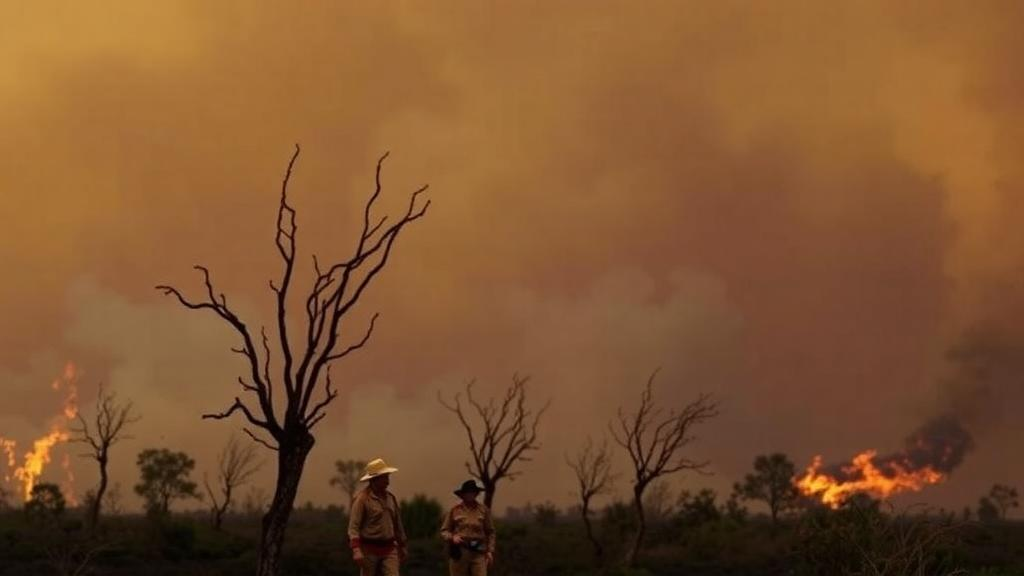
A thousand-year sediment record from southeastern Australia has revealed that the catastrophic wildfires now ravaging the continent’s temperate eucalypt forests are not simply a product of modern climate change. Instead, a study published in Nature shows that the foundations of today’s fire crisis were laid in the nineteenth century, when British colonisation disrupted the sophisticated cultural burning practices of the Indigenous Gunaikurnai people and transformed an open, fire-managed woodland into dense, flammable forest.
An international team led by Michael-Shawn Fletcher of the University of Melbourne, working in partnership with the Gunaikurnai Land and Waters Aboriginal Corporation, reconstructed vegetation and fire history from a wetland site known as Purghagoolah in Gippsland, Victoria. By combining pollen analysis, charcoal records, Fourier-transform infrared spectroscopy of ancient charcoal, and magnetic susceptibility measurements, the researchers pieced together a continuous environmental archive spanning roughly a millennium, from long before the British invasion of 1788 to the present day.
The results are striking. For centuries before colonisation, the Gunaikurnai maintained a stable, open woodland through frequent, fine-grained, low-temperature cultural burning. Charcoal preserved in the sediments shows that fires during this period burned at relatively low temperatures, typically in the range of 200 to 300 degrees Celsius, consistent with the cool, patchy burns that Indigenous fire practitioners use to clear undergrowth, protect habitat, and manage fuel loads without destroying canopy trees.
That regime collapsed after 1788. The study’s change-point analysis, run across thousands of statistical replicates, places the decisive break at around 1867 CE, a period when colonial frontier violence and the documented massacres of Aboriginal people across southeastern Australia drove the Gunaikurnai from their Country. With cultural burning suppressed, fire behaviour changed dramatically: the charcoal record shows a sharp rise in fire temperatures, indicating a shift from cool, controlled burns to hotter, more destructive wildfires.
The ecological consequences cascaded through the landscape. Quantitative reconstruction of land cover using the REVEALS model revealed a fourfold increase in eucalypt cover after colonisation, as open woodland gave way to closed forest. Dense stands of eucalypts, with their oil-rich, highly flammable leaves, created continuous fuel loads that had simply not existed under Indigenous management. The sediment record also shows increased soil erosion, traced through rising magnetic susceptibility, as vegetation loss and hotter fires destabilised catchment soils.
Critically, the researchers demonstrate that these transformations preceded anthropogenic warming. The vegetation shift and the escalation of fire intensity are visible in the record well before the twentieth-century temperature rise, meaning the forests’ vulnerability to wildfire was established by colonial land-use legacies rather than by climate change alone. When modern warming did arrive, it acted on a landscape that had already been made far more flammable than it had been for the previous thousand years.
The team frames this interaction as a reinforcing feedback they call the ‘catastrophic wildfire loop’. High-intensity wildfires kill trees, stimulate dense shrub regeneration, and raise fuel loads, which in turn increase the likelihood and severity of subsequent climate-driven fires. Each megafire therefore pushes the landscape further from the open, resilient state that cultural burning once maintained, locking ecosystems into a trajectory of escalating risk. The 2019 to 2020 Black Summer fires, which exposed unprecedented extents of high-severity burn across southeastern Australian forests, exemplify this dynamic.
The study also carries a pointed methodological message. The researchers compared their palaeoecological reconstruction with Australia’s official vegetation baselines and found that national pre-1750 vegetation maps, which model climate-driven ‘potential natural vegetation’, depict the same dense forest as present-day surveys. In other words, the mapping system treats post-colonial vegetation as the natural reference condition, an assumption the sediment record now shows to be wrong at this site. The pre-colonial landscape was an open woodland, not the closed forest that both datasets record, a finding with implications for how conservation targets and fire policy are set nationwide.
The authors argue that integrating Indigenous knowledge into fire management is essential to restoring resilience and mitigating future wildfire risk. Cultural burning, practised continuously for millennia, produced the fine-grained mosaic of burned and unburned patches that kept fuel loads low and ecosystems productive. Reviving these practices, in partnership with Traditional Owners such as the Gunaikurnai, offers a pathway to break the catastrophic wildfire loop. The research, conducted with the cultural authority and direct involvement of the Gunaikurnai Land and Waters Aboriginal Corporation, who contributed knowledge of their Country and reviewed the manuscript, represents a model of collaborative science that reframes the wildfire crisis not merely as a climate problem, but as a problem of disrupted relationships between people and land.
The analytical toolkit deployed in the study reflects a broader maturation of palaeoecology as a discipline capable of resolving environmental change at decadal rather than centennial scales. Radiocarbon and lead-210 dating anchored the sediment sequence in time, while Bayesian age-depth modelling allowed the researchers to place statistical confidence on the timing of the mid-nineteenth-century transition. The use of Fourier-transform infrared spectroscopy to estimate the temperatures at which ancient charcoal formed is a relatively recent innovation, and it is what enables the reconstruction to distinguish between the cool fires of the cultural burning era and the intense wildfires of the colonial and modern periods. This matters because charcoal abundance alone cannot separate frequent low-intensity burning from rare catastrophic fire; both leave carbon in the record, but the molecular structure of that carbon differs with combustion temperature.
The quantitative land-cover reconstruction also represents a departure from older pollen-based approaches. Traditional pollen percentages can be misleading because different plants produce pollen in vastly different quantities and disperse it over different distances. The REVEALS framework corrects for these biases using estimates of pollen productivity and dispersal, converting raw pollen counts into defensible approximations of past vegetation cover. Applying this method in southeastern Australia, where pollen productivity estimates had to be calibrated against regional vegetation surveys, allowed the team to make the strong claim of a fourfold increase in eucalypt cover rather than a vague statement about ‘more trees’.
The findings resonate with a growing international literature on the ecological consequences of Indigenous dispossession. In northern Australia, the collapse of Aboriginal fire management has been linked to the decline of a Gondwanan conifer, demonstrating that the loss of cultural burning produces measurable biodiversity outcomes, not merely changes in fuel structure. Comparable work in boreal North America has documented how fire exclusion altered forest composition and undermined habitat mosaics that Indigenous communities had maintained for generations. Studies from semi-arid Australian woodlands have shown that fine-grained burn mosaics promote optimal habitat availability for a wide range of species, and that shifting fire regimes are now transforming habitat for threatened species across the continent. Taken together, this body of work suggests that the Gippsland record is not an isolated case but a regional expression of a global pattern in which colonial disruption of Indigenous land management reshaped fire regimes long before industrial-era warming.
The concept of the catastrophic wildfire loop also connects to research on fire suppression in other temperate systems. Work in western North America has shown that a century of aggressive fire exclusion allowed fuel accumulations that made subsequent wildfires more severe and amplified the impacts of climate change. The Australian case adds a distinctive historical dimension: the fuel accumulation in southeastern eucalypt forests was not primarily the product of twentieth-century suppression policy, but of a much earlier rupture in land management. This distinction has practical significance, because it implies that simply reinstating hazard-reduction burning on modern terms may not fully restore historical resilience if the fine-grained, seasonally attuned, culturally embedded character of Indigenous burning is not also recovered.
The eucalypts themselves deserve attention in this context. Their leaves carry volatile oils and their bark and litter characteristics promote both crown fire and spotting, in which embers are carried far ahead of the fire front. These traits evolved over millions of years in a continent where lightning-ignited fire was a recurring presence, but the density at which eucalypts now grow in Gippsland appears to be historically unprecedented. Flammability research at the leaf level has documented how eucalypt traits interact with weather to produce the extreme fire behaviour seen in events such as the Black Summer, and the palaeoecological record now shows that the structural precondition for such behaviour was assembled during the colonial era.
The transparency of the study’s data and code also merits note. All chronological, pollen, charcoal, spectroscopic and magnetic susceptibility data are openly archived in the PANGAEA repository under a Creative Commons licence, and the custom analysis scripts are published through Zenodo, with the underlying vegetation modelling performed using publicly available R packages. Archaeological radiocarbon determinations were drawn from the OCTOPUS database, with precise site coordinates withheld to protect Indigenous Cultural and Intellectual Property and Indigenous Data Sovereignty, a practice that reflects evolving norms in collaborative research with Aboriginal communities.
For land managers and policymakers, the study suggests that the baseline question must be reframed. Rather than asking how to restore forests to a ‘natural’ state defined by current vegetation maps, the more defensible target is the open, culturally maintained woodland documented in the sediment record. Achieving that will require sustained partnership with Traditional Owners, recognition of the historical violence that severed fire knowledge from Country, and a willingness to treat Indigenous fire practice not as a supplementary technique but as the foundation of Australian fire management for most of the past millennium.
Subject of Research: Palaeoecological reconstruction of Indigenous cultural burning and colonial land-use change in southeastern Australian eucalypt forests
Article Title: Australia’s current wildfire crisis linked to colonial land-use change
Article References: Fletcher, M.-S., Romano, A., O’Shea, C., Maezumi, S. Y., Magee, H., Connor, S., Mullett, R., Menéndez, P., Gadd, P. S., Mariani, M., Chevalier, M., Gunaikurnai Land and Waters Aboriginal Corporation, & Mullett, R. (2026). Australia’s current wildfire crisis linked to colonial land-use change. Nature. https://doi.org/10.1038/s41586-026-11097-z
Image Credits: AI Generated
DOI: 10.1038/s41586-026-11097-z
Keywords: wildfire, cultural burning, Indigenous land management, colonisation, palaeoecology, eucalypt forests, Gunaikurnai, fire ecology, vegetation reconstruction, soil erosion, climate change, Australia
Cite Scienmag News
Denise Maddox. (October 7, 2026). Colonial Land-Use Change Set the Stage for Australia’s Wildfire Crisis. Scienmag. https://scienmag.com/colonial-land-use-change-set-the-stage-for-australias-wildfire-crisis/
Denise Maddox. "Colonial Land-Use Change Set the Stage for Australia’s Wildfire Crisis." Scienmag, 7 October 2026, https://scienmag.com/colonial-land-use-change-set-the-stage-for-australias-wildfire-crisis/. Accessed 7 October 2026.
Denise Maddox. "Colonial Land-Use Change Set the Stage for Australia’s Wildfire Crisis." Scienmag. October 7, 2026. https://scienmag.com/colonial-land-use-change-set-the-stage-for-australias-wildfire-crisis/


