


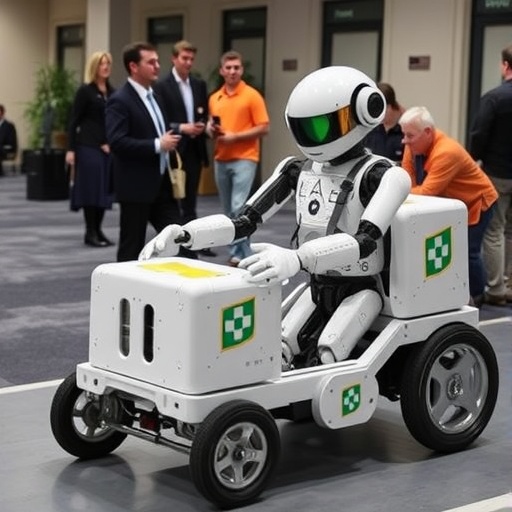
The integration of robotics into human environments continues to transform the landscape of collaboration in various fields, especially in tasks that require physical teamwork between humans and robots. A notable study led by Schuengel, Braunstein, and Goell, which will be published in the journal Autonomous Robots, delves into the biomechanics involved in a human-robot carrying task. This innovative research sheds light on the intricate dynamics of cooperative behavior and paves the way for the next generation of collaborative workspaces designed to enhance human-robot interactions.
In recent years, as automation and robotics have progressed, the concept of humans and robots working side-by-side has become increasingly feasible. The study addresses one of the primary challenges faced in this domain—the alignment of the biomechanical capabilities of robots with those of human counterparts. The researchers scrutinize how robots can be programmed to adjust their movements in tandem with human actions, stimulating a more natural and effective team working environment.
This could mark a significant shift in industries reliant on manual labor, such as logistics and manufacturing, where heavy lifting and transportation tasks are commonplace. By examining biomechanics, the research focuses on understanding how load-sharing in carrying tasks can dynamically evolve based on the participants’ physical capabilities. This adaptability could reduce the physical strain on human workers while maximizing the efficiency of the collective effort.
Another fundamental aspect of the study is the exploration of kinematic variables—how the spatial movement of participants affects the efficiency of carrying tasks. When humans engage in carrying objects, their movement and posture are crucial in determining how effectively the weight can be shared with a robotic partner. Analyzing these variables enables the formulation of guidelines for the design of robotics that can seamlessly communicate and synchronize with their human counterparts.
As robots become more prevalent in the workplace, understanding the biomechanics of human-robot interaction becomes critical. This involves making considerations not just for the physical aspects of the robots but also for how they perceive and respond to human movements. The integration of sensor technologies that can detect a human’s speed, strength, and adapting posture stands out as an essential contribution of this research. By evaluating these sensory inputs, robots can fine-tune their responses, ensuring that they do not hinder human efforts but work consonantly with them.
The potential applications of these findings extend beyond simple labor tasks, venturing into the realms of elder care, surgical assistance, and rehabilitation. In settings where delicate or coordinated assistance is essential, robots that can adapt their movements in real-time to meet human needs promise a higher standard of care and support. The findings from Schuengel et al. offer a pathway for engineers and designers to create robots that are not only capable of performing predefined tasks but are also perceptive entities that engage meaningfully with humans.
Moreover, the implications of this research also raise ethical considerations about the reduction of human labor needs. As robots evolve to take on more sophisticated tasks, the question of workforce displacement becomes pertinent. However, Schuengel and his colleagues emphasize the collaborative aspect, advocating that robots should augment human ability rather than replace it. By enabling more ergonomic and efficient partnerships, the future of human-robot collaboration could lead to smarter and safer work environments.
Schuengel, Braunstein, and Goell have taken an integrative approach by combining insights from robotics, psychology, and biomechanics. The collaborative nature of their research emphasizes that the future of robotics goes beyond technological advancement; it must consider the human experience and the ways we interact with machinery. This holistic view could not only enhance productivity but also foster a work culture where human and robot capabilities are appreciated and maximized together.
Moreover, the research invites further exploration into the design of user-friendly interfaces that allow humans to effectively communicate their intentions to robots. This aspect is crucial for enabling robots to interpret non-verbal cues or even gestures during collaborative tasks. The intention is to make the relationship between human and robot seamless, where each partner is attuned to the other’s actions, thereby minimizing the risk of accidents and increasing the efficiency of carrying out tasks.
A notable takeaway from this study is the recognition that as robots become more integrated into our everyday lives, there must be a strong emphasis on the software that supports their functionality. Advanced algorithms that allow for real-time decision-making and movement coordination highlight the urgent need for research in artificial intelligence, which can enhance the intelligence of robots to understand complex human behaviors and adapt accordingly.
Furthermore, the discourse initiated by this research amplifies the conversation on future directives for engineering education and research. If the goal is to foster a new era of collaborative work, there is a pressing need to incorporate multidisciplinary training that embraces the intersection of robotics, biomechanics, and human factors. Educational institutions must prepare students to think critically about the challenges of human-robot collaboration and equip them with the tools to design innovative solutions.
Ultimately, Schuengel’s team not only contributes to the academic literature on human-robot interaction but also invites industry leaders and policymakers to reflect on how we envision the workforce of the future. Collaborative work environments need to evolve, taking these findings into account to create frameworks that embrace technology positively without sacrificing human value in the labor equation.
As the pace of robotics in the workforce continues to accelerate, understanding the biomechanics behind our interactions with machines will be vital. Future innovations in collaborative robotics will hinge on how effectively we can navigate the complexities of human motion and robotic response. This burgeoning field is set to alter not just efficiency metrics in industries, but also the fundamental dynamics of teamwork in society at large—transforming how we define collaboration in the age of automation.
In conclusion, the research conducted by Schuengel et al. stands at the forefront of advancing our understanding of biomechanics in human-robot interaction. Their insights and findings are pivotal in shaping the framework for future collaborative work environments. This innovative study promises not only technological advancement but also a transformation in the way humans and machines will cooperate in various sectors, ensuring that their cohabitation serves to enhance our capabilities.
Cite Scienmag News
Denise Maddox. (January 20, 2026). Collaborative Carting: Advances in Human-Robot Biomechanics. Scienmag. https://scienmag.com/collaborative-carting-advances-in-human-robot-biomechanics/
Denise Maddox. "Collaborative Carting: Advances in Human-Robot Biomechanics." Scienmag, 20 January 2026, https://scienmag.com/collaborative-carting-advances-in-human-robot-biomechanics/. Accessed 3 September 2026.
Denise Maddox. "Collaborative Carting: Advances in Human-Robot Biomechanics." Scienmag. January 20, 2026. https://scienmag.com/collaborative-carting-advances-in-human-robot-biomechanics/


