


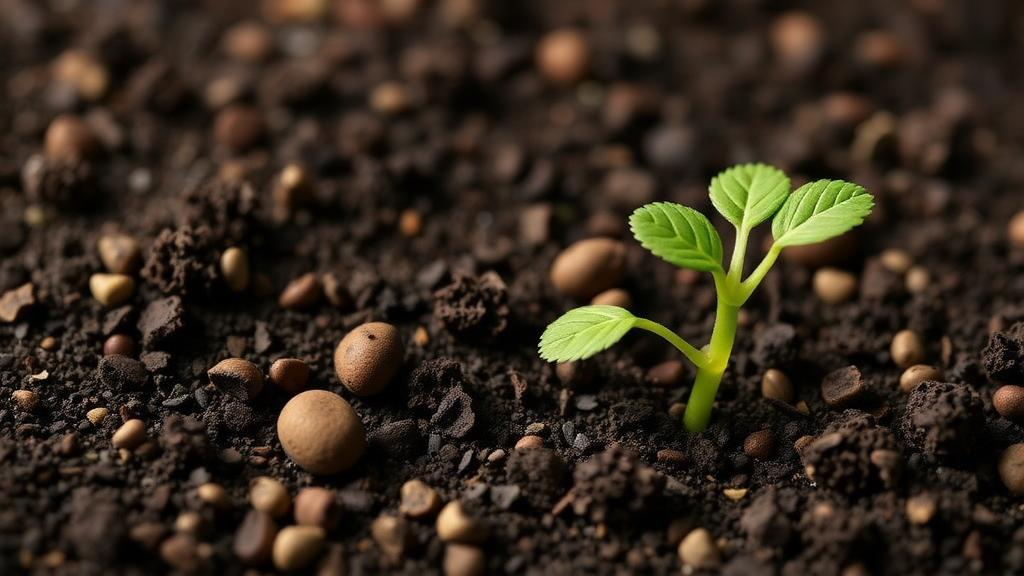
Few tricks in a gardener’s or farmer’s repertoire are as old and as reliable as chilling seeds before planting. The practice, known to plant scientists as stratification, involves holding imbibed seeds at low temperature for a period of time, and it has long been known to coax dormant seeds into sprouting. Yet for decades the molecular choreography behind this seemingly simple treatment has remained obscure. Now a team working at Nanjing Forestry University and Shandong Agricultural University has mapped, in fine biochemical detail, exactly how a stint in the cold dismantles the hormonal locks that keep a seed asleep. Writing in the journal Stress Biology, Yuan Tian, Qin-Lai Liu, Mo-Xian Chen, Ying-Gao Liu and colleagues show that cold treatment does something surprising: rather than simply lowering the level of a dormancy hormone, it physically disconnects two key repressor proteins from the energy machinery that a germinating seed needs to feed itself.
The drama of germination unfolds around a tug-of-war between two plant hormones. Abscisic acid, or ABA, is the guardian of dormancy. It accumulates during seed maturation, keeps the quiescent embryo safe from germinating at the wrong moment, and maintains that arrested state even after the dry seed takes up water. Gibberellins, or GAs, are the antagonists. They promote the weakening of the tissues surrounding the embryo, boost the growth potential of the embryonic axis, and ultimately drive the radicle through the seed coat. The balance between these two hormones determines whether a seed sleeps or wakes, and environmental temperature is one of the most powerful levers on that balance. What the new study reveals is how a specific temperature signal rewires the internal wiring of the hormone network rather than merely tipping the amounts of the hormones themselves.
To dissect the mechanism, the researchers assembled a panel of Arabidopsis thaliana mutants, each defective at a different node of the ABA and GA pathways. Among them were cyp707a2, which cannot degrade ABA and therefore accumulates abnormally high levels of the hormone; sleepy1, which lacks the F-box protein that tags the repressor RGL2 for destruction and so blocks GA signaling downstream; ga3ox1, which cannot synthesize gibberellins in the cold; and rgl2, which lacks the master dormancy repressor altogether. They also built a cyp707a2 sleepy1 double mutant to combine the two defects. Freshly harvested wild-type seeds of Arabidopsis are strongly dormant, and all of these mutants either deepened or altered that dormancy in informative ways, giving the team a genetic toolkit for asking precisely which steps of the pathway cold treatment can and cannot override.
The answer to the first question came quickly: twenty-four hours of stratification at four degrees Celsius completely broke the dormancy of wild-type seeds, and, strikingly, it also rescued the dormant phenotypes of cyp707a2, sleepy1, and the cyp707a2 sleepy1 double mutant. In other words, even seeds flooded with ABA, or unable to destroy the RGL2 repressor, could be roused from dormancy by cold. But stratification failed to rescue ga3ox1, the mutant that cannot make gibberellins. That single asymmetry was the study’s linchpin. It meant that the dormancy-breaking power of cold depends on the seed’s ability to biosynthesize GA. Consistent with this, when the researchers blocked GA biosynthesis pharmacologically with paclobutrazol, stratification lost its effect entirely, and exogenous GA reversed the inhibitor completely. Cold, in essence, works by turning the GA tap back on.
But the deeper story lies in what GA then unlocks. Germination is an energy-intensive undertaking, and a dry seed’s most important fuel reserve is the starch packed into its endosperm. Mobilizing that starch requires alpha-amylase, a starch-digesting enzyme whose activity has long served as a proxy for germination vigor. ABA suppresses alpha-amylase; GA induces it. The team found that stratification dramatically boosted both the transcript abundance and the enzymatic activity of alpha-amylase in freshly harvested wild-type seeds and in mutants carrying elevated endogenous ABA or treated with exogenous ABA. Even in cyp707a2 seeds drowning in ABA, and even in sleepy1 seeds in which RGL2 degradation is blocked, the cold treatment raised AMY1, AMY2, and AMY3 expression and pushed alpha-amylase activity sharply upward, peaking at the radicle emergence stage.
How could cold override a repressor that cannot be degraded? Here the study delivers its most novel insight. Under warm imbibition, ABA stabilizes and amplifies the RGL2-ABI5 module: the DELLA protein RGL2, the dominant germination repressor among Arabidopsis’s five DELLA proteins, cooperates with the ABA-responsive transcription factor ABI5 to form a joint inhibitory complex that clamps down on alpha-amylase genes. The researchers measured a steep, dose-dependent interplay between the hormones: ABA enhanced RGL2 expression while GA suppressed it, and the antagonism extended directly to alpha-amylase activity and AMY gene transcription. Yet stratification substantially suppressed RGL2 expression in wild-type seeds, cutting it by about 66 percent, and it also suppressed ABI5 in wild-type and sleepy1 seeds. Even where ABA levels stayed high and RGL2 and ABI5 transcript levels remained elevated, as in the cyp707a2 double-mutant background, the cold treatment still drove alpha-amylase up.
That observation forced the authors to a conclusion with real conceptual weight: stratification does not simply neutralize the repressors, it uncouples them from their target. The RGL2/ABI5 module can remain transcriptionally active, and ABA can remain abundant, yet the alpha-amylase genes escape their grip. The team’s proposed model describes the cold signal as acting in two coordinated arms. First, low temperature induces GA biosynthetic genes, raising GA content, which relieves the RGL2-mediated repression of alpha-amylase expression. Second, and more importantly, stratification decouples the RGL2/ABI5 checkpoint from its control over alpha-amylase activity, allowing starch hydrolysis and the resulting energy supply to proceed even in the presence of high ABA. Environmental signals, in other words, do not just change hormone levels; they rewire the connectivity of the signaling network itself.
Just as telling is what stratification could not do. Even after cold treatment, high concentrations of exogenous ABA still blocked green cotyledon emergence, the visible milestone of seedling establishment. Stratification only weakly reversed ABA’s inhibition of cotyledon greening at low hormone concentrations and failed entirely at high ones. The authors interpret this as evidence of multiple checkpoints along the journey from dormancy to seedling. Germination proper depends on starch mobilization and radicle elongation, processes that stratification can restore by freeing alpha-amylase. Cotyledon greening, by contrast, involves plastid differentiation, chlorophyll synthesis, and the assembly of the photosynthetic apparatus, processes that likely rely on additional ABA-controlled programs that a short cold shock cannot reach. Dormancy release and seedling establishment, the study shows, are governed by separable molecular switches.
The findings also settle a lingering genetic question about RGL2 itself. Because sleepy1 mutants accumulate RGL2 protein yet can still germinate after stratification, the data indicate that RGL2 degradation is not strictly required for the cold effect; rather, cold acts upstream of GA biosynthesis and then bypasses the repressive influence of whatever RGL2 remains. The rgl2 mutant, lacking the repressor entirely, showed reduced ABA sensitivity and higher GA content, while sleepy1 showed the opposite, corroborating RGL2’s role as the central crosstalk node between the two hormones. The authors propose several candidate mechanisms for how the cell senses cold and conveys the message to the RGL2/ABI5 loci: cold-induced GA gene expression, temperature-driven changes in membrane fluidity and kinase cascades, and epigenetic modifications such as DNA methylation and histone changes that could remodel chromatin at the RGL2 and ABI5 promoters.
Beyond the elegance of the mechanism, the work carries practical promise. Stratification is already a mainstay of horticulture and nursery practice for species from Echinacea to apple and hazel, and seed priming strategies against salt and chilling stress in crops hinge on precisely the GA-ABA-amylase axis this study illuminates. Understanding that cold works by disarming a specific transcriptional checkpoint, rather than by globally draining ABA, suggests new ways to engineer germination vigor: modulating RGL2 or ABI5 function, or their connection to AMY genes, could allow breeders to produce seeds that germinate readily even under the elevated ABA conditions that accompany stress. For now, the study reframes an ancient agricultural practice in modern molecular terms. A night in the cold, it turns out, is not merely a nudge to the seed’s hormone balance; it is a targeted intervention that severs the repressor’s grip on the seed’s fuel supply and lets the embryo eat its way into life.
Subject of Research: How cold stratification overcomes ABA-mediated seed dormancy through RGL2/ABI5 and alpha-amylase regulation in Arabidopsis
Article Title: Stratification overcomes ABA-mediated seed dormancy by uncoupling RGL2/ABI5 inhibition from α-amylase expression
Article References: Tian, Y., Liu, Q.-L., Chen, M.-X., & Liu, Y.-G. (2026). Stratification overcomes ABA-mediated seed dormancy by uncoupling RGL2/ABI5 inhibition from α-amylase expression. Stress Biology, 6(1), Article 43. https://doi.org/10.1007/s44154-026-00312-6
Image Credits: AI Generated
DOI: 10.1007/s44154-026-00312-6
Keywords: stratification, seed dormancy, abscisic acid, gibberellins, RGL2, ABI5, alpha-amylase, Arabidopsis thaliana, SLEEPY1, CYP707A2, starch hydrolysis, plant hormones
Cite Scienmag News
Alan Morgan. (September 30, 2026). Cold Stratification Unlocks Seed Germination by Disabling the RGL2/ABI5 Repression Switch. Scienmag. https://scienmag.com/cold-stratification-unlocks-seed-germination-by-disabling-the-rgl2-abi5-repression-switch/
Alan Morgan. "Cold Stratification Unlocks Seed Germination by Disabling the RGL2/ABI5 Repression Switch." Scienmag, 30 September 2026, https://scienmag.com/cold-stratification-unlocks-seed-germination-by-disabling-the-rgl2-abi5-repression-switch/. Accessed 5 October 2026.
Alan Morgan. "Cold Stratification Unlocks Seed Germination by Disabling the RGL2/ABI5 Repression Switch." Scienmag. September 30, 2026. https://scienmag.com/cold-stratification-unlocks-seed-germination-by-disabling-the-rgl2-abi5-repression-switch/


