


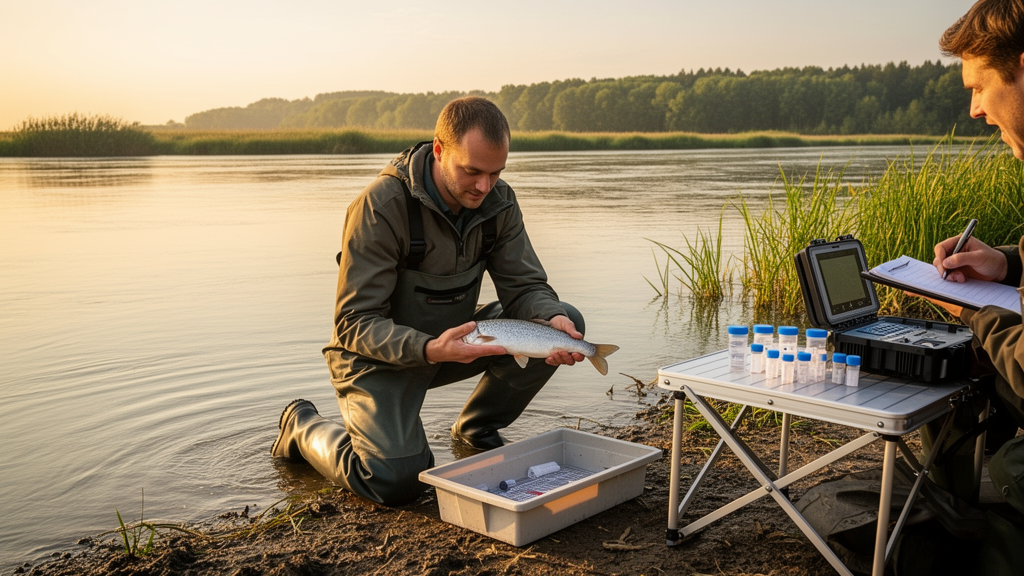
A mitochondrial DNA barcoding study of fishes and lampreys in the Volga River Basin identified seven species not previously recorded there and three genetic lineages that may represent additional species. The study newly barcoded 1,151 specimens representing 80 species and combined them with 176 previously published sequences, producing a reference dataset of 1,327 individuals from 84 species.
Researchers sampled the Upper Volga, Middle Volga, Kama and Lower Volga sub-basins from 2011 through 2024. Samples came from 202 sites and were identified using current morphological keys and species descriptions. The analysis sequenced a 643-base-pair fragment of the mitochondrial cytochrome c oxidase subunit I, or COI, gene, assessed species-identification performance, examined genetic structure and compared haplotype patterns among species. New sequences were deposited in GenBank under accession numbers PV840619–PV841769.
The resulting reference dataset covered about 85% of the fish species recorded in the Volga Basin. Fourteen species had only one sequence, limiting the assessment of within-species variation, while other species had between two and 150 specimens, with a mean of 15.8 individuals per species across the complete dataset. Mean within-species Kimura two-parameter distance was 0.21%, ranging from 0.0% to 2.38%, whereas mean interspecific distance within genera was 5.69%, ranging from 0.0% to 15.77%.
At a 2% K2P threshold, the best-match and best-close-match methods correctly identified 97.73% of sequences. The all-species-barcodes method had a correct-identification rate of 91.25% and produced 102 ambiguous results, or 7.68% of the dataset. A barcode gap was present for more than 95% of analyzed species, supporting the usefulness of COI for identification within the basin, but the study noted limitations associated with singleton species and close pairs including Leuciscus idus and L. leuciscus, and Rutilus caspius and R. lacustris.
The new records included Salmo trutta, Gobio caucasicus, Hemiculter leucisculus, Leucaspius sp., Leuciscus baicalensis, Phoxinus sp., Pseudorasbora parva, Cobitis faridpaki, Cobitis tanaitica and Proterorhinus sp. The authors classified seven as new species records for the basin and three as candidate evolutionary lineages requiring further study. Some records were identified morphologically and confirmed genetically, whereas others were detected primarily through barcode differences. The origin of several records remains uncertain: the authors could not determine whether S. trutta in the Kama system was native or introduced, considered G. caucasicus a possible junior synonym of G. brevicirris pending revision, and presented two interpretations for C. faridpaki in the Volga estuary, including ballast-water transport or a broader natural Caspian Sea distribution.
Two of the newly recorded species, H. leucisculus and P. parva, were identified as alien species. H. leucisculus was recorded in the Lower Volga in 2021, while P. parva was recorded in the Middle Volga in 2024. The authors noted that P. parva might colonize the basin through more than one route, including connections with the Caspian Sea drainage and human-assisted movement between neighboring drainage systems. These records document occurrences; they do not by themselves establish the extent or rate of population expansion.
The haplotype analyses revealed contrasting geographic patterns among individual species. Rudd, Scardinius erythrophthalmus, had one haplotype across 22 specimens from the Upper and Lower Volga. Common dace, Leuciscus leuciscus, had 21 haplotypes among 78 specimens, but samples from the Upper and Middle Volga and the Kama shared haplotypes without clear geographic structure. Stone loach, Barbatula barbatula, had 18 haplotypes among 64 specimens, with partial geographic subdivision. Koshewnikow’s sculpin, Cottus koshewnikowi, had six haplotypes among 40 specimens; Kama and Volga populations did not share haplotypes, and some Kama samples differed by six mutational steps. The authors noted that this divergence could be consistent with species-level differentiation in European Cottus, but its taxonomic significance was not established by the mitochondrial data alone.
The findings support the authors’ interpretation that the Volga has served as a setting for exchanges among adjacent fish faunas. Records in the study corresponded with connections to Arctic Ocean drainage through the Kama-Chusovaya corridor, Black Sea and Sea of Azov drainage through the Don and Dnieper watersheds, and the southern Caspian Sea drainage through C. faridpaki. The Kama system also showed notable genetic differentiation in sculpins and some structure in Barbatula, Phoxinus and Leucaspius. The authors suggested that the Kama may have functioned both as a corridor for fauna exchange and as a refuge for endemic lineages during Pleistocene glaciations, but described this refuge interpretation as a possibility requiring further study rather than as a demonstrated conclusion.
Because the investigation was based on mitochondrial COI barcodes and included only one sequence for 14 species, it could not resolve every taxonomic ambiguity or the evolutionary origin of the newly detected records. The authors stated that nuclear-marker and additional morphological and genetic analyses are needed for several lineages, including Salmo, Leucaspius and Phoxinus. Within those limits, the study provides a substantially expanded reference library for identifying Volga fishes and for future work on their taxonomy, phylogeography, conservation genetics and biogeography.
Subject of Research: DNA barcoding of fish diversity and phylogeography in the Volga River Basin
Article Title: DNA barcoding reference dataset revealed overlooked diversity and clarified biogeography of fishes in the largest European river system – Volga River
Article References: Levin, B. A., Levina, M. A., Artaev, O. N., Bolotovskiy, A. A., Gandlin, A. A., Turbanov, I. S., Komarova, A. S., Mugue, N. S., Pozdeev, I. V., Ruchin, A. B., Litvinov, K. V., Podolyako, S. A., & Simonov, E. (2026). DNA barcoding reference dataset revealed overlooked diversity and clarified biogeography of fishes in the largest European river system – Volga River. Metabarcoding and Metagenomics, 10, Article e174947. https://doi.org/10.3897/mbmg.10.174947
Image Credits: AI Generated
Keywords: Volga River Basin, DNA barcoding, COI marker, fish biodiversity, species identification, phylogeography, cryptic diversity, alien species, mitrochondrial genetics, barcoding, reference, dataset
Cite Scienmag News
Juliet Wilcox. (October 20, 2026). COI barcoding of Volga Basin fishes finds seven new species records and three candidate lineages. Scienmag. https://scienmag.com/coi-barcoding-of-volga-basin-fishes-finds-seven-new-species-records-and-three-candidate-lineages/
Juliet Wilcox. "COI barcoding of Volga Basin fishes finds seven new species records and three candidate lineages." Scienmag, 20 October 2026, https://scienmag.com/coi-barcoding-of-volga-basin-fishes-finds-seven-new-species-records-and-three-candidate-lineages/. Accessed 20 October 2026.
Juliet Wilcox. "COI barcoding of Volga Basin fishes finds seven new species records and three candidate lineages." Scienmag. October 20, 2026. https://scienmag.com/coi-barcoding-of-volga-basin-fishes-finds-seven-new-species-records-and-three-candidate-lineages/


