


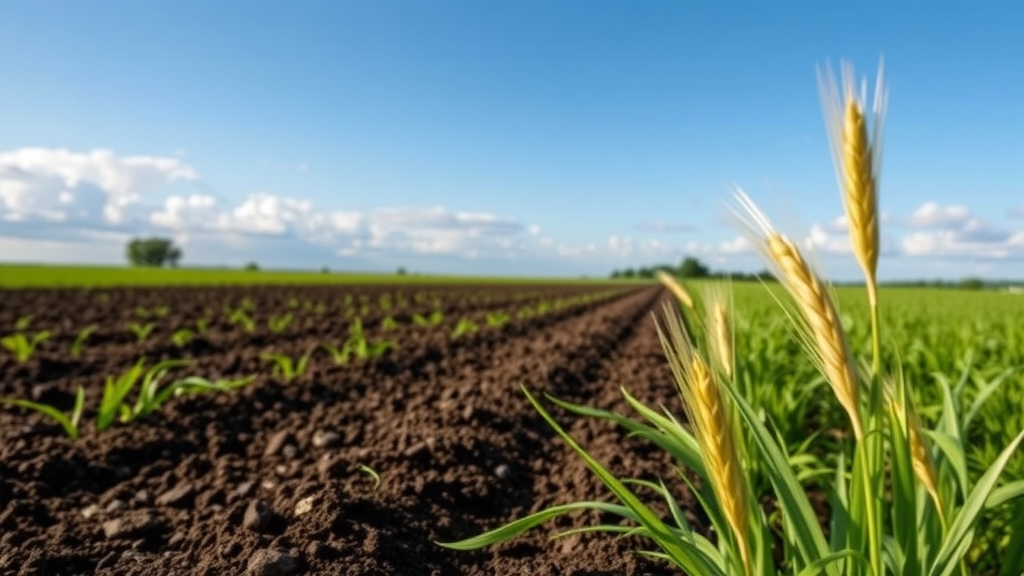
Acidic soils are one of the quiet constraints on global food production, locking away nutrients that crops desperately need and, in many highland farming regions, keeping yields far below their potential. In Ethiopia and other coffee-producing countries, an abundant agricultural residue—the husk stripped from coffee beans during processing—has long been treated as waste. A new study published in Scientific Reports suggests that this overlooked byproduct, transformed into biochar, could become a powerful tool for food barley farmers working on challenging acidic land, particularly when it is combined with carefully calibrated applications of blended NPSB fertilizer.
The research examines a question that sits at the heart of modern agronomy: can soil amendments and mineral fertilizers work together in ways that neither can achieve alone? The investigators tested coffee husk biochar at multiple application rates alongside varying levels of NPSB, a blended fertilizer containing nitrogen, phosphorus, sulfur, and boron, on food barley grown under both limed and unlimed acidic soil conditions. This factorial approach allowed the team to isolate not only the individual contributions of each input but also the interactive effects—the ways in which biochar, fertilizer, and lime can amplify or moderate one another’s influence on crop performance.
The underlying chemistry explains why this combination matters. Acidic soils typically carry elevated levels of exchangeable aluminum and manganese, which are toxic to plant roots, while simultaneously suffering from deficiencies in phosphorus, sulfur, and micronutrients such as boron. Liming is the traditional remedy: applied lime neutralizes acidity, precipitates toxic aluminum, and releases trapped phosphorus into forms that roots can absorb. Yet lime alone does not supply nutrients, and repeated applications can be costly and logistically difficult for smallholder farmers. Biochar, by contrast, is a carbon-rich, alkaline porous material produced by heating biomass in low-oxygen conditions, and it offers a different suite of benefits that complement rather than duplicate those of lime.
Coffee husk biochar brings several properties to the field. Its alkalinity helps raise soil pH, much like lime, but its porous structure also improves cation exchange capacity, giving the soil a greater ability to hold positively charged nutrients such as potassium, calcium, and magnesium against leaching. Biochar can enhance water retention, provide habitat for beneficial soil microorganisms, and slowly release nutrients over multiple growing seasons. Because it is made from an agricultural residue that would otherwise be burned or discarded, it also represents a form of carbon sequestration, locking carbon into a stable solid form rather than releasing it rapidly to the atmosphere.
NPSB fertilizer addresses a different set of constraints. Nitrogen drives vegetative growth and grain protein, phosphorus fuels root development and energy transfer within the plant, sulfur is essential for protein synthesis and enzyme function, and boron plays critical roles in cell wall formation and reproductive development. In many acidic highland soils, particularly those weathered over long periods, all four of these nutrients can be limiting. Blended fertilizers such as NPSB were developed precisely to correct multiple deficiencies at once, replacing older single-nutrient or binary formulations that no longer matched the actual nutrient profiles of depleted tropical soils.
The central finding of the study is that the yield response of food barley depends on the interaction among these inputs rather than on any single amendment applied in isolation. On unlimed acidic soil, biochar and NPSB together produced markedly better results than either input alone, indicating that the biochar’s amelioration of acidity and improved nutrient retention created conditions in which the fertilizer could perform more effectively. Where lime had already been applied, the dynamics shifted: the limed soil provided a more favorable baseline pH, and the biochar and fertilizer combination still contributed to yield, but the marginal benefit of biochar’s acidity-neutralizing capacity was partly redundant with that of the lime. This pattern carries a practical message for farmers, because it suggests that biochar can serve as a partial substitute for lime on soils where lime is unavailable or unaffordable, while still adding value on limed fields through its nutrient-holding and soil-conditioning functions.
For the barley plant itself, these soil improvements translate into measurable agronomic gains. Better root development in less acidic soil allows the crop to explore a larger volume of soil for water and nutrients. Improved phosphorus availability supports tillering, the branching process that determines how many grain-bearing heads a barley plant produces. Adequate nitrogen and sulfur during grain filling raise both yield and grain quality. The study’s yield component analysis, encompassing plant height, tiller number, spike characteristics, biomass production, and harvest index, traced the pathway by which soil chemistry changes ultimately became harvestable grain, linking below-ground processes to above-ground outcomes in a way that field agronomists can act upon.
The broader significance of this work extends beyond a single crop or region. Food barley is a staple for millions of people in highland East Africa and a critical crop in marginal environments where other cereals struggle. At the same time, coffee processing generates enormous quantities of husk residue in precisely the same landscapes, creating a circular opportunity: waste from one major crop system becomes an input for another. Converting coffee husk into biochar through simple pyrolysis technologies accessible to rural communities could simultaneously reduce waste disposal problems, cut greenhouse gas emissions associated with open burning, improve soil health, and raise cereal yields. The economics of such a system are attractive in principle, though the study’s findings underscore that application rates matter, and that biochar is not a limitless substitute for balanced fertilization but rather a complement to it.
The research also contributes to a growing scientific conversation about integrated soil fertility management, the paradigm holding that organic amendments, mineral fertilizers, and physical soil treatments should be combined rationally rather than promoted in competition with one another. Decades of fertilizer-only programs in sub-Saharan Africa delivered disappointing results on degraded acidic soils, while organic-only approaches frequently failed to supply enough nutrients to meet crop demand. The interactive effects documented in this study provide quantitative support for the integrated view: the best yields emerged not from the largest quantity of any one input but from combinations matched to the soil’s specific constraints. For extension services and policymakers, this argues for site-specific recommendations that account for existing soil pH, lime availability, and the local supply of biomass suitable for biochar production.
Questions remain for future research. The durability of biochar’s effects across successive cropping seasons, the optimal frequency of reapplication, the energy and labor costs of on-farm pyrolysis, and the interactions with different rainfall regimes all warrant further investigation. Long-term trials will be needed to confirm whether the yield benefits observed persist or build over time as soil organic carbon accumulates. Nevertheless, the study offers a concrete, testable recipe for farmers on acidic soils: amend with biochar where acidity and nutrient retention are limiting, apply blended NPSB fertilizer to correct multiple nutrient deficiencies, and use lime where it is available, recognizing that these tools work best as a coordinated system. In a world where acidic soils constrain harvests across vast agricultural regions and agricultural waste streams continue to grow, turning coffee husks into barley yields is the kind of practical, circular innovation that sustainable intensification demands.
Subject of Research: The interactive effects of coffee husk biochar and NPSB fertilizer rates on food barley yield in limed and unlimed acidic soils.
Article Title: Interactive effects of coffee husk biochar and NPSB rates on food barley (Hordeum vulgare L.) yield under limed and unlimed acidic soils
Article References: Zewide, I., Tamiru, T., & Wato, T. (2026). Interactive effects of coffee husk biochar and NPSB rates on food barley (Hordeum vulgare L.) yield under limed and unlimed acidic soils. Scientific Reports. https://doi.org/10.1038/s41598-026-67517-7
Image Credits: AI Generated
DOI: 10.1038/s41598-026-67517-7
Keywords: coffee husk biochar, food barley, acidic soils, NPSB fertilizer, soil acidity, liming, soil fertility, integrated soil fertility management, Hordeum vulgare, smallholder agriculture, carbon sequestration, crop yield
Cite Scienmag News
Alan Morgan. (September 12, 2026). Coffee Waste Meets Barley Fields: Biochar and Fertilizer Team Up to Rescue Acidic Soils. Scienmag. https://scienmag.com/coffee-waste-meets-barley-fields-biochar-and-fertilizer-team-up-to-rescue-acidic-soils/
Alan Morgan. "Coffee Waste Meets Barley Fields: Biochar and Fertilizer Team Up to Rescue Acidic Soils." Scienmag, 12 September 2026, https://scienmag.com/coffee-waste-meets-barley-fields-biochar-and-fertilizer-team-up-to-rescue-acidic-soils/. Accessed 5 October 2026.
Alan Morgan. "Coffee Waste Meets Barley Fields: Biochar and Fertilizer Team Up to Rescue Acidic Soils." Scienmag. September 12, 2026. https://scienmag.com/coffee-waste-meets-barley-fields-biochar-and-fertilizer-team-up-to-rescue-acidic-soils/


