


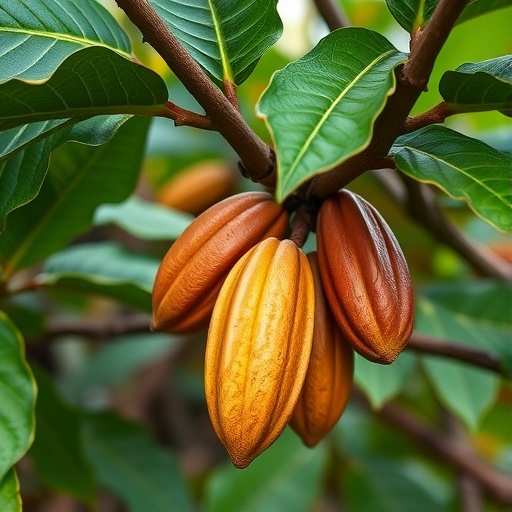
In a groundbreaking exploration of the African cocoa research landscape, a new study sheds light on critical insights into the production, trade outlook, and scientometric data surrounding this universally cherished crop. With the cocoa industry being a significant economic driver for many countries across the continent, the comprehensive assessment conducted by O.A. Otekunrin provides a much-needed perspective on the developments, challenges, and future pathways for cocoa cultivation in Africa.
The research begins by highlighting the importance of cocoa, known scientifically as Theobroma cacao, in global agriculture and trade. Cocoa is not just a source of delicious chocolate; it represents a crucial livelihood for millions of farmers in Africa, where the majority of the world’s cocoa is produced. However, despite its significant economic value, the research has often received limited attention and documentation, overshadowed by more prominent agricultural crops. Otekunrin’s study aims to rectify this knowledge gap and bring cocoa research to the forefront of scientific inquiry.
Delving into the production statistics, the analysis reveals that African countries contribute to over 70% of global cocoa production. Ghana and Côte d’Ivoire are the top producers, making substantial contributions to the international cocoa market. Yet, the researchers argue that the current production methods are unsustainable and vulnerable to climate change impacts, disease, and pest infestations. These challenges necessitate immediate scientific attention and innovative solutions to ensure that cocoa farming remains viable for future generations.
Trade aspects are another focal point of the study. Otekunrin notes that while cocoa is a lucrative export commodity, farmers often face an uphill battle with fluctuating prices and market access issues. The exploitation of smallholder farmers and the lack of equitable trade practices are discussed as critical barriers to sustainable growth in cocoa production. By mapping existing trade relationships and identifying trends in cocoa exports from Africa, the research provides valuable insights aimed at improving the livelihoods of those at the grassroots level.
Scientometrics, the study of the measurement of scientific literature, is also a significant component of Otekunrin’s research. By analyzing published works related to cocoa research in Africa, the study reveals trends in funding, collaboration, and publication rates. Such data can inform future research priorities and funding opportunities, steering the direction of cocoa research toward more impactful outcomes. The indication of growing research output in the field points to an increasing awareness of cocoa’s importance and a potential shift towards more focused scientific inquiries.
The study also emphasizes the need for interdisciplinary approaches to cocoa research. Integrating agronomy, economics, environmental science, and social studies can lead to comprehensive strategies that address the multifaceted challenges within the cocoa sector. By fostering collaborations between researchers, policymakers, and industry stakeholders, the pathways toward sustainable cocoa production can be accelerated, transforming how cocoa is grown, traded, and consumed.
Moreover, Otekunrin advocates for the utilization of modern technologies such as precision agriculture, biotechnology, and data analytics to enhance productivity and sustainability in cocoa farming. These innovations can empower farmers by providing them with tools that optimize crop yields while minimizing negative environmental impacts. The potential of digital technology to revolutionize agricultural practices is becoming increasingly recognized, and cocoa farming must not be left behind in this evolution.
Another critical topic addressed in the study is the impact of climate change on cocoa production. The researchers underscore that rising temperatures and erratic weather patterns pose severe risks to cocoa yields. As such, adaptive strategies and climate-resilient practices must be developed to mitigate these effects. The study serves as a clarion call for increased research efforts focused on climate adaptation specific to cocoa cultivation, ensuring the sector’s resilience in an era of environmental uncertainty.
Furthermore, the socio-economic implications of cocoa farming are explored, as the crop plays a profound role in local communities. Cocoa not only provides direct employment opportunities but also supports various ancillary industries, from processing to chocolate production. The study reveals that empowering farmers through initiatives focused on education, fair trade, and health can create a ripple effect of positive socioeconomic change in rural populations that rely on cocoa farming.
The findings of Otekunrin’s research extend beyond Africa’s borders, as the challenges faced by the cocoa industry are mirrored worldwide. By outlining strategies that have been successful in other cocoa-producing regions, the study encourages knowledge exchange and learning between countries. Such collaboration can lead to the dissemination of best practices that enhance the sustainability of cocoa production globally.
While many cocoa-producing regions struggle with issues of sustainability and profitability, there lies a profound opportunity for innovation. The study posits that through investment in research, infrastructure, and education, African countries can unlock the full potential of their cocoa resources. This presents a unique opportunity to not only bolster local economies but also to contribute to global cocoa supply stability.
In conclusion, Otekunrin’s comprehensive investigation into cocoa research provides a roadmap for navigating the complexities of cocoa production and trade in Africa. As the world increasingly seeks sustainable practices in all sectors, the cocoa industry must adapt to meet these demands head-on. By prioritizing research, fostering interdisciplinary approaches, and investing in technology and education, the future of cocoa can be bright, sustainable, and equitable for all stakeholders involved.
In a time when the awareness of ethical consumption grows among chocolate lovers, the insights from this study can play a pivotal role. It encourages consumers to consider not just the taste of the chocolate they enjoy but also the broader implications of its production. The link between the sweet indulgence and the diligent work of cocoa farmers, along with their challenges, can inspire a movement towards more responsible purchasing decisions.
Changes in consumer behavior, alongside informed policy-making driven by research such as Otekunrin’s, can propel the cocoa industry towards a more sustainable and prosperous future. As we move forward, let us hope that the sweet embrace of chocolate also embodies a commitment to fairness and sustainability across the globe.
Cite Scienmag News
Alan Morgan. (August 29, 2025). Cocoa Research in Africa: Insights on Production and Trade. Scienmag. https://scienmag.com/cocoa-research-in-africa-insights-on-production-and-trade/
Alan Morgan. "Cocoa Research in Africa: Insights on Production and Trade." Scienmag, 29 August 2025, https://scienmag.com/cocoa-research-in-africa-insights-on-production-and-trade/. Accessed 4 September 2026.
Alan Morgan. "Cocoa Research in Africa: Insights on Production and Trade." Scienmag. August 29, 2025. https://scienmag.com/cocoa-research-in-africa-insights-on-production-and-trade/


