


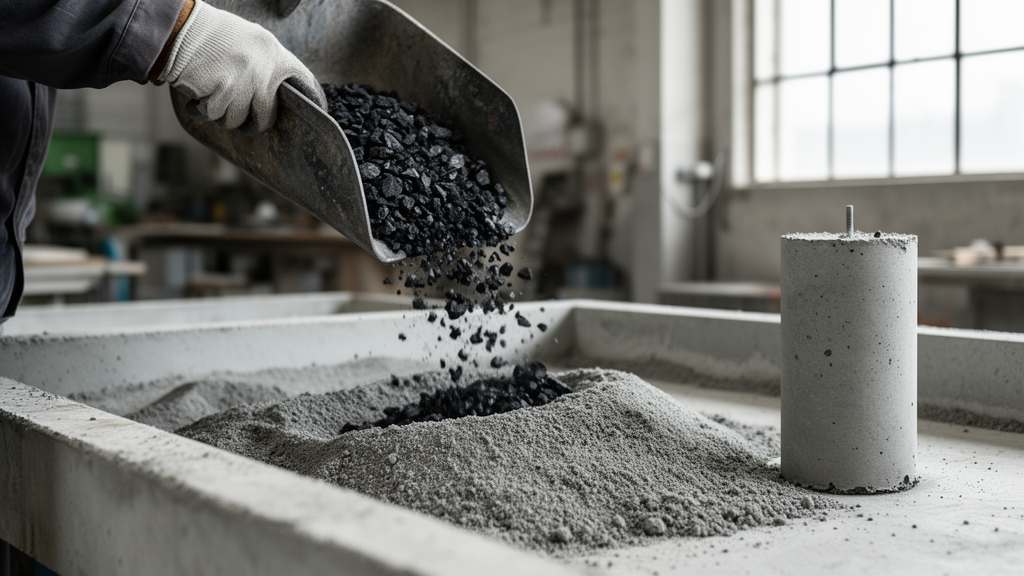
India’s coal-fired power plants generate nearly 60 million tonnes of coal bottom ash every year, a coarse combustion residue that mostly ends up in ash ponds and landfills. At the same time, the country’s construction industry is exhausting its natural river sand reserves, driving riverbank erosion and ecological damage. A new laboratory study now reports that this industrial by-product can substitute for a meaningful share of river sand in Portland pozzolana cement (PPC) concrete, with the best results obtained when sand is replaced at 10 to 20 percent by volume.
The research, published in September 2026, tested concrete mixes in which natural sand was replaced with coal bottom ash at 0, 10, 20, 30, 40, and 50 percent by volume. The bottom ash came from the Jojobera Power Plant in Jamshedpur, India, and was subjected only to crushing and grinding before use. X-ray fluorescence analysis showed the ash belonged to the ASTM Class F category, and scanning electron microscopy revealed irregular, porous, angular particles with a rough surface texture, composed predominantly of silica and alumina.
All mixtures were designed as M25 grade concrete with a water–cement ratio of 0.45, following Indian standard guidelines. Because bottom ash absorbs a great deal of water, the material was pre-moistened to roughly 13 to 15 percent moisture before mixing. The researchers evaluated workability through slump tests and measured compressive, flexural, and splitting tensile strength on standard specimens cured for 7, 28, 56, and 90 days. Durability was probed with ultrasonic pulse velocity, surface electrical resistivity, rapid chloride permeability, and water absorption tests, while scanning electron microscopy with energy-dispersive X-ray analysis revealed the microstructure.
Workability declined as the bottom ash content rose. The control concrete recorded a slump of 100 millimetres with a 0.7 percent superplasticizer dosage, and a slight increase to 105 millimetres appeared at 10 percent replacement. Beyond that point, slump fell steadily from 100 millimetres at 20 percent replacement to 85 millimetres at 50 percent, even though the superplasticizer dosage was progressively raised to 1.3 percent. The authors attribute this to the porous, rough, and angular texture of the ash particles, which soak up mixing water and superplasticizer and increase friction between particles, leaving less free water to lubricate the fresh mix.
Strength results showed a clear pattern. At 28 days, the 10, 20, and 30 percent mixes reached compressive strengths of 37.93, 37.78, and 37.04 megapascals, representing increases of roughly 11.30, 10.87, and 8.72 percent over the control concrete’s 34.07 megapascals. Splitting tensile strength at 28 days improved by 5.17 and 8.62 percent for the 10 and 20 percent mixes respectively. Flexural strength was highest on average for the 10 percent mix, which achieved 3.90 megapascals at 28 days and 4.51 megapascals at 90 days. Statistical analysis, however, tempered these gains: analysis of variance showed that replacement level significantly influenced compressive strength at all ages, but Tukey’s test found the 10 to 30 percent mixes statistically similar to one another at 28 days, and the differences from the control at 56 and 90 days were not significant. The authors therefore describe 10 to 20 percent as the most favourable range investigated rather than a universal optimum.
Higher replacement levels told a different story. At 40 and 50 percent sand replacement, 28-day compressive strengths dropped to 26.52 and 21.48 megapascals, well below the control. The same decline appeared in durability indicators. Electrical resistivity fell consistently with increasing ash content at every curing age, and rapid chloride permeability values rose from about 789 coulombs for both the control and the 10 percent mix at 28 days to 1594 coulombs at 50 percent replacement. Water absorption increased beyond 20 percent replacement, reaching 3.58 percent under immersion for the 50 percent mix at 28 days compared with 3.08 percent for the control.
Not everything worsened with time. Prolonged curing improved nearly every property across all mixes. By 90 days, mixtures containing up to 30 percent bottom ash achieved ultrasonic pulse velocities above 4.5 kilometres per second, corresponding to an excellent quality classification, and all mixes fell within the very low chloride penetrability category in the rapid chloride test. The 10 percent mix recorded the lowest charge passed at 90 days, 510 coulombs, below the control’s value. The researchers link this improvement to continued cement hydration and limited secondary pozzolanic reactions, in which reactive silica and alumina in the ash consume calcium hydroxide and form additional calcium silicate hydrate gel, refining the pore network.
Microstructural observations supported this interpretation. Electron micrographs of the 10 and 20 percent mixes showed comparatively dense, continuous matrices rich in calcium silicate hydrate, while reaction products were visible around individual ash particles, indicating that part of the bottom ash participates chemically rather than acting purely as inert filler. At 40 and 50 percent replacement, however, the microstructure became increasingly heterogeneous, with localized voids and a less uniform distribution of hydration products. The authors conclude that at high replacement levels the porous and irregular particles disturb particle packing and weaken the interfacial transition zone, and these physical drawbacks outweigh any chemical benefit.
The study also derived empirical relationships from its data. A power regression between cube compressive strength and splitting tensile strength explained about 64.5 percent of the variation, and strong correlations emerged between ultrasonic pulse velocity and compressive strength at each curing age, with coefficients of determination between 0.927 and 0.961. This suggests pulse velocity could serve as a non-destructive tool for estimating the strength of PPC-based concrete containing bottom ash, useful for quality assessment without destructive testing.
The authors caution that the work has clear limits: it used a single ash source, one commercially available PPC, and controlled laboratory conditions, and it did not include life-cycle assessment, embodied carbon analysis, or long-term field performance. Quantitative sustainability evaluation remains a subject for future investigation. Even so, the findings indicate that replacing up to 20 percent of natural sand with coal bottom ash can produce PPC-based concrete with satisfactory engineering performance while diverting a substantial industrial residue from landfills and easing pressure on dwindling river sand resources.
Subject of Research: Partial replacement of river sand with coal bottom ash in Portland pozzolana cement concrete
Article Title: Effect of low volume coal bottom ash as partial sand replacement on the strength, durability, and microstructural properties of PPC based concrete
Article References: Sarkar, B. K., Dinda, A., Ghosh, K., & Ghosh, P. (2026). Effect of low volume coal bottom ash as partial sand replacement on the strength, durability, and microstructural properties of PPC based concrete. Discover Concrete and Cement, 2(1), Article 76. https://doi.org/10.1007/s44416-026-00116-x
Image Credits: AI Generated
DOI: 10.1007/s44416-026-00116-x
Keywords: coal bottom ash, PPC concrete, river sand replacement, compressive strength, durability, chloride permeability, workability, microstructure, pozzolanic reaction, ultrasonic pulse velocity, industrial by-product, India
Cite Scienmag News
Denise Maddox. (October 30, 2026). Coal Bottom Ash Can Replace River Sand in Concrete, Study Finds. Scienmag. https://scienmag.com/coal-bottom-ash-can-replace-river-sand-in-concrete-study-finds/
Denise Maddox. "Coal Bottom Ash Can Replace River Sand in Concrete, Study Finds." Scienmag, 30 October 2026, https://scienmag.com/coal-bottom-ash-can-replace-river-sand-in-concrete-study-finds/. Accessed 30 October 2026.
Denise Maddox. "Coal Bottom Ash Can Replace River Sand in Concrete, Study Finds." Scienmag. October 30, 2026. https://scienmag.com/coal-bottom-ash-can-replace-river-sand-in-concrete-study-finds/









