


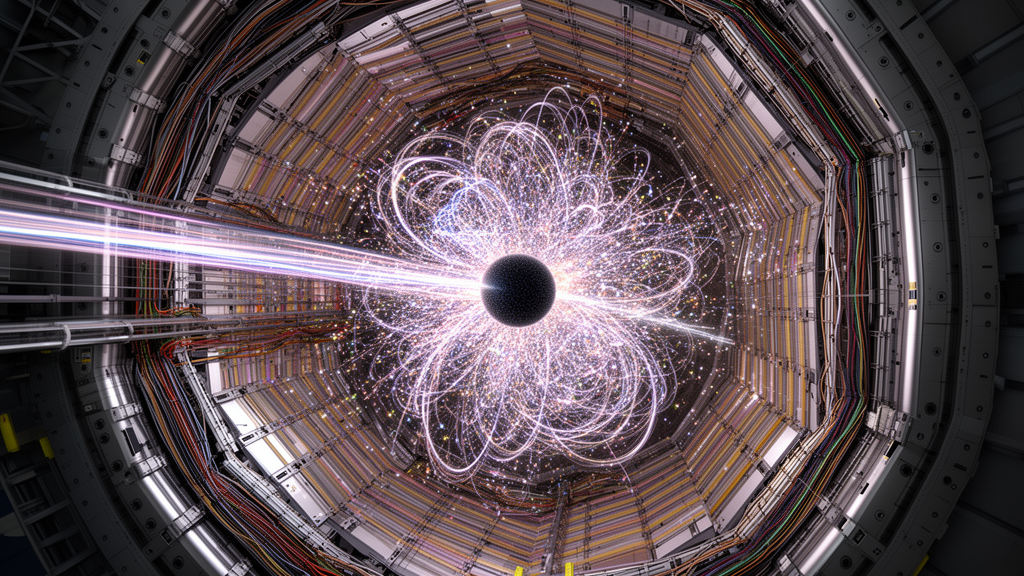
A search for microscopic quantum black holes in proton collisions at the Large Hadron Collider found no evidence of the objects, while setting limits on the extra-dimensional theories in which they could form. The analysis used 2016–2018 data from the Compact Muon Solenoid experiment and introduced what researchers describe as the first particle-physics application of a phase-space distance technique combined with a supervised machine-learning algorithm. The result does not exclude every model of quantum gravity, but it rules out the classes of black-hole and extra-dimension scenarios examined under their stated assumptions. The researchers also applied the method to sphalerons, hypothetical unstable configurations of particle fields, and found no sign of the predicted processes, placing constraints on the fraction of interactions that could produce sphaleron transitions.
Quantum black holes are a speculative consequence of combining general relativity and quantum mechanics. Under the scenario investigated by the CMS researchers, sufficiently energetic proton collisions could compress energy into a region small enough for spacetime to form a tiny black hole if hypothetical extra spatial dimensions exist. Such an object would not be a stable, macroscopic black hole. Instead, it would be expected to decay almost immediately into particles. Physicists could therefore search for its existence indirectly by identifying the pattern of those decay products, rather than by observing a black hole directly. The idea was proposed decades ago, but early ATLAS and CMS searches used comparatively small datasets and found no evidence for the predicted signal.
The scientific motivation extends beyond the black-hole search itself. Quantum field theory, represented by the Standard Model, describes particles and interactions with exceptional success, while general relativity describes gravity on large scales. Combining them into one theory remains a central challenge because gravity becomes especially important where particles are extremely small and energetic. One longstanding puzzle is the hierarchy problem: gravity appears far weaker than the other fundamental forces at the scales familiar to human experience. Some extra-dimensional models address that disparity by allowing gravity to become stronger at short distances, potentially bringing the Planck energy scale closer to the reach of particle accelerators. The absence of new particles at the LHC has therefore made null searches especially important for narrowing the range of theories that remain viable.
The CMS team analyzed collision data in two complementary ways. The first used sphericity, an event-shape variable intended to capture the roughly spherical pattern expected from the decay of a newly formed quantum black hole. The second focused on the total energy carried by the particles produced in a collision, since a black-hole decay would be expected to generate a highly energetic final state. Both approaches were used to define regions of data in which a signal would most likely appear. The study did not find the characteristic behavior predicted by the models, producing an exclusion limit rather than evidence for a new particle. The published result constrains the considered scenarios up to a black-hole mass of about 12 tera-electron volts, while the conclusion about extra dimensions remains conditional on the parameters of the theories tested.
For the new analysis, UCSB particle theorist Nathaniel Craig and collaborators used a phase-space distance method that had not previously been applied to particle-physics data. Phase space represents an event through a multidimensional set of properties, including the directions, energies and momenta of its particles. Rather than examining only one variable, the method measures how individual observed events differ from one another and from reference signal and background distributions. Those distances are condensed into a single Support Vector Machine score, with larger values indicating events that more closely resemble the desired signal. The researchers reported that phase-space distance performed better than sphericity in their comparison.
That result carries a practical advantage beyond this particular analysis. The method is supervised, meaning that the researchers can inspect the mathematical basis of the classification rather than relying on an unexplained black-box output. A higher score is therefore not merely an abstract indicator generated by a machine-learning system; it is tied to an interpretable measure of event geometry. Zhang noted that theories generally predict a range of possible locations for a new particle rather than one exact answer. Each search can eliminate part of that range, while the structure of the data can guide the design of subsequent searches. The same phase-space technique may be transferable to searches for other exotic particles, unusual interactions and previously unknown processes, although the present study does not demonstrate that it will improve every future analysis.
One limitation is that a null result constrains models only to the extent that their predictions resemble the event patterns the analysis can resolve. The exclusion also depends on theoretical assumptions about extra dimensions, black-hole decay and the relevant mass and energy ranges. It does not establish that microscopic black holes are impossible at the LHC, that extra dimensions do not exist, or that quantum gravity can never be studied with particle collisions. Steven Giddings, a UCSB physicist who works on the interface between quantum mechanics and gravity, said that without extra dimensions, producing even the smallest, microgram-scale black holes would require collisions with roughly a million billion times more energy than the LHC currently provides. The exclusion obtained in the present study is consequently specific to accessible energies and to the models for which it was designed.
The same paper documented a search for sphalerons, which are not proposed as ordinary particles but as unstable configurations of particle fields. Like quantum black holes in the models considered, sphaleron processes would be expected to generate approximately spherical energy distributions. Their detection could also bear on the matter–antimatter asymmetry: the standard cosmological account of the Big Bang produces matter and antimatter in equal amounts, whereas the observed universe contains an imbalance that remains unexplained. The researchers did not detect the hypothetical sphaleron processes and consequently constrained the fraction of interactions capable of causing such transitions. These limits, like the black-hole results, depend on the models and analysis assumptions and are not a general prohibition of the underlying physics.
Tamas Vami, a researcher in the CMS experiment, said the search illustrates how experimental data can guide attempts to unify the fundamental forces. A detection could have opened a direct experimental window onto quantum gravity, but the absence of a signal still yields measurable knowledge by excluding regions of theoretical parameter space. Zhang described the result as an exclusion limit: if the sought object existed with the properties assumed by the tested models, the analysis would have detected it, and the fact that it did not rules out that scenario. Future runs with the upgraded High Luminosity Large Hadron Collider will provide additional data for investigating possible new physics, including processes that might illuminate the early universe. The immediate conclusion is narrower but still significant: quantum black holes and sphalerons were not observed in the CMS dataset, and the phase-space distance method provided a more discriminating search tool for evaluating their expected signatures.
Subject of Research: A CMS search for quantum black holes and sphalerons using phase-space distance and supervised machine learning
Article Title: Physicists extend the search for quantum black holes at the LHC
Article References: Physicists extend the search for quantum black holes at the LHC. Original publication (Bibliographic details unavailable.)
Image Credits: AI Generated
DOI: Not provided
Keywords: quantum black holes, Large Hadron Collider, CMS experiment, extra dimensions, quantum gravity, phase-space distance, machine learning, sphalerons, particle searches, hierarchy problem, Physicists, extend
Cite Scienmag News
Katie Riggs. (October 26, 2026). CMS search tightens limits on quantum black holes at LHC. Scienmag. https://scienmag.com/cms-search-tightens-limits-on-quantum-black-holes-at-lhc/
Katie Riggs. "CMS search tightens limits on quantum black holes at LHC." Scienmag, 26 October 2026, https://scienmag.com/cms-search-tightens-limits-on-quantum-black-holes-at-lhc/. Accessed 26 October 2026.
Katie Riggs. "CMS search tightens limits on quantum black holes at LHC." Scienmag. October 26, 2026. https://scienmag.com/cms-search-tightens-limits-on-quantum-black-holes-at-lhc/


