


An experimental three-user quantum cryptographic conferencing system established a shared secure key under total system losses of approximately 59.6 dB, compared with approximately 21.5 dB achieved in the same group’s earlier polarization-encoded measurement-device-independent quantum conferencing experiment. The result, reported in Physical Review Letters, used an asynchronous measurement-device-independent quantum cryptographic conferencing protocol that pairs suitable single-photon detections recorded at different times instead of relying on multiphoton coincidence events. At the maximum tested loss of approximately 59.6 dB, the system obtained a secure key rate of approximately 4.470 × 10⁻⁹ bits per pulse.
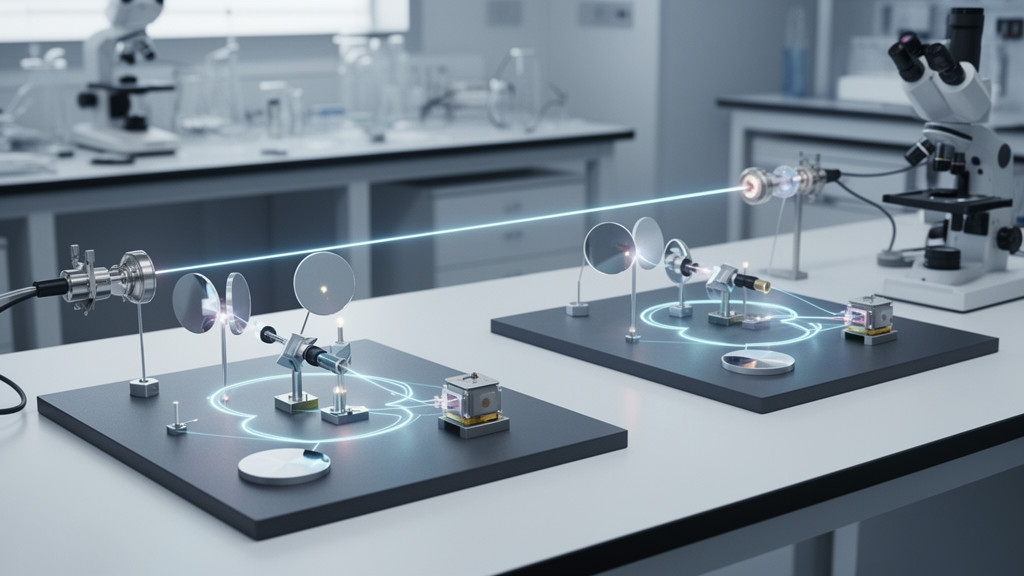
Quantum cryptographic conferencing enables multiple users to share one secret key for protecting group communications. In this laboratory demonstration, three users independently sent optical pulses to a shared measurement station containing a fiber-based multipath interferometer and single-photon detectors. The interferometer enabled interference between signals from the different users. Detection results publicly announced by the measurement station, together with the users’ own encoding information, were then processed through single-photon detection-event pairing, key mapping and classical post-processing to produce a shared conference key. Because the approach is measurement-device-independent, the users do not need to trust the measurement station’s detection equipment, which could otherwise be targeted by an attacker.
The main advance addresses key generation in the presence of transmission loss and a growing number of participants. Conventional measurement-device-independent quantum conferencing protocols generate secure keys from multiphoton coincidence events, which become increasingly rare as transmission losses rise and more users join the network. The asynchronous protocol assembles key-generation events from single-photon detections recorded at different times and pairs appropriate detections during data processing, allowing more efficient use of the detected signals. In an ideal N-user network, the researchers said the key rate changes from a dependence proportional to a conventional N-user term that grows with the number of users to a dependence proportional to η, where η denotes single-user channel transmittance. The loss-scaling exponent therefore does not grow with the number of users, although practical key rates still depend on system parameters and finite collected data.
The experiment also demonstrated a simplified approach to controlling the optical phase effects required for secure key generation. Communication networks using independent, free-running lasers without frequency locking can be affected by differences among laser frequencies and by phase drift in fiber interferometers, both of which can alter interference results. The team used reference optical pulses encoded through time-division multiplexing and applied a fast Fourier transform to estimate the frequency differences between the independent lasers. This procedure also allowed the researchers to estimate phase drift in the multipath interferometer and perform the corresponding compensation during data post-processing. The protocol therefore operated without phase locking while retaining the phase estimation and compensation needed for key generation, reducing dependence on complex phase-control techniques.
The study is a laboratory demonstration rather than a completed intercity quantum network. Its measured results include operation with three users, secure key generation at a maximum total system loss of approximately 59.6 dB, and a secure key rate of approximately 4.470 × 10⁻⁹ bits per pulse at that loss. The research team said the combined use of asynchronous key generation and simplified phase control provides a promising foundation for future secure, long-distance, multiparty communication over optical fiber. Further advances in integrated light sources, modulators and detectors could help translate the demonstrated capability into practical intercity networks, while the revised theoretical scaling with user count points toward more scalable quantum conferencing.
Subject of Research: Experimental three-user asynchronous measurement-device-independent quantum cryptographic conferencing
Article Title: Toward scalable quantum networks: An efficient and practical approach to secure quantum conferencing
Article References: Toward scalable quantum networks: An efficient and practical approach to secure quantum conferencing. Original publication (Bibliographic details unavailable.)
Image Credits: AI Generated
DOI: Not provided
Keywords: quantum networking, quantum cryptography, quantum conferencing, measurement-device independence, secure key generation, single-photon detection, fiber interferometry, phase compensation, optical loss, asynchronous protocol, Toward, scalable
Cite Scienmag News
Katie Riggs. (October 26, 2026). Asynchronous quantum conferencing reaches 59.6 dB system loss. Scienmag. https://scienmag.com/asynchronous-quantum-conferencing-reaches-59-6-db-system-loss/
Katie Riggs. "Asynchronous quantum conferencing reaches 59.6 dB system loss." Scienmag, 26 October 2026, https://scienmag.com/asynchronous-quantum-conferencing-reaches-59-6-db-system-loss/. Accessed 26 October 2026.
Katie Riggs. "Asynchronous quantum conferencing reaches 59.6 dB system loss." Scienmag. October 26, 2026. https://scienmag.com/asynchronous-quantum-conferencing-reaches-59-6-db-system-loss/


