


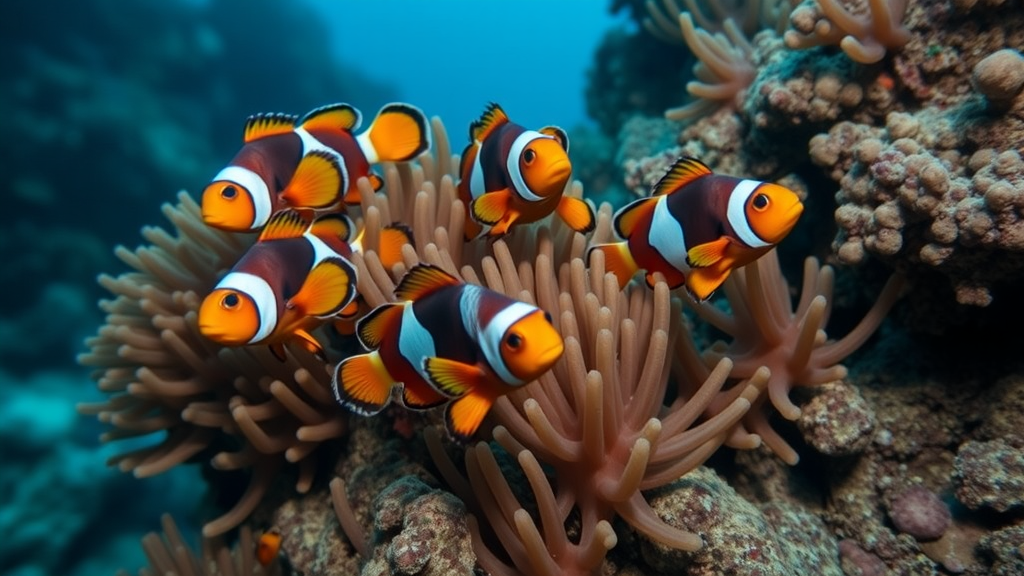
The partnership between anemonefish and their host sea anemones is one of the most recognizable images in the tropical ocean, made famous by cinema and beloved by divers around the world. But beneath that postcard image lies a delicate ecological network that scientists are only beginning to map, and a new study from the coral reefs of central Viet Nam shows just how quickly human activity can reshape it. Researchers surveyed two neighboring bays, Nha Trang Bay and Van Phong Bay, and found that the reef in the heavily impacted bay has lost not only corals but also the shallow-water homes of its anemones, forcing the animals that depend on them into a narrower and more fragile band of habitat.
The study, published in the journal Discover Oceans, was led by Hai-Thanh Thi Nguyen of Nha Trang University together with Mackenzie Stoeltje and James Davis Reimer of the University of the Ryukyus, along with Viet Do Hung Dang of the Joint Vietnam-Russia Tropical Science and Technology Research Center. The team chose their study sites deliberately. Nha Trang Bay, once the center of coral reef research in Viet Nam, has suffered a catastrophic decline: between 2016 and 2018, most of its healthy coral communities were wiped out by outbreaks of crown-of-thorns starfish and Drupella snails, destructive fishing, sedimentation, and pollution from the rapidly growing city of Nha Trang. By 2019, coral abundance in the bay had fallen by more than 90 percent compared with earlier levels. Van Phong Bay, by contrast, is the largest bay in Khanh Hoa province, covering roughly 510 square kilometers, and is generally regarded as having good water exchange and environmental quality despite substantial aquaculture.
Using scuba-based roving diver surveys in September 2022, the researchers examined nine sites across the two bays at depths of one to twenty meters, spending a combined total of more than 950 minutes underwater. They measured every host anemone they encountered, recording its species, depth, and size, and documented every fish and invertebrate sheltering within reach of its tentacles. In total, they observed 94 host anemones belonging to seven species, including the bubble-tip anemone Entacmaea quadricolor, several Heteractis species, and three Stichodactyla species. They also counted 360 individual anemonefish representing four species: Amphiprion clarkii, A. sandaracinos, A. frenatus, and A. perideraion.
The differences between the two bays were striking. In Van Phong Bay, most anemones and anemonefish lived in water less than six meters deep, while in Nha Trang Bay the animals were concentrated between three and nine meters, and below twelve meters only one species, Heteractis crispa, was found. Perhaps most telling, the researchers found no anemones at all in the shallowest waters of Nha Trang Bay, even though historical records from 1996 show that host anemones there once ranged from the surface down to 27 meters. The anemone Cryptodendrum adhaesivum, once common in the shallow waters of Nha Trang Bay, has been encountered only once by the research team since 2015. The anemones that remained in Nha Trang Bay were also significantly smaller, averaging about 3,200 square centimeters, compared with more than 5,300 square centimeters in Van Phong Bay.
The authors suggest that the loss of shallow coral reefs in Nha Trang Bay is one plausible factor behind the disappearance of shallow-water anemones, although they caution that the relative roles of bleaching, poor water quality, predator outbreaks, and natural habitat differences remain unresolved. Environmental data collected from monitoring stations support the contrast between the bays: Nha Trang Bay showed significantly lower pH and higher total suspended solids, consistent with its documented sedimentation and pollution loads. Similar losses of shallow-water anemones and other reef anthozoans have been reported near urban centers elsewhere in the Indo-Pacific, including Singapore, Jakarta, and Okinawa, suggesting the Vietnamese pattern is part of a broader regional trend.
Beyond the famous clownfish, the study revealed a hidden cast of characters living among the anemone tentacles. The researchers recorded 325 individuals of other fish and invertebrate species associated with host anemones, including juvenile threespot dascyllus damselfish, cardinalfish, gobies, three species of cleaner shrimp, and the spotted anemone crab Neopetrolisthes maculatus. The sexy shrimp Thor amboinensis was the most common crustacean symbiont, recorded 33 times, followed by the red-banded coral shrimp Stenopus hispidus. Notably, no anemones were observed without anemonefish, meaning every host in both bays was occupied, and juvenile damselfish coexisted alongside the clownfish rather than taking over vacant hosts as has been seen in Okinawa.
The analysis also uncovered clear patterns of host specificity. Amphiprion sandaracinos was strongly associated with Stichodactyla mertensii, A. frenatus with Entacmaea quadricolor, and A. perideraion with Heteractis magnifica and H. crispa, echoing host preferences documented in previous studies. Two anemonefish species shared the same host in roughly one in five anemones, with A. clarkii and A. sandaracinos cohabiting most frequently. A multivariate analysis grouped the anemone-associated communities into clusters corresponding to anemone genera, with cleaner shrimp and crabs each showing preferences for particular host lineages. Correlation analysis revealed both positive associations, such as between cardinalfish and cleaner wrasses, and negative ones, including a moderate negative correlation between A. clarkii and A. frenatus that may reflect interspecific competition.
When the researchers applied diversity metrics, a nuanced picture emerged. Alpha and gamma diversity of anemones and anemonefish showed no significant differences between the bays, but beta diversity, the variation in community composition among sites, was higher in Nha Trang Bay and had a more nested structure, meaning species-poor sites contained subsets of the species found at richer sites. Crucially, when the two most degraded sites in Nha Trang Bay, located on the southwest of Hon Mun Island and affected by tourism, suspected illegal fishing, and storm damage, were excluded from the analysis, the differences in beta diversity between the bays largely disappeared. Permutational multivariate analysis of variance reinforced this interpretation: bay identity explained only about 2.3 percent of the variation in associated community composition, while site-level structure explained roughly 11 to 12 percent and was statistically significant across analyses.
This site-level signal carries an important management message. The authors argue that marine protected areas should not treat an entire bay as a homogeneous unit, but instead identify and prioritize unusual or vulnerable sites within each bay. The two most degraded sites in Nha Trang Bay contributed disproportionately to the nestedness component of beta diversity, a statistical fingerprint of disturbance. Tourism is a cornerstone of the Khanh Hoa economy, contributing an estimated 10 to 15 percent of provincial GDP, and much of that industry depends on the very reefs and reef creatures that draw visitors underwater. Diving has already been prohibited in the core zone of the Hon Mun Marine Protected Area since 2022, and the effectiveness of such measures will depend on enforcement and continued monitoring.
The study also documents what has already been lost. Nine species of host anemones were reported from Khanh Hoa two decades ago, but two of them, Cryptodendrum adhaesivum and Macrodactyla doreensis, were not found in the current surveys. Five anemonefish species are known from the province, including the saddleback clownfish A. polymnus, which depends on the anemone Stichodactyla haddoni, a species popular in local aquarium shops and now rare on the reefs. The authors are careful to acknowledge the limitations of their work: the sampling was unbalanced between bays, benthic habitat data were not collected, and environmental measurements came from stations several kilometers from the survey sites. Even so, the message is clear. Anemone communities are more than just clownfish and their hosts; they are hubs of reef biodiversity supporting damselfish, cardinalfish, cleaner shrimp, crabs, and the cleaning stations that keep reef fish healthy. Protecting them means protecting the water quality, coral habitat, and local conditions that allow these miniature cities of the reef to thrive, and the researchers hope future monitoring across Viet Nam and Southeast Asia will build on this first detailed look at an anemone-associated community under human pressure.
Subject of Research: Comparative ecology of sea anemone and anemonefish communities in reefs under different levels of human impact in Viet Nam
Article Title: Differences in communities of anemones, anemonefish, and other associated species between two bays under different levels of anthropogenic impacts in Viet Nam
Article References: Nguyen, H.-T. T., Stoeltje, M., Dang, V. D. H., & Reimer, J. D. (2026). Differences in communities of anemones, anemonefish, and other associated species between two bays under different levels of anthropogenic impacts in Viet Nam. Discover Oceans, 3(1), Article 39. https://doi.org/10.1007/s44289-026-00153-1
Image Credits: AI Generated
DOI: 10.1007/s44289-026-00153-1
Keywords: anemonefish, sea anemones, coral reefs, Viet Nam, Nha Trang Bay, Van Phong Bay, symbiosis, beta diversity, anthropogenic impacts, cleaner shrimp, marine conservation, crown-of-thorns starfish
Cite Scienmag News
Margaret Porter. (September 26, 2026). Clownfish Communities Reveal the Hidden Toll of Human Pressure on Vietnamese Reefs. Scienmag. https://scienmag.com/clownfish-communities-reveal-the-hidden-toll-of-human-pressure-on-vietnamese-reefs/
Margaret Porter. "Clownfish Communities Reveal the Hidden Toll of Human Pressure on Vietnamese Reefs." Scienmag, 26 September 2026, https://scienmag.com/clownfish-communities-reveal-the-hidden-toll-of-human-pressure-on-vietnamese-reefs/. Accessed 17 October 2026.
Margaret Porter. "Clownfish Communities Reveal the Hidden Toll of Human Pressure on Vietnamese Reefs." Scienmag. September 26, 2026. https://scienmag.com/clownfish-communities-reveal-the-hidden-toll-of-human-pressure-on-vietnamese-reefs/


