

Wednesday, May 20, 2026
Science
No Result
View All Result
  • Login
  • HOME
  • SCIENCE NEWS
  • CONTACT US
  • HOME
  • SCIENCE NEWS
  • CONTACT US
No Result
View All Result
Scienmag
No Result
View All Result
Home Science News Social Science

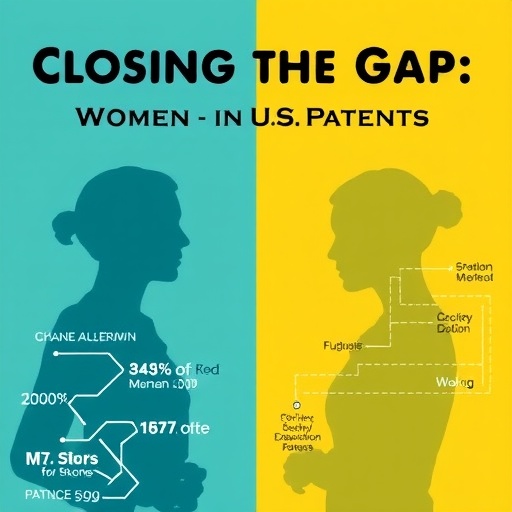
Closing the Gap: Women in U.S. Patents

November 17, 2025
in Social Science
Reading Time: 2 mins read
0
Closing the Gap: Women in U.S
65
SHARES
592
VIEWS
Share on FacebookShare on Twitter
ADVERTISEMENT

The passage provided is a detailed summary of descriptive statistics and findings on gender participation in U.S. patenting. Here’s a concise breakdown highlighting key points that could be useful for reporting, presentation, or further analysis:


Summary of Key Findings on Gender and Patenting in the U.S.

Population Representation vs. Patenting:

  • Women represent approximately 51% of the U.S. population (U.S. Census Bureau, 2023).
  • Women constitute about 47% of the U.S. workforce.
  • However, within 1.78 million distinct U.S. inventors, only 13.1% (232,534) are women.
  • Of 3.7 million U.S. patents analyzed:
    • 17.6% (651,327) include at least one female inventor.
    • 84.7% of these patents include mixed-gender teams (women + men).
    • Only 2.7% are from all-women inventor teams.

Trends Over Time (1976 to 2021):

  • Patents involving at least one female inventor increased from 4.4% (1976) to 25.8% (2021).
  • Growth is primarily driven by mixed-gender teams, reaching 22.8% in 2021.
  • Patents from all-women teams remain rare, consistently below 3%, with a decline noted in the 2000s.
  • Female inventors’ share increased from <2% in 1976 to 12%+ in 2021.
  • Growth rate slowed recently: 3.5% (1980) → 9.1% (2000) → 11.8% (2020).

Impact of Gender Composition on Patent Characteristics:

  • Highly significant relationship between team gender makeup and patent features such as reliance on science and use of public support.
  • Science Citations:
    • All-male teams cite 4.3 scientific papers on average.
    • All-female teams cite 6.2 papers (≈44% more).
    • Mixed-gender teams cite 13.2 papers on average, the highest by far.
  • Regression models (Model #1 and Model #2) confirm that patents involving women tend to cite significantly more scientific literature.
  • Mixed-gender teams also better leverage public support mechanisms (details would be found in actual tables and figures referenced, e.g., Table 4, Fig. 3).

Notes for Reporting or Further Study

  • The gender gap in patenting is stark despite increased female workforce participation.
  • Mixed-gender collaboration appears most effective in integrating scientific knowledge.
  • All-women teams remain an underutilized resource in innovation.
  • The slow progress in closing the gender gap in recent decades points to persistent structural or institutional barriers.
  • Further analysis of regression outputs and time series plots (from tables and figures referenced) would provide deeper insights.

If you want, I can help you prepare:

  • A detailed executive summary
  • Visualizations based on this data (e.g., recreate or enhance Fig. 2 trends)
  • Suggestions for policy interventions or diversity initiatives

Just let me know!

Tags: all-women inventor teamsanalysis of patent citationsfemale inventors statisticsgender equity in innovationgender participation in patentinghistorical patenting trendsimpact of gender on patent characteristicsmixed-gender innovation teamsrepresentation of women in STEMtrends in patenting by genderU.S. patent demographicswomen in U.S. patents
Share26Tweet16
Previous Post

California Beach Widths Demonstrate Resilience, Study Finds

Next Post

GAS6/AXL Boosts M2 Microglia to Combat Sepsis

Related Posts

Study Reveals AI Can Appear More Human Than Actual People in Classic Turing Test — Social Science
Social Science

Study Reveals AI Can Appear More Human Than Actual People in Classic Turing Test

May 19, 2026
In Vivo Brain Macromolecules in Schizophrenia Spectrum — Social Science
Social Science

In Vivo Brain Macromolecules in Schizophrenia Spectrum

May 19, 2026
Artificial Intelligence Faces Challenges in Comprehending the Mainz Dialect — Social Science
Social Science

Artificial Intelligence Faces Challenges in Comprehending the Mainz Dialect

May 19, 2026
COVID Racism Fueled by Factors Beyond Just Fear of Infection — Social Science
Social Science

COVID Racism Fueled by Factors Beyond Just Fear of Infection

May 19, 2026
Surprising Advances in Digital Adaptability Within Monastic Communities — Social Science
Social Science

Surprising Advances in Digital Adaptability Within Monastic Communities

May 19, 2026
Incheon National University Develops Method to Transform Customer Reviews into Practical Insights — Social Science
Social Science

Incheon National University Develops Method to Transform Customer Reviews into Practical Insights

May 19, 2026
Next Post
AXL Boosts M2 Microglia to Combat Sepsis

GAS6/AXL Boosts M2 Microglia to Combat Sepsis

  • Mothers who receive childcare support from maternal grandparents show more parental warmth, finds NTU Singapore study

    Mothers who receive childcare support from maternal grandparents show more parental warmth, finds NTU Singapore study

    27646 shares
    Share 11055 Tweet 6909
  • University of Seville Breaks 120-Year-Old Mystery, Revises a Key Einstein Concept

    1050 shares
    Share 420 Tweet 263
  • Bee body mass, pathogens and local climate influence heat tolerance

    679 shares
    Share 272 Tweet 170
  • Researchers record first-ever images and data of a shark experiencing a boat strike

    543 shares
    Share 217 Tweet 136
  • Groundbreaking Clinical Trial Reveals Lubiprostone Enhances Kidney Function

    528 shares
    Share 211 Tweet 132
Science

Embark on a thrilling journey of discovery with Scienmag.com—your ultimate source for cutting-edge breakthroughs. Immerse yourself in a world where curiosity knows no limits and tomorrow’s possibilities become today’s reality!

RECENT NEWS

  • Two Million Years of Rising Rain in Amazonia
  • Global Warming Boosts Extreme Rainfall Risk in Poor Nations
  • Evaluating APR-246 Response in Ovarian Cancer Mutants
  • Cerebral NIRS: Key in Managing Post-Hemorrhagic Dilation?

Categories

  • Agriculture
  • Anthropology
  • Archaeology
  • Athmospheric
  • Biology
  • Biotechnology
  • Blog
  • Bussines
  • Cancer
  • Chemistry
  • Climate
  • Earth Science
  • Editorial Policy
  • Marine
  • Mathematics
  • Medicine
  • Pediatry
  • Policy
  • Psychology & Psychiatry
  • Science Education
  • Social Science
  • Space
  • Technology and Engineering

Subscribe to Blog via Email

Enter your email address to subscribe to this blog and receive notifications of new posts by email.

Join 5,146 other subscribers

© 2025 Scienmag - Science Magazine

Welcome Back!

Login to your account below

Forgotten Password?

Retrieve your password

Please enter your username or email address to reset your password.

Log In
No Result
View All Result
  • HOME
  • SCIENCE NEWS
  • CONTACT US

© 2025 Scienmag - Science Magazine

Discover more from Science

Subscribe now to keep reading and get access to the full archive.

Continue reading
