

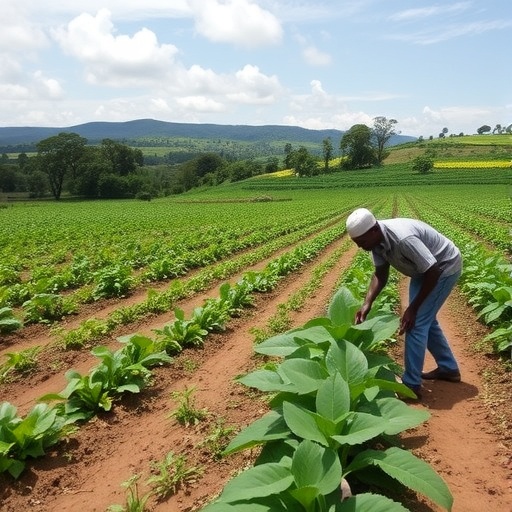
In the constantly evolving world of agriculture, the urgent call of climate change compels researchers to explore new methods and technologies that can enhance resilience and sustainability. The future of farming hinges on adopting climate-smart agricultural technologies, which aim to mitigate climatic risks while maximizing productivity and ensuring food security. A recent study conducted by Nyamwero, Kabote, and Kadigi delves into the intricacies of these adoption patterns across the diverse agro-ecological zones of Mvomero District in Tanzania.
The researchers set their sights on Mvomero, a region that embodies the challenges of changing climatic conditions. By focusing on distinct agro-ecological zones within this district, the study provides invaluable insights into how farmers interact with climate-smart technologies. The researchers employed a mix of qualitative and quantitative methodologies to unravel the factors influencing adoption levels among local communities. This multi-faceted approach allowed them to explore not only the technologies themselves but also the underlying economic, social, and environmental dynamics at play.
Central to the research is the identification of key determinants that influence the adoption of these agricultural technologies. The study highlights how social factors, such as community networks and traditional practices, significantly impact farmers’ decisions. In many cases, farmers are more inclined to adopt new technologies when they can observe credible proof of their effectiveness within their communities. This social validation serves as a robust motivator that drives technological uptake among farmers who may initially be skeptical.
Additionally, the researchers identified economic factors as crucial to the adoption process. Access to credit and financial resources can determine whether a farmer can invest in new technologies. When financial constraints exist, even the most revolutionary climate-smart tools may remain out of reach for many farmers. The study emphasizes the importance of creating financial incentives and support systems that can bridge this gap, enabling all farmers to take part in the climate-smart revolution.
Another significant area explored by the study is the influence of education and knowledge dissemination. The research underlined that farmers’ educational levels play a pivotal role in their willingness to engage with innovative agricultural practices. Those with higher levels of education are more likely to recognize the benefits of adopting such technologies, effectively translating knowledge into practical actions. Educational programs aimed at enhancing farmers’ understanding of climate-smart practices can further accelerate the adoption process.
Moreover, the role of governance and institutional frameworks cannot be understated. The research points out that supportive governmental policies and extension services directly impact farmers’ capacity to access and implement climate-smart agricultural technologies. A transparent, efficient policy environment can ease challenges related to land tenure, access to markets, and environmental regulations, paving the way for broader technology adoption.
Interestingly, the findings reveal that gender dynamics also play a vital role in shaping adoption patterns. Women, who often bear the brunt of climate impacts, are frequently the key decision-makers in household agricultural practices. The study suggests that engaging women in discussions about climate-smart technologies can amplify their adoption rates and results. This positioning of women as central figures in agriculture can drive transformative change and create a more equitable agricultural landscape.
Furthermore, the research highlights the significance of climate variability in shaping farmers’ decisions. As weather patterns become increasingly unpredictable, farmers are compelled to adapt their practices accordingly. The study indicates that farmers who experience severe weather events are more likely to seek solutions that provide resilience, which creates an acute demand for climate-smart technologies.
It is remarkable how local innovations can emerge from these challenges. The study draws attention to indigenous knowledge systems, which often embody sustainable agricultural practices honed over generations. Researchers advocate for a hybrid approach that integrates modern technologies with traditional practices, offering farmers a nuanced pathway towards sustainability.
In addition, the role of climate information systems was emphasized. Access to reliable weather forecasts and climate trends is a game-changer for farmers making decisions about crop planning and management. The research underlines the necessity of establishing robust information systems to ensure that farmers can respond proactively to climatic shifts instead of reactively, which can lead to serious losses.
While this research focuses on Mvomero District, the implications of these findings extend far beyond its borders. They offer a lens through which we can evaluate the challenges and opportunities faced by farmers globally as they grapple with the reality of climate change. The study stresses the urgency of collaborative efforts that bring together farmers, government entities, and researchers to create a synergistic environment conducive to innovation.
The ripple effects of adopting climate-smart technologies can lead to enhanced food security, improved livelihoods for farming communities, and a more sustainable agricultural sector. As countries worldwide strive to meet their climate commitments, frameworks that support such technologies will become increasingly essential. Ultimately, the success of climate-smart agricultural practices hinges on collective action and long-term investments in farmer education, infrastructure, and policy development.
To encapsulate, the critical need for climate-smart agricultural technologies is unmistakable. The research undertaken by Nyamwero, Kabote, and Kadigi lays a vital foundation for understanding not only the factors that influence adoption but also the myriad ways in which these technologies can reshape the agricultural landscape in response to climate change. By harnessing collective efforts, integrating innovations, and fostering resilience, the possibility of a sustainable agricultural future becomes a tangible reality.
As we reflect on the insights presented, we are reminded that the journey towards sustainable farming is not solely in the hands of researchers or policymakers but requires concerted efforts from all stakeholders involved. The path forward may contain challenges, but with a collaborative spirit and an unwavering commitment to innovation, a climate-resilient agricultural future is within our grasp.
Subject of Research: Determinants of climate-smart agricultural technology adoption in Mvomero District, Tanzania.
Article Title: Adoption patterns and determinants of climate-smart agricultural technologies across agro-ecological zones of Mvomero district in Tanzania.
Article References:
Nyamwero, N., Kabote, S.J. & Kadigi, M. Adoption patterns and determinants of climate-smart agricultural technologies across agro-ecological zones of Mvomero district in Tanzania. Discov Agric 4, 35 (2026). https://doi.org/10.1007/s44279-026-00503-9
Image Credits: AI Generated
DOI: https://doi.org/10.1007/s44279-026-00503-9
Keywords: Climate-smart agriculture, Mvomero District, Tanzania, adoption patterns, agro-ecological zones, sustainability.


