


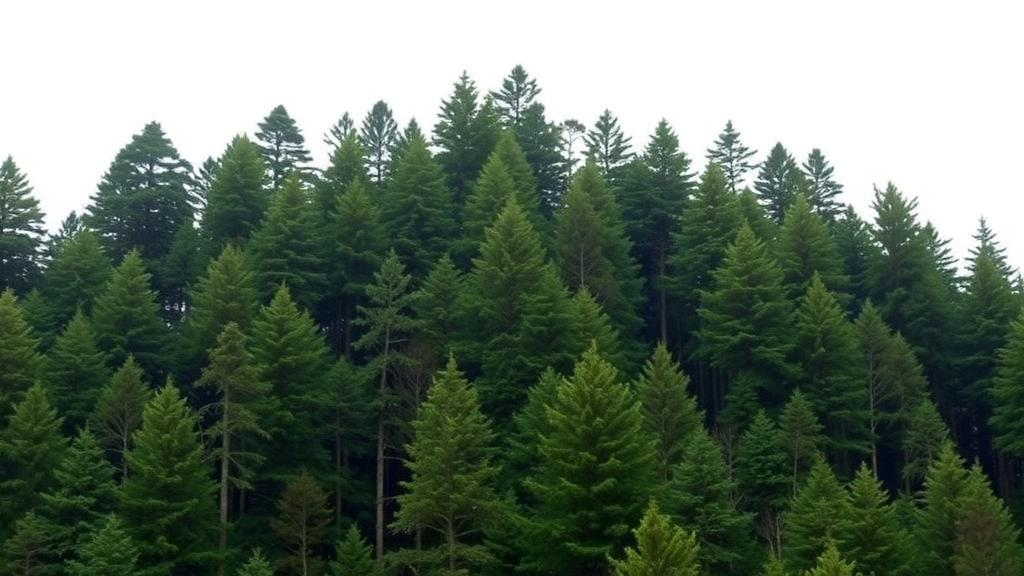
Deep in the mid-elevation forests of Northeast India grows a tree that most people have never heard of, yet one that botanists fear could be squeezed out of existence within a single human lifetime. Phoebe bootanica, a member of the laurel family prized for its timber, is already classified as endangered on the IUCN Red List, hemmed into a fragment of the Indo-Myanmar Biodiversity Hotspot. Now a new modelling study suggests that climate change could strip away nearly all of its most suitable habitat in the coming decades, before conditions partially rebound toward the end of the century. The work, published in Environmental Monitoring and Assessment by researchers at Manipur University, offers one of the most detailed pictures yet of how a rare, data-poor tree species may respond to warming and shifting rainfall patterns across one of the world’s most biologically rich regions.
The research team, led by Yengkhom Devajit with colleagues Neekee Thangjam and Vivek Vaishnav, confronted a problem that plagues conservation science: how do you model the future of a species when you have very few confirmed locations for it? Standard species distribution models typically require dozens or hundreds of occurrence records to perform reliably. The team compiled 122 field records of Phoebe bootanica from across Northeast India, but after applying spatial thinning, a technique that removes clustered observations to reduce sampling bias, only 22 records remained. Rather than abandon the effort, the researchers turned to an approach known as an ensemble of small models, or ESM, which was specifically developed to overcome the rare species modelling paradox.
The ESM technique works by decomposing a complex modelling problem into many simple pieces. Instead of building one large model with all twelve environmental variables at once, which would overfit badly with only 22 presence points, the team constructed bivariate models, each pairing the occurrence data with just one or two predictors. Six different algorithms contributed to the ensemble: artificial neural networks, classification tree analysis, generalized additive models, generalized boosting models, multivariate adaptive regression splines, and random forests. These bivariate models were then combined through weighted averaging, with better-performing component models carrying more influence over the final prediction. The resulting ensemble was evaluated with three independent metrics, and all three told the same story of excellent performance.
The area under the receiver operating characteristic curve, a standard measure of a model’s ability to discriminate suitable from unsuitable sites, reached 0.905, well above the 0.9 threshold conventionally considered excellent. The true skill statistic, which corrects for prevalence and is widely regarded as more informative than the older kappa statistic, came in at 0.745. The Boyce index, which evaluates how well predicted suitability ranks align with actual presences, scored 0.795. For a species with barely two dozen usable records, these figures represent a remarkable level of predictive confidence, and they lend weight to the sobering projections that followed.
So what determines where Phoebe bootanica can live? Elevation emerged as the single most important driver, with a relative contribution of 1.56, and the species shows a clear preference for altitudes between 1500 and 2000 meters. Close behind were the precipitation of the driest month, contributing 1.47, and precipitation during the warmest quarter, at 1.35. Isothermality, a measure of how much day-to-night temperature variation is moderated by the seasonal cycle, contributed 1.33, and soil total nitrogen rounded out the top five at 1.19. This combination of variables paints a portrait of a tree adapted to cool, consistently moist mid-elevation forests with nutrient-rich soils, precisely the conditions that warming and drying trends are expected to disrupt most sharply in the Himalayan foothills.
Under present-day conditions, the models identify 1168.58 square kilometers of highly suitable habitat, defined as areas with a habitat suitability index above 0.6, concentrated in the mid-elevation forests of the region. That figure becomes alarming when projected forward. Under the moderate SSP1-2.6 emissions scenario, highly suitable area collapses by 99.54 percent by the 2040s, shrinking to a mere 5.41 square kilometers, an area smaller than a typical city park system. The habitat then recovers somewhat to 539.82 square kilometers by 2100, but the recovery comes with a geographic catch: the modelled suitable zone shifts away from its current stronghold in Manipur and Nagaland toward Meghalaya’s West Khasi Hills, hundreds of kilometers to the west.
The high-emissions SSP5-8.5 scenario tells a similarly dramatic story. Highly suitable habitat loses 92.92 percent of its extent by 2040, falling to 82.75 square kilometers, before rebounding to 1440.03 square kilometers by the end of the century, with the recovered area concentrated in stable refugia such as the West Khasi Hills. Moderately suitable habitats decline by anywhere from 3 to 51 percent across the projected scenarios, while areas classified as not suitable expand by up to 34 percent in the near term before contracting by up to 30 percent by 2081 to 2100 as conditions partially recover. The pattern of severe near-term contraction followed by partial rebound suggests that the mid-century period represents a critical bottleneck during which populations could be lost irreversibly, even if the climate later becomes favorable again.
The projected westward shift raises a thorny biological question: can the tree actually get there? Phoebe bootanica is a long-lived timber species whose seeds are dispersed over limited distances, and its populations are already fragmented and depleted by over-exploitation. A habitat that becomes climatically suitable in Meghalaya is of little value if no seeds, seedlings, or dispersers can bridge the gap from Manipur and Nagaland. This disconnect between shifting climate envelopes and static populations is a well-documented feature of range-shift dynamics in mountain systems, where species must typically migrate upslope rather than laterally, and where human land use further fragments the corridors they would need. For an endangered tree with slow life-history dynamics, assisted migration and active reintroduction may be the only realistic routes to the newly suitable areas.
The study’s authors argue that the findings point toward a concrete conservation strategy: prioritizing mid-elevation nature reserves in regions of niche suitability and persistent refugia, particularly the West Khasi Hills, to enhance the species’ resilience under future climates. Because the ESM approach explicitly addresses the constraints of limited occurrence data, the framework could be applied to other rare and threatened trees across the Indo-Myanmar Hotspot, which harbors numerous endemic species facing similar pressures from logging and climate change. The research was partially funded by the State Forest Development Agency of Manipur and a Startup Research Grant from India’s Science and Engineering Research Board, reflecting growing institutional recognition that climate-adapted conservation planning cannot wait for perfect data.
For now, Phoebe bootanica remains rooted in forests that the models say are slipping away. The study is a reminder that biodiversity loss under climate change is not always a story of gradual decline; it can be a story of sudden bottlenecks, geographic traps, and refugia that arrive too far away and too late. Whether this endangered laurel survives the century may depend less on the climate itself than on whether conservationists act on the maps that science can now provide, protecting the refugia that remain and helping the species cross the distances it cannot cross alone.
Subject of Research: Projected climate change impacts on the habitat distribution of the endangered tree species Phoebe bootanica in Northeast India
Article Title: Endangered Phoebe bootanica tree populations may face severe habitat contraction and potential distributional shifts under projected climate change in Northeast India
Article References: Endangered Phoebe bootanica tree populations may face severe habitat contraction and potential distributional shifts under projected climate change in Northeast India. (n.d.). https://doi.org/10.1007/s10661-026-16009-2
Image Credits: AI Generated
DOI: 10.1007/s10661-026-16009-2
Keywords: Phoebe bootanica, climate change, species distribution modeling, ensemble of small models, Northeast India, Indo-Myanmar Biodiversity Hotspot, habitat suitability, endangered species, timber tree, conservation planning, refugia, Lauraceae
Cite Scienmag News
Margaret Porter. (October 10, 2026). Climate Models Predict Steep Habitat Loss for Endangered Himalayan Timber Tree. Scienmag. https://scienmag.com/climate-models-predict-steep-habitat-loss-for-endangered-himalayan-timber-tree/
Margaret Porter. "Climate Models Predict Steep Habitat Loss for Endangered Himalayan Timber Tree." Scienmag, 10 October 2026, https://scienmag.com/climate-models-predict-steep-habitat-loss-for-endangered-himalayan-timber-tree/. Accessed 10 October 2026.
Margaret Porter. "Climate Models Predict Steep Habitat Loss for Endangered Himalayan Timber Tree." Scienmag. October 10, 2026. https://scienmag.com/climate-models-predict-steep-habitat-loss-for-endangered-himalayan-timber-tree/


