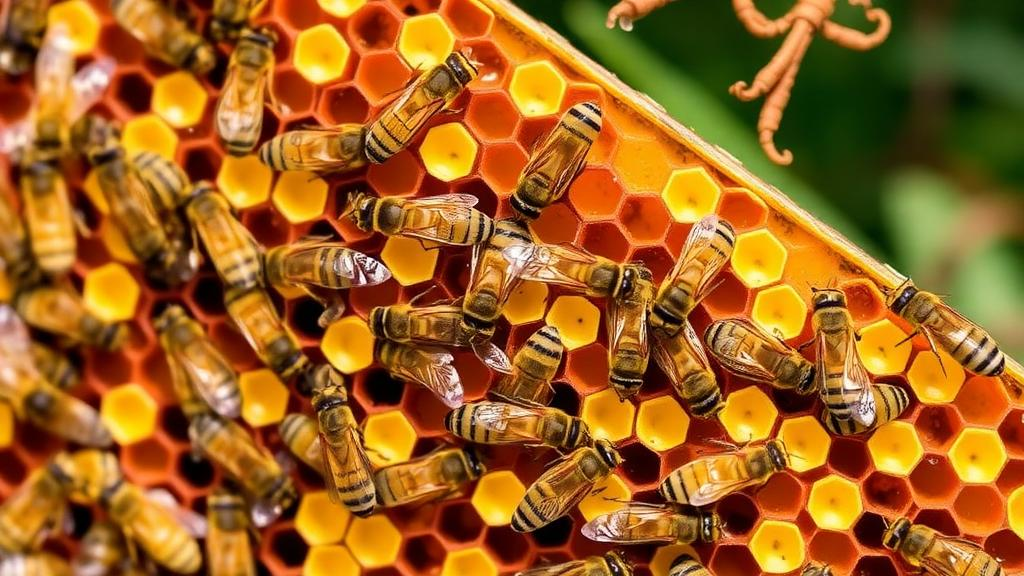
A honey bee colony has long been treated as a collection of individuals: one queen, a few hundred drones, and tens of thousands of worker bees, each with its own tasks. A new study argues that this familiar picture misses something fundamental. According to researchers at Lund University in Sweden and the University of Oulu in Finland, a queen and her colony should instead be understood as a single animal — a superorganism made of bees in much the same way that a mammal is made of cells. The claim, published in the journal Insectes Sociaux, is not merely a matter of metaphor. The authors contend that redefining the colony as one organism changes how biologists should interpret its development, its ageing, its reproduction, and, ultimately, how beekeepers should manage it.
The study grew out of a Master’s thesis by Hannes Bonhoff, who recently completed his degree in biology at Lund University, and was co-authored with Heikki Helanterä, professor of evolutionary biology and genomics at the University of Oulu. Their starting point was a conceptual one: what does it actually mean, biologically, for a colony to be a single organism rather than a society of many? The superorganism idea has circulated in biology for more than a century, but the authors argue that it has rarely been worked through in a genuinely biological context for honey bees. By taking the concept seriously, they say, previously familiar features of colony life fall into a new and revealing pattern.
The most striking of these patterns concerns the life cycle. Bonhoff likens the colony to an individual mammal that passes through gestation and extensive parental care. Every generation of a honey bee colony, he notes, develops from a single bee — the queen — and progresses through stages that parallel those of a mammal: embryo, foetus, juvenile, and adult. The comparison extends to mortality. Just as an individual animal ages, the colony as a superorganism undergoes an inevitable biological ageing process, which means that a colony dies after only a few years. In this framing, the death of a colony is not a failure of management but a normal stage in the life history of a single, long-lived organism.
Reproduction is where the analogy becomes most vivid. Honey bees reproduce by swarming: the queen and roughly half of the colony’s workers fly off together to find a new hive, while a newly raised queen remains in the old nest to found the next generation. Viewed through the superorganism lens, this is parental care of an extraordinary kind. The offspring colony inherits the mother’s nest — a fully built, climate-controlled structure stocked with food — while the parent organism risks its life by flying away to settle elsewhere. “When this superorganism reproduces, the offspring are cared for with great dedication by the parent, in some cases even at the cost of the parent’s life,” Bonhoff says.
The care does not end with real estate. The developing offspring colony matures inside the safety of its mother colony, supplied with food, shelter, and a well-constructed hive. The mother colony also transmits knowledge. Young bees learn the species’ famous dance language, the symbolic communication system used to direct nestmates to flowers, and the parent colony guides the new generation toward the most nutritious foraging sites. In biological terms, the researchers describe a form of cultural and nutritional provisioning that parallels the extended parental investment seen in mammals and birds, here spread across thousands of individual workers acting, functionally, as the organs of a single body.
Niklas Wahlberg, professor of systematic biology at Lund University and one of Bonhoff’s thesis supervisors alongside Helanterä, finds the reframing valuable precisely because it gives the superorganism concept concrete biological content. “The concept itself has been around for a long time, but this is the first time it has been applied in a genuine biological context,” he says. “It’s fascinating to think that, just as individual cells make up an organism, individual bees with different roles make up the superorganism.” His comment underscores the intellectual appeal of the paper: it takes a term that has often served as an evocative analogy and asks what follows if it is treated as a literal description of the colony’s biology.
The practical stakes emerge when the framework is applied to modern beekeeping. Contemporary management, the authors argue, is built on the assumption that a colony can be kept young and healthy indefinitely. Two of the most widespread interventions — the forced replacement of queens and the artificial prevention of swarming — are designed precisely to interrupt the colony’s natural life cycle, suppressing reproduction and resetting the superorganism’s biological clock. Bonhoff’s analysis suggests that these practices do not merely inconvenience the bees; they fundamentally conflict with the colony’s natural reproductive strategy and, in doing so, may undermine its ability to cope with disease.
The most urgent example is the Varroa mite, a parasitic arachnid that preys on honey bees worldwide and is widely regarded as one of the greatest threats to managed pollination. Because the superorganism framework ties colony health to the natural life history — including swarming, which naturally breaks the reproductive cycle of parasites within a nest — Bonhoff argues that understanding colonies as single organisms offers crucial insights into how to deal with such parasites. A shift in perspective, he suggests, is valuable for the global beekeeping community as it works to safeguard this essential pollinator, pointing toward more sustainable and animal-friendly methods rather than indefinite artificial rejuvenation.
“We have analysed what it means for a bee colony to be a single organism, which opens up new insights into the fascinating life of the honey bee,” Bonhoff says. Whether the field adopts the superorganism as a working biological category or treats it as a productive heuristic, the study makes a clear case that the choice is not cosmetic. If a colony is an individual — developing, ageing, reproducing, and dying on its own schedule — then every management decision that interrupts that schedule becomes a biological intervention with consequences that beekeepers have not fully accounted for. For an animal on which much of the world’s food production depends, that reframing may prove to be more than a philosophical exercise.
Subject of Research: The honey bee colony as a superorganism and its implications for beekeeping
Article Title: A honey bee colony can be viewed as a superorganism
Article References: A honey bee colony can be viewed as a superorganism. (n.d.). Original publication
Image Credits: AI Generated
DOI: Not provided
Keywords: honey bees, superorganism, colony biology, swarming, Varroa mite, beekeeping, parental care, life history, Insectes Sociaux, Lund University, evolutionary biology, pollinators
Cite Scienmag News
Gavin Prescott. (October 10, 2026). Honey Bee Colonies Are Superorganisms, and Beekeeping May Need to Catch Up. Scienmag. https://scienmag.com/honey-bee-colonies-are-superorganisms-and-beekeeping-may-need-to-catch-up/
Gavin Prescott. "Honey Bee Colonies Are Superorganisms, and Beekeeping May Need to Catch Up." Scienmag, 10 October 2026, https://scienmag.com/honey-bee-colonies-are-superorganisms-and-beekeeping-may-need-to-catch-up/. Accessed 10 October 2026.
Gavin Prescott. "Honey Bee Colonies Are Superorganisms, and Beekeeping May Need to Catch Up." Scienmag. October 10, 2026. https://scienmag.com/honey-bee-colonies-are-superorganisms-and-beekeeping-may-need-to-catch-up/