


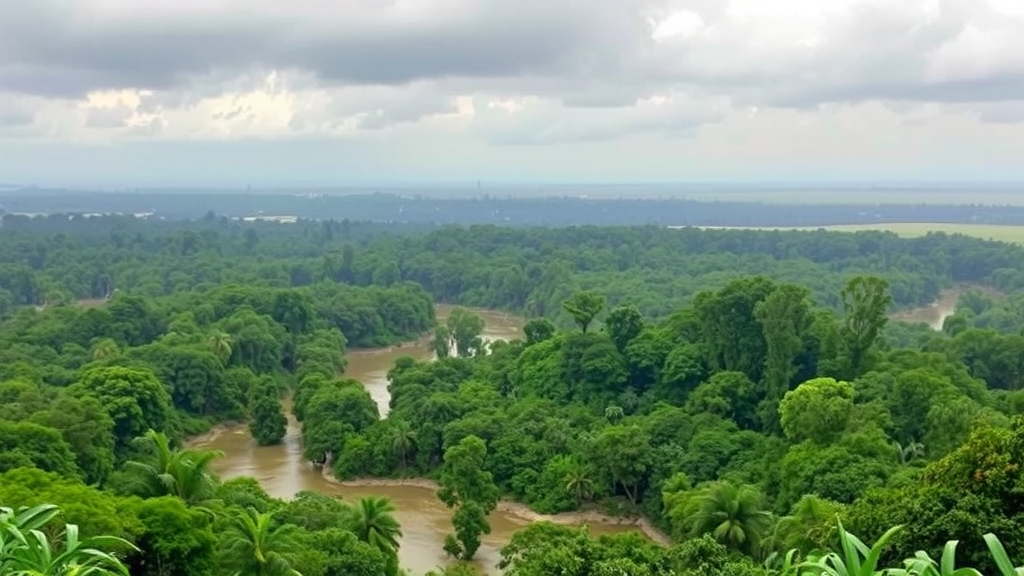
The Amazon rainforest has long been described as the planet’s most iconic bulwark against climate change, a vast expanse of humid tropical forest that recycles moisture across an entire continent and stores an immense quantity of carbon in its trees and soils. A new study published in Communications Earth & Environment now adds an urgent and troubling dimension to that picture: climate extremes across the basin are not merely becoming more frequent in the well-known drought and fire epicenters, but are rising rapidly in regions that scientists had previously regarded as comparatively buffered. By mapping the pace at which extreme events have intensified across Amazonia, the research reveals new areas of concern where ecosystems and communities face mounting pressure with little historical precedent to guide their adaptation.
The research team set out to answer a deceptively simple question: not just where climate extremes occur in the Amazon, but where they are increasing fastest. This distinction matters because vulnerability is not a static property of a landscape. A region that has experienced recurrent droughts for decades may have developed some degree of ecological and social resilience, while a region where extremes are only now emerging may find itself exposed without warning. By focusing on rates of change rather than absolute frequencies, the authors identify hotspots of accelerating risk that conventional risk maps, built on long-term climatological averages, tend to overlook.
Methodologically, the study draws on high-resolution gridded climate datasets covering the Amazon basin, analyzing trends in extreme precipitation and temperature indices over recent decades. Rather than examining mean annual rainfall or average temperatures, which can mask critical variability, the researchers focused on the tails of the distribution: the driest dry seasons, the hottest hot spells, and the intensity and duration of anomalous episodes. This approach aligns with the way ecosystems actually experience the climate. A forest can often tolerate a gradual shift in average conditions, but a sudden concatenation of an intense dry season followed by record heat can push trees past their hydraulic limits within a single year.
The central finding is stark. Across large portions of Amazonia, the frequency and intensity of climate extremes have increased rapidly, and the acceleration is geographically uneven. While some of the intensification concentrates in areas already known to be stressed, such as the southern and eastern fringes of the forest where deforestation has long interacted with drought, the analysis also flags regions that had not featured prominently on lists of climate concern. These newly identified areas of accelerating extremes often lie in the central and northwestern portions of the basin, suggesting that the climatological heart of the rainforest is no longer as climatically stable as earlier assessments implied.
The implications of this geographic shift are profound for our understanding of Amazon forest resilience. Much of the central Amazon has historically served as a moisture engine, drawing up water through deep root systems and releasing it through transpiration, generating clouds and rainfall that sustain not only the forest itself but also agriculture and hydropower far beyond the basin’s borders. If extremes intensify in this core region, the feedback loops that maintain the forest’s own climate could be jeopardized. Reduced moisture recycling during droughts can compound water stress, weaken trees, and raise flammability, creating conditions in which natural or human-set fires spread into ecosystems that evolved without regular fire exposure.
The study also underscores the interplay between climate extremes and the physical structure of the atmosphere over the basin. Rising temperatures increase atmospheric evaporative demand, effectively drying the landscape even when total rainfall remains unchanged. This vapor pressure deficit dynamic has been implicated in previous episodes of widespread tree mortality in the Amazon and elsewhere in the tropics. When periods of high evaporative demand coincide with reduced rainfall, the combined stress can exceed the physiological tolerance of even mature, deep-rooted trees. The rapid intensification documented in the study suggests that such compound extremes are becoming more common, shortening the intervals during which forests can recover between damaging events.
For the people who live in and around the forest, the new areas of concern carry immediate practical consequences. Many Amazonian communities depend on river transport, fisheries, and small-scale agriculture that are acutely sensitive to the timing and magnitude of the annual flood pulse. Extreme droughts lower rivers to levels that strand villages and halt the movement of goods, while extreme rainfall events trigger floods that destroy crops and contaminate water supplies. Where these extremes accelerate fastest, local infrastructure, emergency planning, and livelihoods built around historical climate rhythms face the steepest adjustment challenges. The study’s identification of emerging hotspots therefore provides a practical early-warning map for adaptation investments, from water storage and river transport planning to health system preparedness for fire-related smoke exposure.
The findings also speak to a broader scientific debate about how close the Amazon system may be to a critical transition. Long-standing research has suggested that continued deforestation and climate change could eventually push portions of the forest across a threshold beyond which humid forest gives way to a more open, fire-prone, savanna-like state. The pace and distribution of extreme events are central variables in that debate, because thresholds in complex systems are often crossed not by gradual averages but by the hammer blows of exceptional events striking in quick succession. A basin-wide picture of accelerating extremes, especially one that reveals intensification in the moist core of the forest, sharpens the urgency of that discussion without necessarily settling it. Whether the newly flagged regions will exhibit the kinds of compositional and structural changes seen in the repeatedly drought-stricken south is a question that ongoing ecological monitoring will need to answer.
One of the study’s most useful contributions is its emphasis on rapidity. By quantifying how quickly extremes are intensifying, rather than simply how severe they are today, the researchers offer a metric that captures the experience of ecosystems and societies alike: the challenge of keeping pace. Species that regenerate slowly, soils that lose organic matter under repeated stress, and institutions that plan on decadal timescales all struggle when the risk landscape shifts faster than adaptation can proceed. Identifying where the pace of change is greatest allows conservation agencies, governments, and researchers to prioritize monitoring, protect corridors that may facilitate species movement, and target fire prevention resources before new hotspots become chronic crisis zones.
As the planet continues to warm, the Amazon’s fate remains one of the most consequential uncertainties in Earth system science. This study adds a critical layer of nuance by showing that the geography of climate risk in the basin is changing faster than many frameworks assume, drawing new regions into the circle of concern while intensifying pressure on old ones. The message for policymakers is that protecting the forest cannot rest on averages or on historical maps of vulnerability; it must anticipate where extremes are heading next. For the scientists, the task is to pair this climatological mapping with on-the-ground ecological observation to determine how the newly identified hotspots are responding. And for the millions of people whose lives depend on a functioning Amazon, the research is a reminder that the forest’s climate is shifting beneath their feet at a rate that demands attention now, not after the next record-breaking drought or flood makes the new areas of concern impossible to ignore.
Subject of Research: Rapid intensification of climate extremes across the Amazon basin and the emergence of new ecological risk hotspots
Article Title: Rapid increase of climate extremes reveals new areas of concern in Amazonia
Article References: Barlow, J., Carvalho, N. S., Nunes, C. A., Aguiar, A. P. D., Alencar, A., Anderson, L. O., Aragão, L. E., Baccaro, F., Barrett, M., Berenguer, E., Bodolai, K., Brando, P. M., Couto, T. B. A., Domingues, T. F., Elias, F., Feldpausch, T. R., Ferreira, I. J. M., Ferreira, J. N., Flores, B. M., … Wiederhecker, H. C. (2026). Rapid increase of climate extremes reveals new areas of concern in Amazonia. Communications Earth & Environment, 7(1), Article 746. https://doi.org/10.1038/s43247-026-03975-1
Image Credits: AI Generated
DOI: 10.1038/s43247-026-03975-1
Keywords: Amazon rainforest, climate extremes, drought, forest resilience, Communications Earth & Environment, moisture recycling, deforestation, climate risk, tropical ecology, adaptation, fire risk, hydrological cycle
Cite Scienmag News
Gavin Prescott. (September 23, 2026). Climate Extremes Are Accelerating Across the Amazon, Exposing New Hotspots of Concern. Scienmag. https://scienmag.com/climate-extremes-are-accelerating-across-the-amazon-exposing-new-hotspots-of-concern/
Gavin Prescott. "Climate Extremes Are Accelerating Across the Amazon, Exposing New Hotspots of Concern." Scienmag, 23 September 2026, https://scienmag.com/climate-extremes-are-accelerating-across-the-amazon-exposing-new-hotspots-of-concern/. Accessed 5 October 2026.
Gavin Prescott. "Climate Extremes Are Accelerating Across the Amazon, Exposing New Hotspots of Concern." Scienmag. September 23, 2026. https://scienmag.com/climate-extremes-are-accelerating-across-the-amazon-exposing-new-hotspots-of-concern/


