


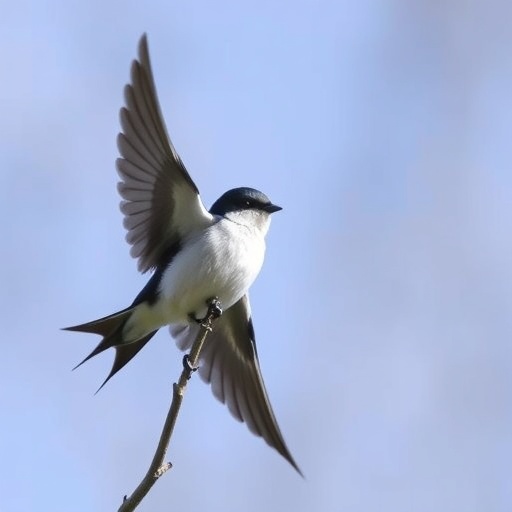
A groundbreaking study led by Cornell University reveals that northern populations of tree swallows are significantly more vulnerable to climate change than their southern counterparts, despite both groups exhibiting similar temperature responses. By analyzing nearly 95,000 nests collected over five decades across 123 sites from Alaska to the southern United States, researchers uncovered a critical timing challenge that threatens the survival of these northern migratory birds.
Tree swallows in northern regions face harsher conditions due to pronounced warming and increased temperature variability during the vital pre-breeding period. The study found that egg laying advances by nearly one day per degree of warming consistently across the species’ range. However, northern swallows experience extreme fluctuations, such as early warm spells followed by cold snaps, complicating their breeding timing.
This climatic volatility narrows the window between the birds’ arrival at breeding grounds and the onset of egg laying, placing northern populations under intense physiological and ecological stress. Longer migration distances to these breeding sites further exacerbate their condition upon arrival, limiting their capacity to adjust breeding schedules optimally.
“During a critical three-week pre-breeding window, tree swallows engage in a high-stakes decision-making process about when to breed,” explains lead author Conor Taff. Early egg laying offers high reproductive success in warm years, but if followed by unexpected cold conditions, success rates plummet due to impacts on offspring development and the availability of flying insects, their primary food source.
The northern populations’ breeding abundance has steeply declined over the past fifty years, contrasting with stable or increasing numbers in southern populations. This disparity suggests that northern tree swallows are nearing the limits of their adaptive flexibility in response to accelerating climate shifts.
Co-author Maren Vitousek emphasizes the precarious position of these birds: “Northern tree swallows appear to be approaching a tipping point, where variable and extreme weather patterns severely curtail their ability to time breeding effectively.” The implications of this timing squeeze extend beyond tree swallows, highlighting broader conservation challenges faced by migratory species under climate stress.
This extensive collaborative study pooled data not only from academic research groups but also from 40,000 citizen scientists participating in programs like NestWatch and eBird. Such long-term, large-scale monitoring underscores the value of integrated scientific efforts in understanding complex climate change impacts on wildlife.
Funded by prominent agencies including the National Science Foundation and the U.S. Department of Agriculture, the research offers unprecedented insights into how climate warming and variability synergistically disrupt phenological cues, posing existential threats to northern migratory bird populations.
Cite Scienmag News
Sloane Callahan. (July 8, 2026). Climate Change Threatens Northern Tree Swallow Populations Most. Scienmag. https://scienmag.com/climate-change-threatens-northern-tree-swallow-populations-most/
Sloane Callahan. "Climate Change Threatens Northern Tree Swallow Populations Most." Scienmag, 8 July 2026, https://scienmag.com/climate-change-threatens-northern-tree-swallow-populations-most/. Accessed 4 September 2026.
Sloane Callahan. "Climate Change Threatens Northern Tree Swallow Populations Most." Scienmag. July 8, 2026. https://scienmag.com/climate-change-threatens-northern-tree-swallow-populations-most/


