


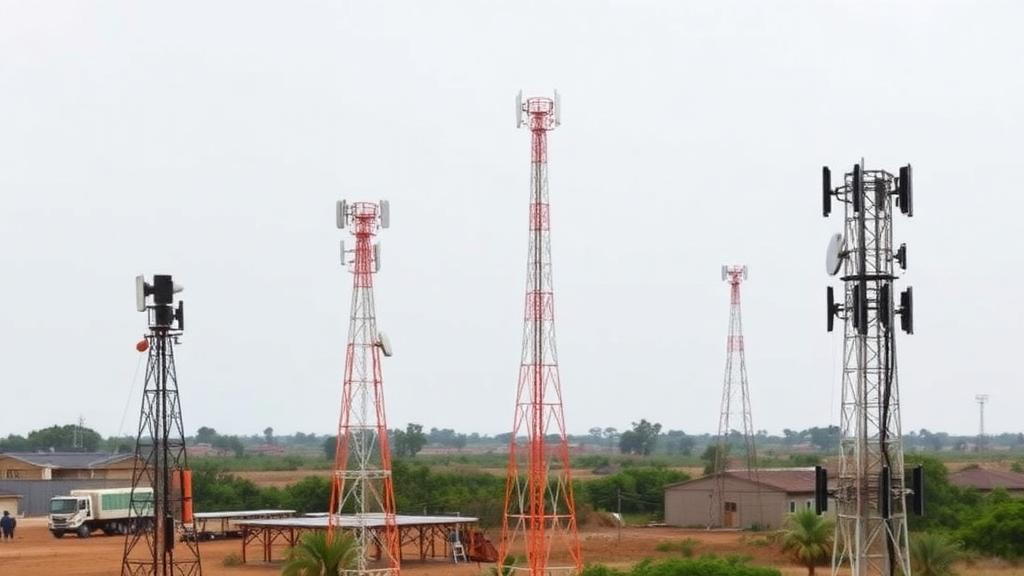
Every phone call, satellite broadcast, and wireless connection that crosses Nigeria depends on an invisible property of the atmosphere that most people have never heard of: radio refractivity. This quantity, denoted N by engineers, describes how the lower atmosphere bends, slows, and distorts radio waves as they travel from transmitter to receiver. When refractivity shifts, signals can bend sharply toward the ground, skip over their intended targets, or fade into static. Now, a team of Nigerian physicists has produced the most comprehensive picture yet of how this hidden variable is changing across the country’s dramatically different climate zones, and their findings carry an urgent warning for the telecommunications industry.
The research, published in Discover Geoscience, analyzed 42 years of meteorological data from 1981 to 2022 at eight locations spanning Nigeria’s major eco-climatic zones, from the humid Mangrove swamps of Ikot Akpaden and the Freshwater zone of Yenagoa in the south, through the transitional Rainforest and Guinea Savannah sites of Ibadan, Abuja, and Jalingo, to the semi-arid Sudan and Sahel Savannah stations of Sokoto, Gombe, and Kukawa in the north. Using temperature, relative humidity, atmospheric pressure, and precipitation records drawn from NASA’s POWER data repository, the team calculated refractivity using the standard formula recommended by the International Telecommunication Union, which combines a dry component driven by pressure and temperature with a wet component governed by water vapour pressure.
The results reveal a striking north-south divide. Refractivity reached its highest values, around 380 N-units, at the coastal locations of Yenagoa and Ikot Akpaden, where relative humidity hovers near 90 percent, while the arid northern stations of Sokoto and Kukawa recorded the lowest values, around 310 N-units. This gradient matters because high refractivity in humid coastal air creates conditions favorable to atmospheric ducting, a phenomenon in which radio waves become trapped in layers of the atmosphere and travel in unexpected ways. In practical terms, network operators in the humid south may need to increase transmission power to maintain reliable connectivity, while northern sites face different propagation challenges altogether.
To detect long-term trends, the researchers deployed two complementary statistical tools. The Mann-Kendall trend test, a non-parametric method widely used in climate science, identified statistically significant monotonic changes in the time series. Five of the eight locations, including Yenagoa, Ikot Akpaden, Ibadan, Sokoto, and Kukawa, showed significant increasing trends in refractivity, with the coastal stations exhibiting Sen’s slope values of roughly 0.16 N-units per year. The second tool, Şen’s Innovative Trend Analysis, or ITA, goes further by splitting each record into two halves and plotting them against each other, allowing researchers to see whether trends are confined to low, medium, or high values rather than spread uniformly across the distribution.
The ITA approach proved crucial for uncovering behavior the Mann-Kendall test missed. At Kukawa in the Sahel, for example, the overall trend was increasing, but ITA showed the rise was concentrated only in the high-value range of the data. At Jalingo and Gombe, refractivity actually declined in the lower and medium value ranges even as other sites rose steadily. This range-specific sensitivity matters because localized climate effects can push different portions of a distribution in different directions, and a single summary statistic can obscure exactly the kind of variability that matters most for engineers designing radio links in a specific place.
The seasonal analysis added another layer of insight. Rather than treating the year as simply wet or dry, the team divided it into four phases: onset, peak rainy, cessation, and dry periods, defined by the movement of the Inter-Tropical Discontinuity, the boundary where moist maritime air from the Atlantic meets dry continental air from the Sahara. Positive refractivity trends were largest and most consistent during the wet and cessation periods, particularly over humid and coastal areas, reaching 0.13 to 0.15 N-units per year. In contrast, the dry and onset periods in the Sahel and Sudan Savannah showed weaker or negative trends, ranging from -0.236 to 0.224 N-units per year. During the onset months in the north, the sporadic northward migration of the Inter-Tropical Discontinuity produces alternating pulses of moist and dry air that suppress any persistent trend.
Correlation analysis confirmed what the physics predicts: relative humidity is the dominant driver of refractivity. At the northern stations the relationship was almost deterministic, with correlation coefficients exceeding 0.90 at Kukawa, Sokoto, and Gombe, peaking at 0.98 in Kukawa. Temperature showed a moderately positive relationship with refractivity but a strongly negative one with humidity, reaching -0.93 at Abuja, reflecting the well-known inverse coupling between heat and moisture in tropical environments. Atmospheric pressure, by contrast, correlated only weakly with refractivity, indicating that its role, while embedded in the governing equation, is secondary in practice.
To quantify these relationships, the team built a multilinear regression-based sensitivity framework, standardizing all variables so that coefficients could be compared fairly across locations. The models explained between 82 and 99 percent of refractivity variability, which is unsurprising given that refractivity is physically defined by the same meteorological inputs. The percentage contributions, however, told a fascinating story about climate. Relative humidity accounted for 65 to 77 percent of refractivity variation in the arid Sudan and Sahel zones, but only about 52 percent in the humid coastal south, where temperature played a proportionally larger role. The explanation lies in the saturation physics of the Clausius-Clapeyron relation: in dry climates with high saturation vapour pressure, even small changes in humidity produce large swings in the water vapour term of the refractivity equation, amplifying its influence.
The implications extend well beyond Nigerian borders. As climate change continues to warm the planet and alter moisture distributions, the propagation environment for radio waves is shifting in ways that most network planning models never anticipated. Rising refractivity in humid regions heightens the likelihood of super-refraction and ducting, which can cause signal blackouts, multipath interference, and unpredictable communication ranges. Declining refractivity in arid zones during dry seasons points toward sub-refraction and reduced signal range. The authors recommend that telecommunications operators incorporate real-time meteorological data into network performance monitoring, that regulators consider atmospheric variability in spectrum management, and that meteorological agencies collaborate directly with telecom providers. For a country of more than 200 million people whose digital economy depends on reliable wireless connectivity, the message is clear: the weather is not just something that interrupts your signal during a storm. It is slowly, measurably, and predictably rewriting the rules of how radio waves travel, and the networks of the future will need to be designed with the climate in mind.
Subject of Research: Long-term trends in meteorological parameters and radio refractivity across Nigeria's eco-climatic zones
Article Title: Spatiotemporal trends and seasonal variations in meteorological parameters and radio refractivity across Nigeria’s eco-climatic zones
Article References: Agbo, E. P., Nathaniel, E. U., Thomas, J. E., Offorson, G. C., Nkajoe, U., & Ndoma, E. G. (2026). Spatiotemporal trends and seasonal variations in meteorological parameters and radio refractivity across Nigeria’s eco-climatic zones. Discover Geoscience, 4(1), Article 336. https://doi.org/10.1007/s44288-026-00708-x
Image Credits: AI Generated
DOI: 10.1007/s44288-026-00708-x
Keywords: radio refractivity, Nigeria, climate change, telecommunications, radio wave propagation, relative humidity, Mann-Kendall test, innovative trend analysis, eco-climatic zones, atmospheric ducting, NASA POWER, seasonal variability
Cite Scienmag News
Sloane Callahan. (October 5, 2026). Climate Change Is Quietly Rewiring Nigeria’s Radio Signals, 42-Year Study Reveals. Scienmag. https://scienmag.com/climate-change-is-quietly-rewiring-nigerias-radio-signals-42-year-study-reveals/
Sloane Callahan. "Climate Change Is Quietly Rewiring Nigeria’s Radio Signals, 42-Year Study Reveals." Scienmag, 5 October 2026, https://scienmag.com/climate-change-is-quietly-rewiring-nigerias-radio-signals-42-year-study-reveals/. Accessed 5 October 2026.
Sloane Callahan. "Climate Change Is Quietly Rewiring Nigeria’s Radio Signals, 42-Year Study Reveals." Scienmag. October 5, 2026. https://scienmag.com/climate-change-is-quietly-rewiring-nigerias-radio-signals-42-year-study-reveals/


